Description
Monsolle Peach Tree
The Monsolle peach tree is a modern white-fleshed peach variety bred by R. Monteux-Caillet and released by Star Fruits under Plant Breeders’ Rights, positioned in the early white-peach slot, ten days after the Gypse® variety. The Monsolle peach tree stands out for its strong sizing potential, juicy flesh with a mild flavour, and very high productivity. We graft it at our nursery, in Le Passage d’Agen, Lot-et-Garonne.
Monsolle peach tree identity card
| Criterion |
Value |
Detail |
| Species |
Prunus persica |
White-fleshed peach |
| Variety status |
Plant Breeders’ Rights |
Protected modern variety |
| Breeder |
R. Monteux-Caillet |
Distributor: Star Fruits |
| Flowering |
Semi-early |
Low to medium floral density |
| Pollination |
Self-fertile |
No pollinator needed |
| Ripeness |
Gypse® + 10 days |
Mid-June to early July depending on site |
| Fruit shape |
Round to oval |
Strong colouring |
| Size |
2A/A |
152 g average in trials |
| Stone |
Semi-clinging |
Partially separates |
| Firmness |
High |
Holds up well after harvest |
| Flavour |
Mild, juicy flesh |
Low acidity |
| Vigor |
Strong to very strong |
Semi-upright habit |
| Productivity |
Very high |
Light thinning needed |
| Agronomic strength |
Not very prone to bud necrosis |
Even after a mild winter |
| Rootstocks offered |
|
— |
Introducing the Monsolle Peach Tree
The Monsolle peach tree belongs to the series of R. Monteux-Caillet introductions distributed by Star Fruits, alongside Monange, Monclaire, Monmeil and Montar, which together cover the whole peach season. Monsolle occupies the early white-flesh slot, around late June, where variety choice remains limited.
It’s worth being clear about what the Monsolle peach tree is: a variety selected for the production orchard, on criteria of size, firmness and yield. It is not a heritage variety, and its appeal is not the same as that of a Grosse Mignonne or a Reine des Vergers. The Monsolle peach tree is for anyone wanting large fruit, early in the season, on a tree that crops heavily.
Fruit characteristics
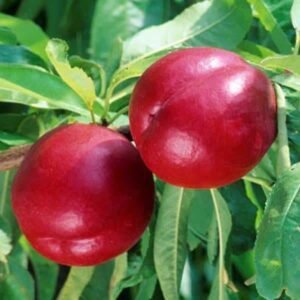
The Monsolle peach is round to oval, size 2A/A, with strong colour intensity — clearly red skin over a pale background. The average weight recorded in trials is 152 g, with 58% of fruit in size A and 26% in AA.
- Flesh: white, juicy, very firm.
- Flavour: mild, only lightly tangy.
- Stone: semi-clinging — it separates partially, without the clean release of a freestone variety.
Monsolle’s semi-clinging stone has a practical consequence: to stone it cleanly, it is better to cut the fruit into wedges along the suture line rather than try to separate two halves. On the other hand, its high firmness makes the Monsolle peach a fruit that travels and handles well, where a melting flesh would get crushed.
Pollinating the Monsolle Peach Tree
The Monsolle peach tree is self-fertile: a single tree produces fruit, with no pollinator variety needed. As with all peach trees, there is neither a flowering group nor incompatibility between varieties. Since Monsolle’s floral density is low to medium, the issue is not the quantity of flowers but preserving them: a frost on open flowers is what jeopardises a harvest, not the absence of a neighbouring tree.
Growing and caring for the Monsolle Peach Tree
Soil and exposure
The Monsolle peach tree needs deep, healthy, well-drained soil, and full sun exposure. Winter root asphyxiation is the leading cause of failure with peach trees. Avoid low-lying ground where cold air settles in spring.
Planting
Our bare-root trees are shipped from December to March. Given Monsolle’s strong to very strong vigour, allow plenty of room: at least 5 m between two trees in a family orchard. Plant with the graft union above ground, water generously, mulch.
Pruning
The breeder’s advice is explicit: match pruning intensity to floral density. In other words, if the tree has set few buds, prune lightly — otherwise you remove the crop. If the fruit load is heavy, thinning stays light on Monsolle, which self-regulates well.
Diseases and resistance
The breeder does not publish susceptibility data for Monsolle against peach leaf curl or brown rot. In the absence of information, apply the standard regime for the species: two preventive copper treatments against leaf curl, at leaf fall and before bud break, and systematic removal of mummified fruit to limit brown rot. The only published health data concerns bud necrosis, covered below.
Culinary uses
Monsolle’s high firmness makes it a versatile peach. Eaten fresh, it has more bite than melt. It holds up particularly well to cooking: tarts, roasted peaches, syrup preserves, where a melting flesh would fall apart. Its mild acidity invites lifting preparations with a touch of lemon or verbena.
Monsolle and mild winters: the bud necrosis question
This is Monsolle’s most interesting agronomic argument, and one rarely mentioned to the general public. Bud necrosis is a die-back of flower buds that occurs when the tree has not accumulated enough winter chill: the buds turn brown and drop before opening, and the crop collapses. The phenomenon gets worse as winters grow milder.
Star Fruits states that the Monsolle peach tree “does not appear prone to bud necrosis, even in mild winters”. For Lot-et-Garonne, where the winters of 2019-2020 and 2023-2024 were particularly mild, this is a safety criterion that matters more than a difference in flavour.
What national trial network data shows
The Monsolle peach tree is monitored under the national charter for studying fruit variety performance, which brings together the FNPF, CEP, INRAE, Ctifl and regional stations. In a Sud Expé trial published in 2016, on trees in their seventh leaf:
- Flowering began on 26 February, full bloom on 15 March.
- Harvest from 10 to 20 June, with no pre-thinning.
- 40 kg per tree, i.e. 33 t/ha, for an average weight of 152 g.
Two caveats. These dates come from a Mediterranean site: under the Lot-et-Garonne climate, expect later timing. And 40 kg on a tree grown in an intensive, thinned and irrigated orchard does not predict what a garden tree will yield. In 2025, the national network still described Monsolle as “a variety that remains of interest in the early white-peach slot”.
Frequently asked questions about the Monsolle peach tree
Is the Monsolle peach tree self-fertile?
Yes, the Monsolle peach tree is self-fertile. A single tree is enough to produce fruit, with no pollinator variety needed nearby. Like all peach trees, it belongs to no flowering group. As its floral density is low to medium, the main risk to the harvest remains spring frost on open flowers.
When are Monsolle peaches harvested?
Monsolle’s ripeness falls ten days after the reference variety Gypse®. In Mediterranean trials, harvest runs from 10 to 20 June; nursery fruiting calendars instead suggest 23 June to 5 July. Under the Lot-et-Garonne climate, expect a harvest from late June to early July.
Is the Monsolle peach tree an old variety?
No. Monsolle is a modern introduction, protected by Plant Breeders’ Rights, created by R. Monteux-Caillet and released by Star Fruits. It was selected for the production orchard, on criteria of size, firmness and yield, and is not found in a heritage orchard like old varieties are.
Does the stone of the Monsolle peach separate from the flesh?
Partially: Monsolle’s stone is semi-clinging. It does not separate as cleanly as in a freestone variety, without sticking as much as a clingstone. In practice, cut the fruit into wedges along the suture line rather than trying to separate two halves.
Is the Monsolle peach tree suited to a home garden?
Yes, on two conditions. Its strong to very strong vigour requires space: allow at least 5 metres around the tree. And its variable floral density calls for adapting pruning each year rather than applying an automatic routine: if the tree has set few buds, prune lightly, or you will remove the crop.
Our experience at the nursery (Lot-et-Garonne)
Our tips in video
Our other peach trees