25,00 €
🌸 Flowering period: June-July
🌰 Harvest period: Late September to mid-October
❄️ Storage: Several weeks in a cool, ventilated room
In stock
Plus d'informations
Paiement sécurisé par carte bancaire.

The Marigoule chestnut tree is a remarkable natural hybrid between the European chestnut (Castanea sativa) and the Japanese chestnut (Castanea crenata). This exceptional variety was selected in 1986 in the Migoule orchard at Ussac, in the Corrèze. Its name is in fact a contraction of “Marron de Migoule”.
Recognised as one of the best-performing hybrids on the French market, Marigoule has established itself alongside the Bouche de Bétizac variety as an essential reference for professional growers and for anyone who appreciates quality chestnuts.
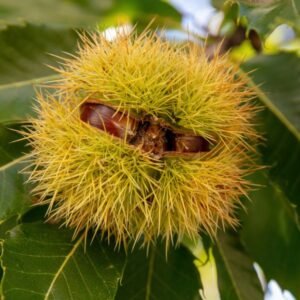
Marigoule chestnuts stand out for their generous size, ranging from large to very large depending on growing conditions. Their elliptical shape and fine glossy dark mahogany colour give them a particularly attractive appearance on the stall.
| Characteristic | Description | Benefit |
|---|---|---|
| Size | Large to very large | Premium presentation |
| Flesh | Very firm, sweet | Holds its shape well when cooked |
| Split kernels | Below 5% | Easier peeling |
| Storage | Good | Extended storage possible |
The very firm flesh of Marigoule shows a low rate of split kernels (below 5%), which makes peeling considerably easier. This feature, combined with its sweet, fragrant flavour, makes it a variety much valued for the fresh market and for culinary processing.
Marigoule excels in many preparations:
⚠️ Note: in fine confectionery, the nut can prove too brittle for some delicate preparations.
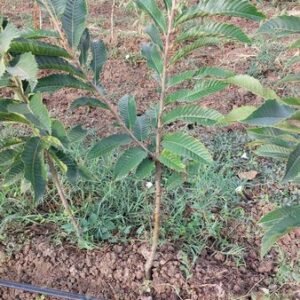
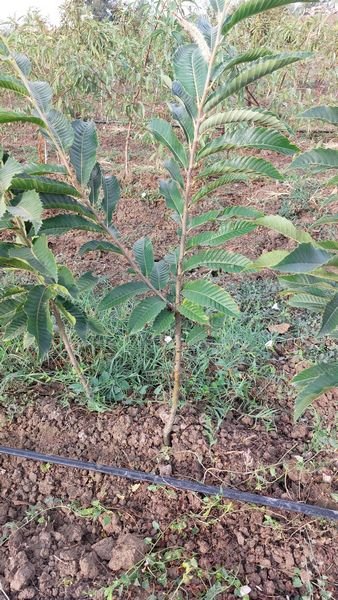
The Marigoule chestnut tree makes a very vigorous tree with a semi-upright habit, reaching 15 to 25 metres in height at maturity. This remarkable vigour, together with the quality of its timber, also makes it of interest for reforestation.
| Parameter | Value |
|---|---|
| Mature height | 15 to 25 m |
| Spread | 8 to 12 m |
| Vigour | Strong |
| Habit | Semi-upright |
| Time to bearing | 4 to 5 years |
| Hardiness | -15 °C to -20 °C |
Marigoule flowers from mid-June to early July. The male flowers appear from 18 to 30 June, while the female flowers are receptive from about 20 June to 7 July.
Marigoule is a longistaminate variety, which means that it produces pollen. That pollen is, however, of moderate quality, which can affect pollination in unfavourable weather (a wet spring).
🐝 A good pollinizer: Marigoule can act as a pollinizer for other varieties such as the Bouche de Bétizac chestnut tree, which is an astaminate variety (pollen-free).
Recommended pollinizers for Marigoule: any longistaminate Castanea sativa, Précoce Migoule, or even wild chestnut trees nearby.
One of Marigoule’s major strengths lies in its remarkable disease resistance:
This robustness against ink disease, which has decimated French chestnut groves since the nineteenth century, is a considerable advantage for sustainable, productive growing.
The Marigoule chestnut tree is demanding about soil quality, which must be rich in organic matter. To express its full potential, it needs specific growing conditions.
Recommended growing areas: southern Dordogne, Lot-et-Garonne, sheltered valleys of the south-east, and the warmest situations in Brittany (with lower productivity).
To give your Marigoule chestnut tree the best chance, follow these recommendations:
For optimal production in an orchard, allow 10% pollinizers if the plot is not surrounded by wild chestnut trees (5% is enough if it is). The pollinizers should be spread evenly across the plot, since pollination is mainly carried out by insects.
Marigoule ripens mid-early, with the harvest generally spread from late September to mid-October. The nuts fall naturally in their burs, often fairly close together in time, which makes harvesting easier.
Marigoule chestnuts have good natural keeping quality. Stored in a cool, well-ventilated room, they keep for several weeks without significant loss of eating quality.
The Marigoule chestnut tree is a sound choice for anyone wanting to produce chestnuts of professional quality while benefiting from excellent resistance to the main chestnut diseases.
Our advice on video
Our other chestnut trees
Ils parlent de nous
 Publié sur Google
 Theo Bernede
Trustindex vérifie que la source originale de l'avis est Google.
Tous les arbres que j’ai reçus et plantés ont bien grandi, et j’ai déjà des mini-pommes cette année ! Très satisfait de la qualité, je recommande vivement. Je repasse d’ailleurs commande cette année sans hésiter!!!Publié sur Google hubert grallPépiniériste très serviable et réactif,commande livrée rapidement en excellent état. une adresse à recommander.Publié sur Google
 Matthieu CARBONNEAccueil de qualité et disponibilité, à des prix très raisonnables. Merci pour tous les conseils.Publié sur Google
 Béatrice BRUVraiment super. J'ai reçu de beaux arbres, rapidement et bien conditionnés à des prix très corrects. Merci beaucoup pour votre engagement, à l'année prochaine pour de futures commandes.Publié sur Google
 Lyda Shun-keoDe très bon conseil, Vincent m'a aidé à choisir des variétés de fruitiers adaptés à la région et la terre de mon jardin. Les scions sont d'excellente qualité et les prix très compétitifs. Je recommande+++Publié sur Google
 Marie PierreMes 4 arbres sont arrivés. Rien à dire sinon parfait de la commande à la livraison. Les petits arbres sont magnifiques. Pépinière à recommander.Publié sur Google
 Stéphane SigSuper adresse,des fruitiers de qualité sont proposés à des prix très abordables. Le patron,en plus de cela, offre un suivi très rapproché si besoin. Adresse à recommander !!!Publié sur Google
 Marie de CAZALSDes variétés anciennes, peu courantes dans les pépinières. Des scions d'excellentes qualités et des conseils précieux. Vous pouvez y aller les yeux fermés. En tout cas, pour ma part, je vous dis à l'année prochaine!Publié sur Google
 Geoffrey LanchasTrès pro, à l'écoute, je recommande ! Merci Vincent.
🎉 Perfect!
Your email has been saved.
See you in late August / early September for pre-orders!
Thanks! 🌱