Description
Nashi Nijisseiki
The Nashi Nijisseiki, also known as the “20th Century Pear” or “20th Century”, is an iconic variety of Asian pear tree discovered in Japan in 1898. This revolutionary apple-pear harmoniously combines the refreshing crunch of the apple with the delicate juiciness of the pear, creating a unique and irresistible taste experience.
Particularly appreciated for its ease of cultivation and remarkable productivity, Nijisseiki has become one of the most popular nashi varieties in the world. Its ability to adapt to temperate French climates makes it an ideal choice to diversify your orchard with an exotic fruit with exceptional taste qualities.
Characteristics of the fruit
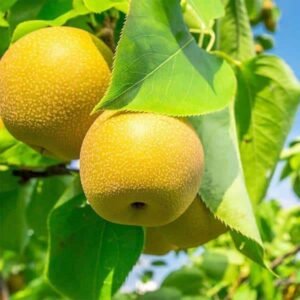
The fruits of Nashi Nijisseiki are distinguished by their perfectly round shape and smooth skin of a beautiful golden green-yellow, sometimes enhanced with a slight pink tint. Medium to large in size, they generally weigh between 150 and 250 grams and measure 6 to 8 centimeters in diameter.
The creamy white to pale yellow flesh offers a unique texture: crunchy like an apple but incredibly juicy like a pear. The delicate taste has a refreshing sweetness with a hint of subtle acidity that enhances the whole. This taste harmony makes it a tasting fruit par excellence, particularly appreciated in hot weather.
| Feature |
Description |
Note |
| Juiciness |
Exceptionally juicy |
★★★★★ |
| Crunchy |
Firm and crunchy |
texture
★★★★★ |
| Conservation |
Excellent hold |
★★★★ ☆ |
Tree Features
The Nashi Nijisseiki pear tree develops a harmonious spreading habit, typical of Asian fruit trees. Of moderate growth, it usually reaches 3 to 4 meters in height and 3 to 4 meters in wingspan, making it a perfect choice for medium-sized gardens.
Its deciduous foliage consists of oval leaves that are slightly larger than those of European pear trees, of a bright green gloss. In autumn, the tree is adorned with a splendid orange-red livery that extends its ornamental interest long after the harvest.
Particularly resistant to common pear diseases, Nijisseiki has a remarkable hardiness that can withstand temperatures down to -15°C, or even -18°C in good conditions. This robustness makes it an ideal tree for beginners in arboriculture.
Flowering and pollination
Nashi Nijisseiki’s bloom generously in May, covering the tree with a cloud of delicately scented pinkish-white flowers. This spectacular bloom attracts many pollinators and is a real decorative asset for the spring garden.
🌱 Unique advantage: Nijisseiki has the particularity of being partially self-fertile, which means that it can produce fruit even planted on its own. However, to optimize fruit production and quality, cross-pollination is still highly recommended.
For optimal pollination, pair it with Nashi Shinseiki, Nashi Chojuro , or Nashi Hosui. It can also be pollinated by European pear trees such as the Williams or the Conference.
Cultivation and maintenance
🌞 Exposure and soil
Nashi Nijisseiki thrives in sunny exposure, an essential condition for fully developing its aromas and sugar content. It tolerates partial shade but production is reduced.
Regarding the soil, this Asian pear tree appreciates well-drained, light to medium soil, with a slightly acidic to neutral pH (6.0 to 7.0). It is particularly afraid of calcareous soils which can cause iron deficiency (chlorosis). Soil enriched with organic matter promotes its growth and fruiting.
🌿 Planting
Planting is ideally done in autumn (October-November) for bare-root plants, allowing good rooting before winter. Container plants can be planted all year round, avoiding periods of frost and high heat.
- Dig an 80 cm hole in all directions
- Amend the soil with well-rotted compost
- Be careful not to bury the graft stitch
- Install a sturdy stake for the first few years
- Water copiously after planting
💧 Watering and fertilizing
The young trees require regular watering for the first two years to ensure their establishment. Once established, Nashi Nijisseiki tolerates temporary drought well, but watering during the fruit swelling period greatly improves fruit quality.
An annual supply of compost in the spring is usually sufficient for the nutritional needs of the tree. In poor soil, a balanced fertilizer rich in potash promotes fruiting and improves fruit preservation.
✂️ Size
The pruning of the Nashi remains simple and is carried out at the end of winter, during the vegetative rest period:
- Remove dead, diseased or misdirected wood
- Thin the center to promote aeration
- Shorten branches that are too long slightly
- Avoid severe pruning that stimulates excessive growth
Harvesting and storage
The harvest of Nashi Nijisseiki is spread from the end of August to the beginning of September depending on the region and the climatic conditions. The fruits are ready when they take on their characteristic golden colour and are easily detached from the tree with a slight rotation.
🍐 Harvesting tip: Harvest nashis slightly before full maturity for optimal storage. They continue to ripen after picking and thus fully develop their aromas.
Conservation is one of the major assets of this variety. Stored in the refrigerator in a crisper drawer, fruits can easily be stored for 4 to 6 months while maintaining their crunch and juiciness. This long shelf life allows nashis to be enjoyed well beyond the harvest period.
Culinary Uses
Nashi Nijisseiki is mainly eaten chilled, bitten like an apple after a simple rinse. Its richness in water (85%) makes it a thirst-quenching fruit perfect for hot summer days.
In the kitchen, it brings an original crunch to fruit salads, goes deliciously with mild cheeses and is a refreshing accompaniment to spicy dishes. Unlike European pears, it does not lend itself to prolonged cooking which alters its characteristic texture.
Benefits of the Nijisseiki Variety
- Ease of cultivation: Ideal for beginners
- Partially self-fertile: Production possible even in isolation
- Early productivity: Fruiting from the 2nd year
- Excellent shelf life: 4 to 6 months in the fridge
- Disease resistance: Robust and healthy variety
- Unique taste quality: Incomparable texture and flavour
- Ornamental interest: Beautiful blooms and autumn colours
- Climate adaptation: Hardy to -15°C
Nashi Nijisseiki is the perfect introduction to the world of Asian fruits. Its ease of cultivation, combined with its exceptional taste qualities and good preservation, makes it a valuable addition to any family orchard looking for originality and new flavors.
Our advice in video
Our other Nashi