Description
Garnier Blue Muscat Vine
The Muscat Bleu Garnier vine is an exceptional Swiss grape variety, created in the 1930s by the nurseryman Charles Garnier in Geneva. This interspecific variety is the result of a skilful cross between the Garnier 15-6 (Villard Noir × Müller-Thurgau) and the Perle Noire (Seyve-Villard 20-347).
Included in the French catalogue of table grape varieties, this variety is still unknown in France despite its exceptional qualities. It is widely grown in Switzerland on several hectares, as well as in Belgium, Austria and Germany, where it is very popular with lovers of quality grapes.
Characteristics of the Garnier Blue Muscat Vine
🍇 Fruit and production
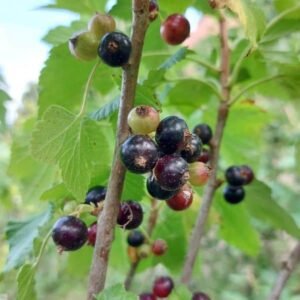
Muscat Bleu Garnier produces large, conical and winged bunches, more or less loose, weighing about 200 to 300 grams. A unique feature of this variety is the natural disparity of its kernels: small and large kernels can be found side by side on the same bunch.
| Scalable |
Color
Cluster |
size
Texture |
| Black → Purple → Blue |
Large, loose (200-300g) |
Crunchy under the tooth |
🎯 Outstanding taste qualities
The medium to large berries, short ellipsoid in shape, have a very pruinated skin of bluish black colour, crunchy to the bite. The firm, juicy and tangy flesh develops an exceptional nutmeg taste with notes of nutmeg that are much appreciated by connoisseurs.
The color of the flesh varies from mauve to slightly bluish, creating a unique visual experience. Warning: the taste of muscat may decrease if ripeness is pushed to the extreme or during prolonged storage.
Climate resilience and adaptation
🛡️ Exceptional natural resistance
Muscat Bleu Garnier is one of the varieties that is naturally resistant to fungal diseases and therefore does not require any chemical treatment:
- 🦠 Downy mildew : excellent natural resistance
- 🍄 Powdery mildew : very good tolerance
- 🐛 Phylloxera : protection by grafting
- 🌧️ Grey mould : good resistance
❄️ Remarkable hardiness
This variety has excellent resistance to cold, withstanding temperatures down to -10°C. It is particularly resistant to harsh winters and adapts perfectly to the mid-mountains, making it an ideal choice for cold geographical areas with little sunlight.
🏔️ Altitude adaptation and cold regions
Particularly suitable for northern, mountainous and high-altitude regions, this early variety allows gardeners in cold climates to obtain a good harvest of quality grapes.
Cultivation and maintenance
🌱 Planting and soil
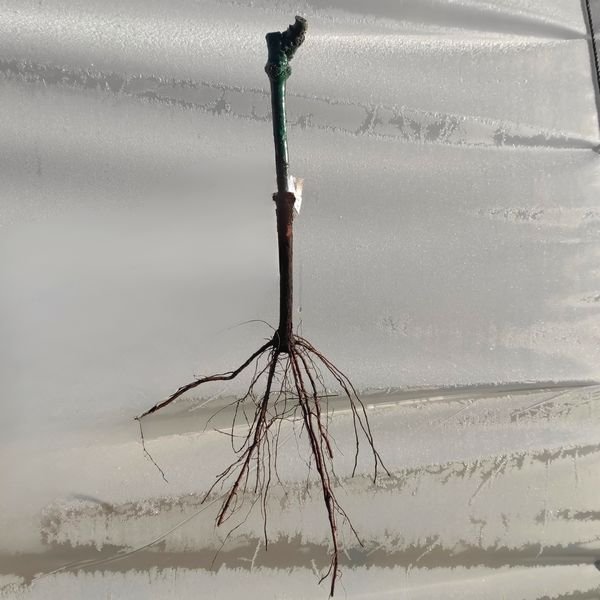
The Muscat Bleu Garnier vine is particularly fond of deep and rich soils but adapts to all types of soils as long as they are well drained. Avoid grafting it onto a rootstock that is too vigorous as it can be susceptible to coulure.
⚡ Growth and development
This vigorous, robust variety with an upright habit is characterized by:
- 🌿 Semi-erect habit: medium vigour, controlled growth
- ⏰ Earliness : medium bud break, harvest from mid-August
- 📈 Productivity : fairly productive, steady yield
- 🏗️ Versatility : trellised rows, trellises, pergolas
🌞 Driving and Supports
Although it is preferable to grow Muscat Bleu Garnier in trellised rows, this grape variety adapts perfectly to other types of cultivation such as trellis to create a climbing vine on a pergola or against a wall thanks to its dense foliage.
Multiple uses
🍽️ Premium Table Grape
An excellent table grape, Muscat Bleu Garnier is best enjoyed chilled and can be presented as an aperitif or to accompany cheeses at the end of a meal, bringing refined fruity touches.
🍷 Renowned winemaking
In our Belgian neighbours, this variety produces an excellent sweet wine whose flavour and aromas are very much appreciated by connoisseurs and amateur winemakers. The wines are described as “sweet and grapey” by experts.
🥤 Miscellaneous transformations
- 🥤 Natural juices : concentrated muscat flavours
- 🍯 Jams : ideal firm texture
- ☀️ Raisins: optimal preservation of aromas
- 🍨 Desserts : refined nutmeg notes
Harvest period of the Muscat Bleu Garnier vine
The harvest takes place from the second half of August to mid-September depending on the desired sugar level and climatic conditions. This relatively late ripening makes it possible to effectively avoid late frosts.
It is recommended to proceed with the harvest as soon as the grapes obtain their final colour to preserve the characteristic Muscat taste as much as possible.
Benefits of the Garnier Blue Muscat Vine
- 🏆 Natural resistance : fungal diseases, no treatment
- ❄️ Very hardy : down to -10°C, mountain
- 🎯 Exceptional taste : muscat nutmeg
- 🌿 Organic farming : ideal for ecological viticulture
- ⏰ Early : harvest from mid-August in the north
- 🎨 Originality : disparate grains on the same bunch
- 🍷 Versatile : table, wine, juice, jam
- 🏔️ Difficult areas : mountains, cold regions
- 🌍 European reference : recognized Switzerland, Belgium, Germany
Points of vigilance
Keep an eye out for bees and birds, which are particularly fond of these tasty grapes. Avoid rootstocks that are too vigorous and can cause coulure. Mulching and fertilizing are recommended in very cold areas.
Why choose Vigne Muscat Bleu Garnier?
Muscat Bleu Garnier represents Swiss excellence in resilient viticulture. This exceptional variety combines ease of cultivation, natural resistance and premium taste quality, offering a choice alternative to the traditional Muscat de Hamburg, but with incomparable resistance and adaptation to cold.
Our other vines
Our advice in video