Description
Nashi Hosui
Nashi Hosui (豊水), literally “abundant water” in Japanese, is an iconic variety created in 1972 that accounts for 30% of Japan’s national production. Developed by the cross between “Kōsui” and “I-33”, this Asian pear perfectly embodies the balance between tradition and Japanese horticultural innovation.
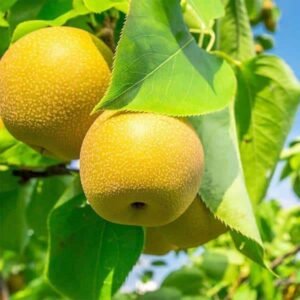
Recognizable by its golden bronze skin punctuated by white lenticels, Hosui is distinguished by its exceptionally juicy flesh and harmonious taste combining sweetness and refreshing acidity. This medium to large variety is one of the “three large pears of Japan” alongside Kōsui and Niitaka.
Distinguishing characteristics of the fruit
| Visual |
appearance
Taste |
profile
Technical qualities |
| Round, slightly flattened |
shapePerfect
sweet and tart balance |
Very vigorous and productive |
| Bronze skin with white lenticels |
Fine
and refreshing flesh |
Disease resistant |
| Superior caliber in Kōsui |
Slightly grainy |
texture
Excellent storage |
Hosui is characterized by a stronger acidity than its cousins Kōsui or Niitaka, giving it a complex and refreshing taste with a subtle aftertaste of brandy. Its ivory-white flesh, dense and crunchy, contains an exceptional juiciness that fully justifies its name.
Culture and climate adaptation
Nashi Hosui demonstrates a remarkable ease of cultivation, inherited from the thousand-year-old Japanese horticultural tradition. Its exceptional hardiness down to -20°C makes it a variety particularly adapted to the French climate.
🌱 Optimal planting conditions
- Soil: Light, well-drained, slightly acidic to neutral
- Aspect: Sunny to semi-shaded
- Planting: October to April (bare roots) or year-round (container)
- Spacing: 3-4 meters between trees
🌳 Development and port
This very vigorous tree reaches 3 to 4 meters in height with rapid development. Its deciduous foliage of a luminous green accompanies a delicate flowering at the end of March, creating a remarkable ornamental spectacle in spring.
💧 Maintenance and care
Thanks to its natural resistance to disease, Hosui requires few treatments. Regular watering during the fruit formation period and mulching at the foot optimise its production. Its good drought tolerance makes it a smart choice for undemanding gardens.
Pollination and fruiting
Nashi Hosui is not self-fertile and requires the presence of a compatible pollinator to ensure its fruiting. The best combinations include Nashi Shinseiki or Williams pear trees that bloom simultaneously.
Its delicate flowering at the end of March requires protection against late frosts (sensitive from -2°C). Once this critical period has passed, the tree reveals its generous nature with abundant and regular production.
Harvest and tasting period
The Hosui harvest takes place from the end of August to mid-September, an ideal period when the summer heat enhances its refreshing juiciness. Unlike European pears, nashis must be harvested at maturity because they do not continue to ripen after picking.
📅 Japanese Production Schedule
In Japan, Hosui follows the traditional calendar: after early varieties such as Kōsui (August), it takes over until late varieties such as Niitaka (October), offering continuity of tasting throughout the autumn.
Culinary use and tasting
Hosui reveals its full flavor when served fresh and sliced, a Japanese tradition that allows you to appreciate its unique texture. Its balanced taste profile makes it a reference for pastry and desserts:
- 🍃 Fresh consumption: Peeled and sliced, served chilled
- 🥗 Fruit salads: Provides crunch and freshness
- 🍰 Pastry: Excellent for pies, crumbles and compotes
- 🍯 Jams: Original texture thanks to its firmness
- 🥤 Juices and syrups: Very popular in Japan
- 🍷 Flavored sake: Japanese tradition with slices of nashi
Japanese Heritage and Tradition
Hosui is part of a two-thousand-year-old tradition, with nashi seeds having been discovered at the archaeological site of Toro (1st century). This modern strain continues the legacy of techniques developed by master gardeners such as Abe Gendayu who, in 1782, revolutionized the cultivation of nashis with his trellis system.
Benefits of Nashi Hosui
- 🇯🇵 Authentic variety – 30% of Japanese production
- ⚖️ Balanced taste – perfect sweet and tart balance
- 💪 Very vigorous – fast growing and generous production
- 🛡️ Naturally resistant – not very susceptible to disease
- ❄️ Very hardy – resistant to -20°C
- 🥤 Exceptionally juicy – justifies its name “abundant water”
- 🍰 Versatile in the kitchen – fresh, cooked or processed
- 📅 Good storage – keeps for a month in the fridge
Nashi Hosui represents the excellence of Japanese horticulture adapted to the French terroir. This reference variety offers an authentic taste experience, combining thousand-year-old tradition and modern qualities. Its perfect balance of juiciness, refreshing acidity and ease of cultivation makes it an essential choice to discover the fascinating world of Asian pears.
Our advice in video
Our other Nashi