Description
Apple Tree Cabarette – Président Van Dievoet
The Cabarette apple tree, also known as Président Van Dievoet, is an ancient variety emblematic of Belgian and French Flanders. This cross-border apple, obtained in the first half of the nineteenth century, is particularly appreciated for its exceptional robustness and long shelf life.
Traditionally grown in the orchards of Nord-Pas-de-Calais, particularly in the districts of Dunkirk, Saint-Omer and Calais, this variety is distinguished by its characteristic high acidity which is sometimes reminiscent of the taste of lemon. It is a real treasure of the regional fruit heritage.
Characteristics of the Cabarette – Président Van Dievoet
🍎 Characteristics of the fruit
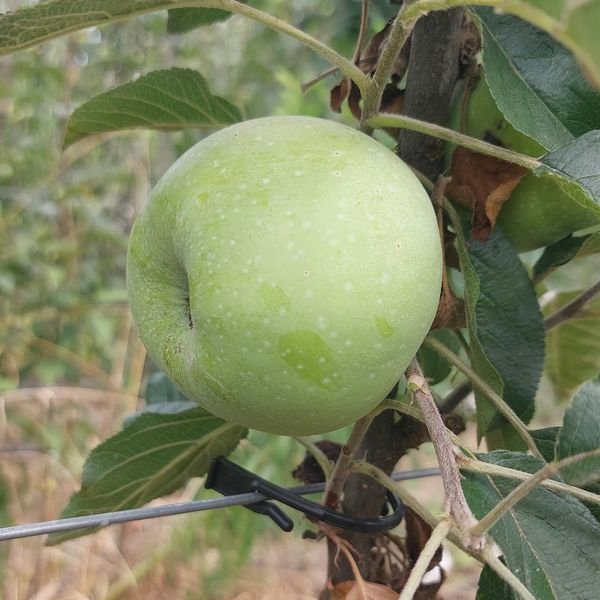
Cabarette apples are medium to large in size, flattened in shape. The smooth epidermis changes from green to light yellow when ripe, sometimes presenting a slight pink-orange cheek on the side exposed to the sun.
The flesh is bright white, very firm and crunchy. It has a remarkable balance between sugar and acidity, with a very pronounced acidity at the beginning of the season that gradually softens. This high acidity, sometimes close to lemon, makes this variety unique.
🌳 Tree Features
The Cabarette apple tree is a vigorous and very productive tree, easy to manage. It has an erect habit with a 60° branch insertion angle that spreads out during fruiting. The branching is dense with many vertical suckers.
This variety adapts to all forms of training (high-stem, low-stem, palmette) and to all rootstocks, making it a versatile choice for all types of orchards.
Pollination and compatible varieties
🌸 The Cabarette is self-sterile and requires the presence of a pollinator. It is itself an excellent pollinator for mid-season flowering varieties (flowering groups 4, 5 and 6).
For optimal pollination, combine it with the Reine des Reinettes, the Gueule de Mouton, the Reinette Étoilée or the Jonathan.
Culinary Use
The Cabarette is a versatile winter apple that excels in many uses:
- 🍎 Table apples : excellent from January when the acidity balances out
- 🥤 Juice and cider : ideal thanks to its high acidity
- 🍯 Compotes : brings a nice acidity to preparations
- 🥧 Pastry : perfect for pies that require a firm apple
⚠️ Important: This apple is difficult to eat before January because the flesh is still too firm and the acidity too strong. It becomes excellent as soon as it turns yellow and retains its qualities until May-June.
Cultivation and maintenance
🌱 Planting
Plant your Apple Cabarette in well-drained soil, preferably in the sun. This hardy variety adapts to different types of soil: sandy, sandy-loamy, silty or clayey, with a neutral pH.
Planting is done outside the frost period, with good mulching (straw, hay, RCW). Monitor water needs in the first few years.
🌿 Care
Water regularly in the first year and in case of drought. This highly productive variety tends to alternate, which may require fruit thinning.
Carry out an annual pruning to maintain good ventilation and remove the many suckers. As the variety is very vigorous, regular pruning is recommended.
Disease resistance
✅ The Cabarette has a good natural resistance :
- 🛡️ Not very sensitive to powdery mildew
- 🛡️ Moderately susceptible to scab
- 🛡️ Moderately susceptible to canker
- 🛡️ Suitable for organic cultivation
This natural resistance makes them a variety of choice for environmentally friendly cultivation, requiring only a few preventive treatments.
Harvesting and storage
The harvest is carried out late in October-November, before the first frosts. It is not uncommon to see fruit remaining in good condition on the tree until February in the northern regions.
🏆 Exceptional conservation : apples can be kept perfectly from January to May-June in a traditional non-refrigerated cellar, i.e. up to 6 months! This remarkable longevity makes the Cabarette a reference winter apple.
Particularities of the Cabarette
| Feature |
Detail |
| 🌍 Origin |
Belgian Flanders, nineteenth century |
| 🍋 Acidity |
Very strong, reminiscent of lemon |
| 📦 Conservation |
January to May-June (6 months) |
| 🌸 Pollination |
Excellent pollinator |
| 🌳 Adaptability |
All shapes, all rootstocks |
Origin and heritage
📜 The Cabarette – Président Van Dievoet is a cross-border heritage variety that testifies to the fruit exchanges between France and Belgium. Its breeder, President Van Dievoet, is said to have obtained it by sowing seeds of a variety from Russia.
Spotted and multiplied by Hector Demey, a nurseryman in Bollezeele, it has spread widely in the traditional orchards of Nord-Pas-de-Calais. This variety perfectly illustrates the adaptation of fruit varieties to local terroirs and deserves to be preserved.
Tasting tips
🍎 To fully appreciate the Cabarette:
- Wait until January to eat it fresh
- Watch the color : as soon as it yellows, it becomes delicious
- Savor the acidity: that’s its uniqueness
- Use it in cooking : perfect for balancing out sweet preparations
💡 Expert tip: La Cabarette is a bona fide of patience! Harvested in November, it reveals all its aromas from January. Combine it with the Queen of Reinettes for a balanced orchard combining tradition and taste quality.
Our advice in video