
France imports more than 18,000 tons of pistachios each year, mainly from the United States and Iran, while this thousand-year-old crop was historically present in Provence. Faced with climate change and the need to diversify agricultural production, the pistachio tree is experiencing a real revival in our territory: more than 500 hectares have been planted since 2018, with an ambitious target of 2000 hectares by 2035. This revival can be explained by the remarkable adaptation of the pistachio tree to the new climatic conditions – resistant to temperatures ranging from -15°C to +45°C and requiring little water – making it the ideal fruit tree for sustainable agriculture. At Terra’Terre Nursery, we actively participate in this movement by offering varieties of pistachio trees selected for their adaptation to the French terroir, grown according to the principles of organic farming. Producing your own pistachios is no longer a dream: it is an economic and ecological opportunity to be seized now.
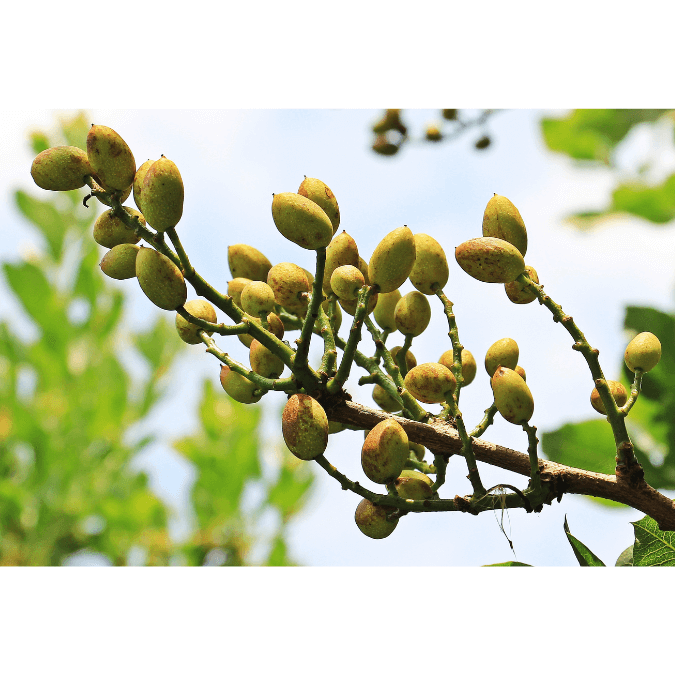
The pistachio tree (Pistacia vera), a member of the Anacardiaceae family like the mango and cashew trees, is a Mediterranean fruit tree of remarkable hardiness. Native to the arid areas of Iran where it was cultivated more than 4000 years ago, this tree conquered the Mediterranean basin thanks to the Romans who introduced it at the beginning of our era. Its historical presence in Provence is immortalized by Cézanne’s famous painting painted in 1900, representing a female pistachio tree from Tholonet which is now approaching 200 years old.
lifespan
green leaflets
tree
What distinguishes the pistachio tree from other fruit trees of old varieties is its exceptional ability to thrive in extreme conditions. Its powerful roots allow it to adapt to poor, calcareous and well-drained soils, while its resistance to drought makes it an ideal candidate to face current climate challenges. This natural robustness explains why more and more farmers are turning to this promising crop, which is particularly suited to the French Mediterranean regions.
Faced with the challenges of climate change and the scarcity of water resources, the pistachio tree is emerging as a solution for the future of French arboriculture. Its exceptional resistance to extreme conditions makes it a valuable ally for a more resilient and ecological agriculture.
The climatic advantages of the pistachio tree:
This ability to adapt makes the pistachio tree a particularly relevant alternative to traditional crops that are suffering. Unlike cherry or apricot trees , which fear late frosts and require regular watering, the pistachio tree offers production security in an uncertain climatic context. This is why many winegrowers and arboriculturists are now diversifying their farms with this crop of the future.
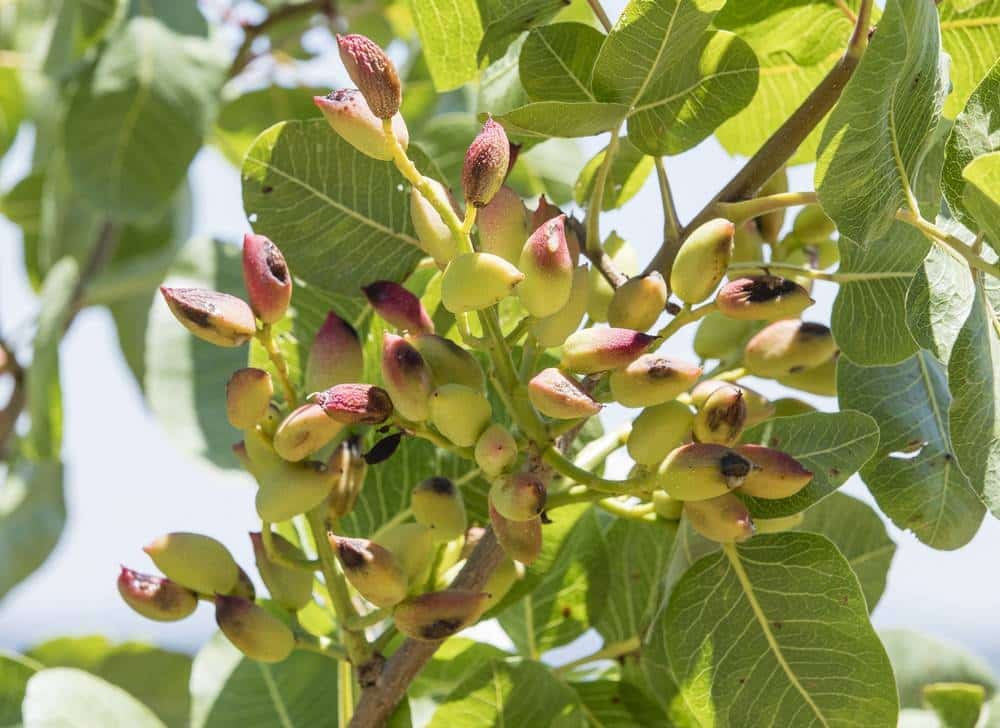
As the pistachio tree is a dioecious species, the success of your production depends on a wise choice between male and female varieties. A ratio of one male to 5 to 8 females ensures optimal pollination, which is essential for a bountiful harvest. At Terra’Terre, we have selected the varieties best suited to the French terroir, combining rusticity, productivity and taste quality.
| Variety | Origin | Advantages |
|---|---|---|
| Kerman Up to 8kg/shaft |
Iran Late |
flowering- Hardy -15 to -18°C – Large pistachios – Strong vigour |
| Sirora Medium to large |
Australia Flowering mid-April |
– 85%+ open pistachios – Avoids late frosts – Medium vigour |
| Variety | Origin | Compatibility |
|---|---|---|
| Peter 3-5m height |
USA 1 for 8-10 females |
– Best for Kerman – Radiant green foliage- Synchronized flowering |
| C-Special Late |
Iran 1 for 5-6 females |
– Kerman + Sirora – Resistant up to 45°C – Ultra hardy |
For optimal production, we recommend combining several male varieties in order to spread out the pollination period. The combination Kerman (female) with Peter or C-Special (males) remains the safe bet to start. The grafted plants that we offer start producing from the 2nd year after planting, with full production reached between 7 and 10 years. Discover our complete collection of pistachio trees selected for their adaptation to the French climate.
Female varieties are the heart of your future pistachio production. Each cultivar has unique characteristics in terms of yield, taste quality and climatic adaptation. Here are our two flagship varieties, selected for their excellence and their adaptation to the French terroir.
referenceOrigin: Iran – Introduced in California in the 1920s
Production: Up to 8 kg of pistachios per tree at maturity
Fruit quality: Large pistachios with a rich taste and floral
fragranceHardiness: Excellent (-15 to -18°C)
Flowering: Late, avoiding spring frosts
Major asset: The most cultivated variety in the world for its exceptional
productivityDiscover the Kerman pistachio tree
innovationOrigin: Australia – Open pollinated breeding of ‘Red Aleppo’Production
: Medium to large fruit, excellent quality
Fruit quality: High percentage of open pistachios (facilitates consumption)
Flowering: Mid-April, natural protection against late
frostsVigour: Strong, remarkable
adaptationMajor asset: Ideal for areas with frequent
Both of these female varieties require the presence of a male pollinator to produce. Their combination with our male varieties guarantees optimal fruiting and generous harvests year after year.
Without male pollinators, no pistachio production is possible. The choice and strategic positioning of your male plants directly determines the success of your orchard. Synchronizing flowering between males and females is crucial to ensure optimal fruiting.
Optimal ratio: 1 male (♂) to 8-10 females (♀)
Planting distance: 6-7 meters between each tree
habit
American selectionLearn more
Iranian selectionRead more
💡 Expert tip: Plant your males in the center or in the direction of the prevailing winds to optimize pollen dispersal. Pollination is carried out by the wind (anemophilic), making the presence of pollinating insects unnecessary.
The choice of variety is the keystone of successful pistachio production. After years of experimentation in France, some varieties stand out for their remarkable adaptation to our terroirs and climates. This selection, the result of the expertise of pioneering growers and agronomic research, will guide you to the most promising cultivars for your project.
Origin: Iran (introduced to California in the 1920s)
Highlights:
taste
storage
Point of vigilance: Sensitivity relative to alternation (60-70% variation)
Terra’Terre verdict: ★★★★★ – A must for beginners
Origin: Australia (modern open-pollinated breeding)
Highlights:
quality
Point of vigilance: Production slightly lower in Kerman
Terra’Terre verdict: ★★★★★ – Ideal areas with late frosts
Origin: Cyprus (traditional Mediterranean variety)
Highlights:
Mediterranean climate
flavour
diseasesPoint of vigilance: Medium size, moderate production (4-5 kg/tree)
Terra’Terre verdict: ★★★★ ☆ – For taste purists
Origin: Aegina Island, Greece (PDO)
Strengths:
Pistachios
Point of vigilance: Lower yield (3-4 kg/tree)
Terra’Terre verdict: ★★★★ ☆ – For high-end markets
Origin: Tunisia (old local selection)
Strengths:
Good
conditions
alternationPoint of vigilance: Smaller pistachios, average
% openingTerra’Terre verdict: ★★★ ☆☆ – For very dry land
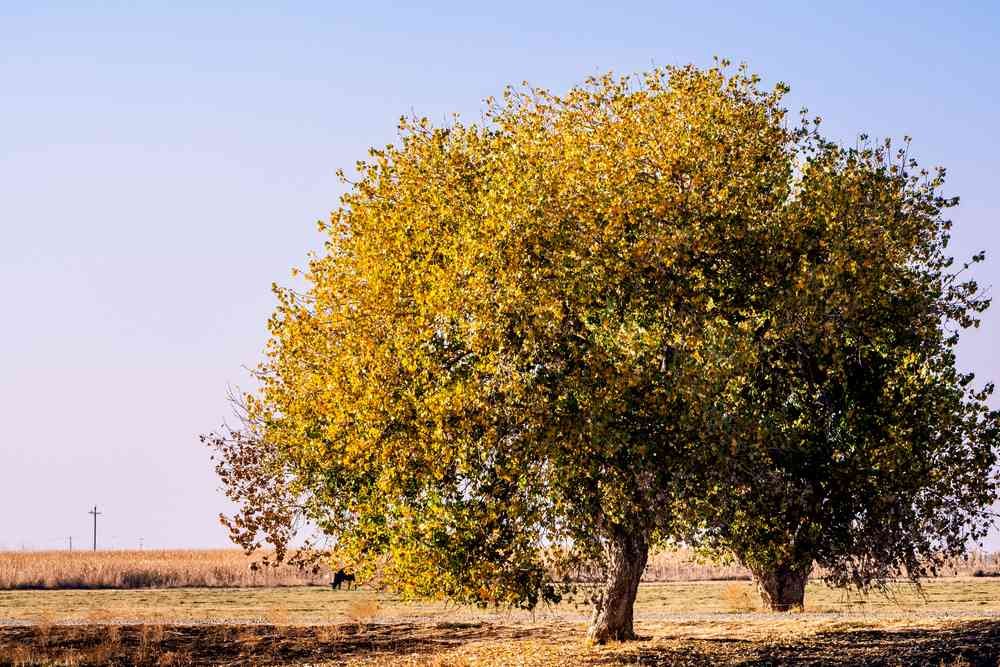
| Combination | Notes | Benefits |
|---|---|---|
| Kerman + Peter Classic |
Productivity: ★★★★★ Hardiness: ★★★★ ☆ Quality: ★★★★★ |
– Optimal yield- Large pistachios – Safe bet |
| Sirora + C-Special Resistant |
Productivity: ★★★★ ☆ Hardiness: ★★★★★ Quality: ★★★★★ |
– Late frost anti-frost- 85%+ open – Very hardy |
| Kerman/Sirora + Peter mixPremium 🏆 Combo |
Productivity: ★★★★★ Hardiness: ★★★★★ Quality: ★★★★★ |
– Spreading the harvest – Maximum safety- Taste diversity |
For a family orchard or a first project, we recommend the Kerman + Sirora + Peter association. This combination offers production security (staggered flowering), excellent fruit quality and optimal adaptation to the French climate. The two female varieties complement each other perfectly: Kerman for volume, Sirora for quality and resistance to climatic hazards.
The planting of the pistachio tree follows the same principles as for other fruit trees, with some specificities related to its particular needs. The ideal period is from November to March, during the vegetative rest, with a preference for autumn which allows better rooting before winter.
checklist
To learn more about planting techniques that are right for your area, check out our complete guide on when to plant a fruit tree according to your climate zone.
The location of your pistachio tree largely determines its future productivity. This Mediterranean tree has specific requirements that must be met to ensure optimal growth and successful fruiting. A poor choice of location can delay production by several years, or even permanently compromise the health of the tree.
⚠️ Fatal mistake to avoid: Never plant a pistachio tree in an area where water stagnates after rain. Excess moisture at the root level causes root asphyxiation and the development of fungal diseases that are fatal to the tree.
For difficult terrain, find out how Choosing the right rootstock tailored to your specific requirements. Pistachio trees are usually grafted onto Pistacia terebinthus or Pistacia atlantica for better adaptation to French calcareous soils.
Planting a pistachio tree with bare roots requires precision and method. Our plants, available from December to March, require a quick planting after reception to guarantee optimal recovery. Follow this visual guide to avoid common mistakes that often jeopardize recovery.
roots
Action: Dig a 60 cm x 60 cm
cubic hole Keypoint: Loosen the bottom for an additional 20 cm with a spade
❌ fork Common mistake: Hole too small that constrains the roots
Action: Place 10-15 cm of gravel or pozzolan at the bottom
Key point: Create a slight slope towards the outside of the hole
❌ Common mistake: Forgetting drainage in heavy soil = tree death
Action: Form a dome of soil in the centre, spread the roots naturally
Keypoint: Graft point 5-10 cm above the final
❌ soil Common mistake: Burying the graft point = rootstock development
filling
Action: Fill in 10 cm layers, tamping lightly
Keypoint: Gently shake the tree to eliminate air
❌ pockets Common mistake: Packing too hard = root asphyxiation
Watering
Action: Water with 20-30 litres of water in 2 times
Keypoint: Form a basin with a diameter
❌ of 80 cm Common mistake: Insufficient watering = poor soil/root contact
Action: Install a stake 10 cm from the trunk, on the prevailing wind side Key
point: Use flexible figure-8 ties to avoid injury
Protection: Install a rodent deterrent
❌ sleeve Common mistake: Tying too tightly = trunk constriction
Finish by installing a mulch collar to maintain humidity and limit weed competition. This often neglected step doubles the chances of retaking in the first year.
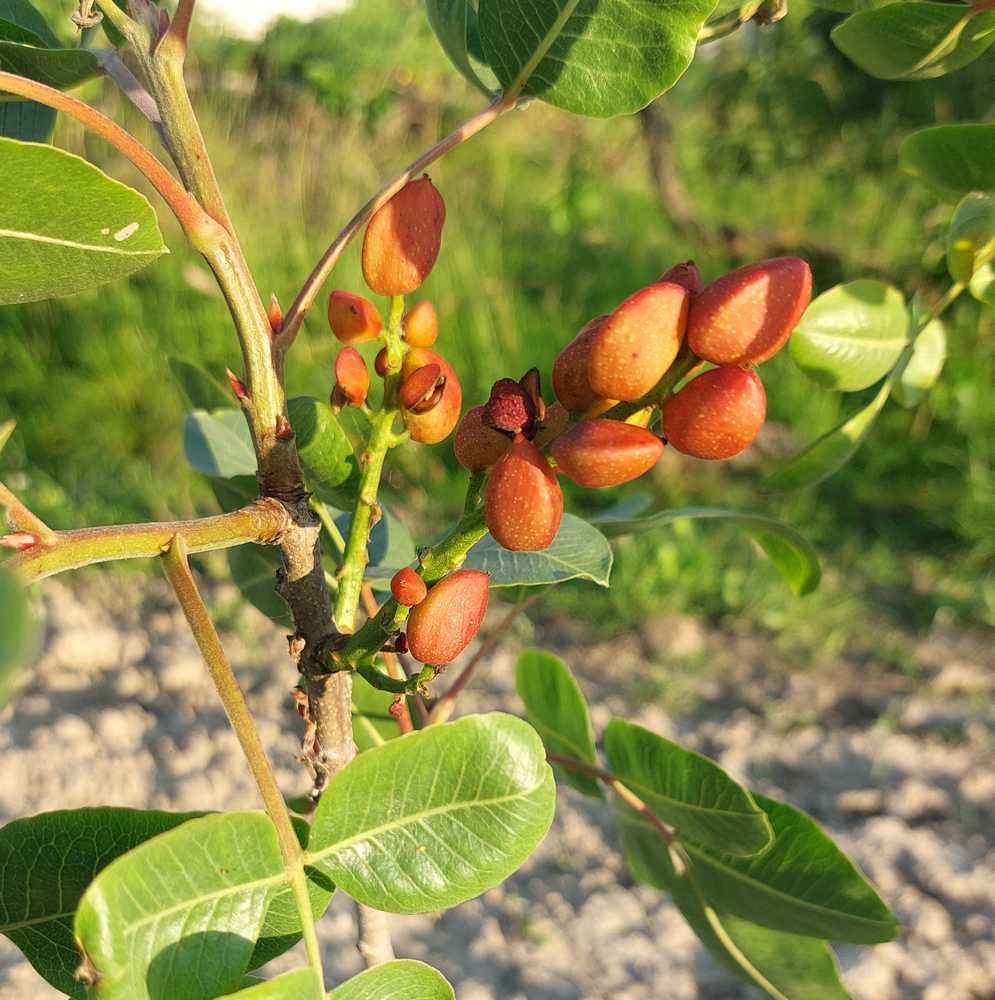
The pistachio tree is one of the most suitable fruit crops for organic farming. Its natural hardiness and low susceptibility to diseases allow for pesticide-free production, thus meeting the growing expectations of consumers. In France, 30% of pistachio producers have already chosen organic, a proportion that continues to increase in the face of the convincing results obtained.
At Terra’Terre, all our pistachio trees are grown according to the principles of organic farming, certified by Ecocert. This approach ensures healthy plants, suitable for natural management of your orchard, while preserving biodiversity and soil quality.
farming
pistachios
The organic management of the pistachio tree is based on three fundamental pillars: prevention through varietal choice and planting, organic nutrition adapted to the specific needs of the tree, and ecological management of grass cover. This global approach makes it possible to obtain yields comparable to conventional while preserving the environment.
Since our conversion in 2018, we have developed specific techniques to optimize the organic cultivation of the pistachio tree:
terroirs
The absence of chemical treatments enhances the taste quality of pistachios and preserves their nutritional richness. The analyses show higher levels of antioxidants and minerals in organically grown fruits. This qualitative added value, combined with AB certification, opens up access to premium markets and valuable short circuits.
A well-structured maintenance schedule ensures the health and productivity of your pistachio trees in organic farming. The interventions, limited but targeted, respect the natural cycle of the tree while optimizing its development. Here is the annual schedule developed by Terra’Terre, with the precise doses of organic amendments authorised in organic farming.
| Period | Actions | Organic fertilization |
|---|---|---|
| January-February Vegetative Dormancy |
– Gentle pruning (10-15%) – Cleaning of the trunk ⚠️ Frost-free |
– |
| March Vegetative |
– Superficial scratching- Organic ⚠️ mulching Radius 1.5m |
Compost: 15-20 kg/tree Horn: 200g/tree |
| April Flowering |
– Flowering monitoring- 1st inter-row ⚠️ mowing Height 10 cm |
– |
| May-June Fruit set |
– Watering if dry – Thinning (year 3+) ⚠️ 40L/tree/week |
Nettle manure 10%: 10L/tree/month |
| July-August Magnification |
– Watering support – 2nd partial ⚠️ mowing Water stress |
Potash: 150g/Kieserite tree : 100g/tree |
| September 🌰 HARVEST |
– Open hull harvest- Immediate ⚠️ drying Speed = quality |
– |
| October Post-harvest |
– Light ploughing- Sowing green ⚠️ manure Vetch-oats |
Composted manure: 20-30 kg/tree (biennial) |
| November Winter |
– Preventive copper treatment- Rodent ⚠️ protection Out of rain |
Bordeaux mixture: 12g/L if necessary |
| December Rest |
– Plan extensions – Order Terra’Terre plants⚠️ |
– |
Contrary to popular belief, the pistachio tree requires very little pruning. This minimal intervention, limited to a maximum of 10-15% of the crown, is mainly aimed at maintaining an airy and balanced structure. Over-pruning compromises future production and weakens the tree in the face of climatic stresses.
each other
vertical suckers
dead wood
light
goblet structure
technique
To learn more about pruning techniques suitable for fruit trees, check out our guide on when to prune fruit trees. The pistachio tree follows the same general principles as other Mediterranean species such as the almond tree, with an even more measured intervention.
The pistachio tree has a remarkable natural resistance to diseases, particularly in France where its main original pests are not present. However, some problems can arise, especially in adverse conditions. Prevention remains the best protection, combined with effective biological solutions when necessary.
Frequency: Main pistachio disease (5-10% of orchards affected)
sector
soil
Immediate removal of affected branches + burning
spray
Frequency: Occasional in hot and dry periods
air Prolonged
Frequency: Rare but possible in a wet year
centreVisible
necrosis
leaf collection
annual preventive program
decoction
sanitary cleaning
For a global approach to the protection of your fruit trees, discover our bee-friendly trees that attract natural auxiliaries, creating a balanced ecosystem that naturally limits parasitic attacks.
Patience is the first virtue of the pistachio producer. Unlike cherry trees which bear fruit from the 3rd year, the pistachio tree requires time to establish its deep root system before investing its energy in production. This wait, often a source of frustration, is nevertheless the guarantee of sustainable production for more than a century.
root development- Slow vegetative growth- No flowering
Alternation is part of the genetics of the pistachio tree. A year of high production (the “on” year) depletes the tree’s reserves, naturally leading to a year of rest (“off” year). This biennial cycle can see yields vary by 60 to 80% from year to year.
ratio and positioning of males
pruning: Vegetative/productive
balance
With an average selling price of €15-20/kg in organic farming and a production of 6-8 kg/adult tree, a pistachio tree can generate €90-160 in annual income. On a density of 150 trees/hectare, the potential reaches €13,500-24,000/ha in a year of full production, more than compensating for the initial investment and the patience required.
The lack of production on an adult pistachio tree is a legitimate cause for concern. Before becoming alarmed, it is essential to carry out a methodical diagnosis. In 90% of cases, the problem falls under one of the five main causes identified below, all of which can be solved with the right corrective actions.
Symptoms: Abundant flowering but no fruit / Total
flower dropDiagnosis:
✅ Solution: Plant a Peter or C-Special pistachio tree upstream of the wind
Symptoms: Vigorous tree but without flowers / Significant
vegetative growthDiagnosis:
✅ Solution: Patience + nitrogen reduction + controlled water stress in July
Symptoms: Blackened flowers / Irregular production depending on the year
Diagnosis:
✅ Solution: Frost protection / Choice of late variety such as Sirora
Symptoms: Premature fruit drop / Wilted foliage in summer
Diagnosis:
✅ Solution: Support irrigation (40L/tree/15 days in summer) + mulching
Symptoms: Lush vegetation / Late tender shoots / Few flowers
Diagnosis:
✅ Solution: Nitrogen stop + potash/magnesium supply + grass cover
season
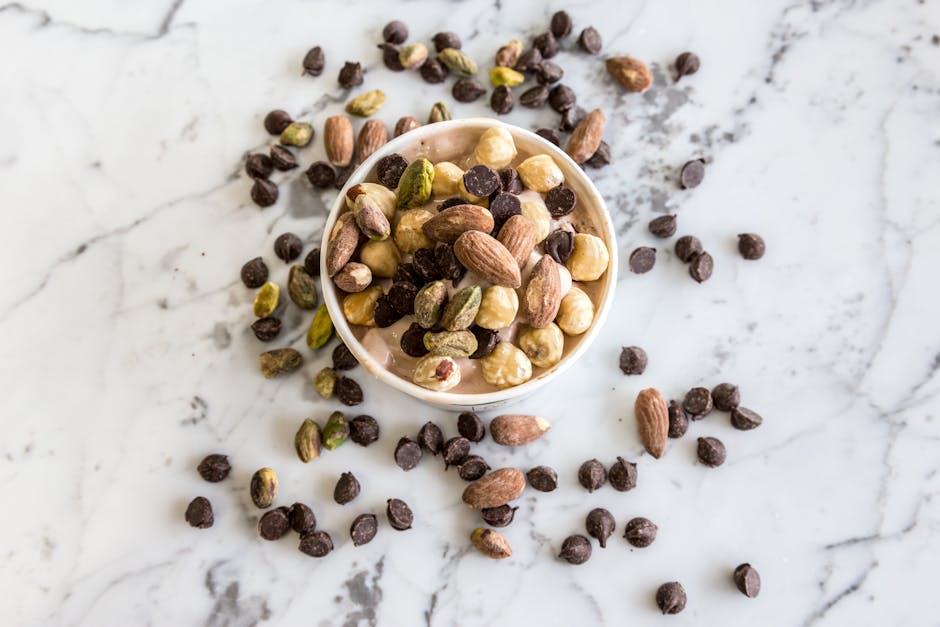
The pistachio harvest marks the culmination of several years of patience and care. This crucial moment, usually between the end of August and mid-September, determines the final quality of your production. Contrary to popular belief, pistachios do not ripen after harvesting, so timing is essential to obtain tasty, well-opened fruit.
split
🗓️ Optimal period: Between 25 August and 15 September depending on the region
⏰ Harvest window: 10-15 days maximum once maturity has been reached
fruit
bag
humidity
jars
place
cellar or cellar
Sauté 200g of fresh pistachios in a dry pan for 5 minutes. Add 1 tbsp of olive oil and 1 tsp of fleur de sel. Stir for 2 minutes. A delightful aperitif!
Mix 100g pistachios + 50g parmesan + 2 cloves of garlic + fresh basil + 10cl olive oil. Perfect on pasta or as a spread.
Replace the almond powder with homemade pistachio powder. The natural green color and delicate taste will delight your guests.
💚 The producer’s privilege: Fresh pistachios, eaten within 48 hours of harvest, offer an incomparable taste experience. Tender and milky, they have nothing to do with store-bought dried fruit. One more argument to plant your own Terra’Terre pistachio trees !
Living in an apartment or having a small garden should not deprive you of the pleasure of growing your own pistachios. The pistachio tree adapts remarkably well to growing in pots, as long as its specific needs are respected. This option even makes it easy to protect the tree during harsh winters and to optimize its exposure on a south-facing terrace or balcony.
saucer
substrate
watering
weather
wintering
wrap
ground
errors
root rot
errors
blockage
death
errors
chlorosis
mistakes
maintenance schedule
fertilization
protection
An 80-100 liter potted pistachio tree can produce 1-2 kg of pistachios after 8-10 years, or about 25% of the yield in the ground. This production, although modest, offers the unique satisfaction of tasting your own organic pistachios in an urban environment. To optimize pollination on the terrace, combine a compact female Sirora with a C-Special male in close pots.
A grafted pistachio tree begins to produce its first pistachios between 5 and 7 years after planting. Full production is reached around 10-15 years with a yield of 6 to 8 kg per tree. Pistachio trees from seedlings require 10 to 15 years to fruit, which is why we always recommend grafted plants.
The pistachio tree thrives in regions with a moderate Mediterranean or continental climate. It can withstand temperatures from -15°C to -18°C in winter and can withstand heat up to 45°C. The ideal regions are: Provence, Languedoc, Roussillon, the Rhône Valley, and even some sheltered areas in the South-West. It is especially fearful of excessive moisture and heavy soils.
Yes, absolutely. The pistachio tree is a dioecious species: there are separate male and female plants. To obtain fruit, you must plant at least one male pollinator for every 5 to 8 producing females. Pollination is done by wind within a radius of 50 meters.
An adult pistachio tree requires a spacing of 6 to 7 meters between each tree, or about 40 to 50 m² per tree. For a minimum productive orchard (1 male + 5 females), count 1500 m². In a pot on a terrace, plan for a container of at least 50 cm in diameter and as much in depth.
No, on the contrary. The pistachio tree is one of the most drought-resistant fruit trees. After 2-3 years of installation with regular watering, it is satisfied with natural rainfall. In very dry summer, an intake of 40 litres every 15 days is sufficient. Excess water is its worst enemy.
The pistachio tree prefers calcareous, well-drained and rather poor soils. Ideal pH: 7.5 to 8. It adapts to stony, sandy or light clay-limestone soils. To be avoided at all costs: heavy soils, compact clay, wet or flood-prone areas. Good drainage is vital for its survival.
Fresh harvested pistachios are naturally unsalted and delicious as is. After drying (5-7 days in the sun), you can keep them plain or grill them for 5 minutes in a pan with a little olive oil and fleur de sel. Homemade pistachios have a sweeter, fruitier flavor than store-bought pistachios.
Great question! The pistachio tree is perfectly suited to organic farming. Its natural resistance to diseases and pests allows for pesticide-free cultivation. At Terra’Terre, all our pistachio trees are certified organic. In France, 30% of producers are already organic with excellent results.
This is the natural phenomenon of alternation, inscribed in the genetics of the pistachio tree. After a year of high production (“on” year), the tree rests the following year (“off” year) with 60-80% less fruit. To limit this alternation, thinning by removing 30% of the fruit in years of high load.
The pistachio tree is one of the longest-lived fruit trees: it can live and produce for 150 to 300 years. In Iran, some thousand-year-old specimens are still producing! It is a real transgenerational investment. A pistachio tree planted today will feed your great-grandchildren.
At Terra’Terre, we have been growing our pistachio trees according to the strict principles of organic farming since 2018. Each plant is selected for its hardiness, productivity and adaptation to the French terroir. Our expertise as a specialised nurseryman guarantees you healthy trees, grafted onto suitable rootstocks, with a one-year take-back guarantee and personalised support throughout your project.
✓ Production: Up to 8 kg/tree
✓ Hardiness: -15 to -18°C
✓ Quality: Large tasty pistachios
✓ Origin: Iran – World
reference variety
50€ INCL. VAT
✓ Specificity: High % open pistachios
✓ Flowering: Late (avoids frosts)
✓ Vigour: Strong adaptation
✓ Origin: Australia – Recent
innovation
50€ INCL. TAX
✓ Pollinates: 8-10 females
✓ Compatible: Ideal for Kerman
✓ Size: 3-5 meters, compact
✓ Flowering: Perfectly synchronized
50€ TTC
Commitments
A question? An orchard project? Our team is at your disposal
📞 05 53 95 16 16 | Monday to Saturday 9am-6pm

Growing pistachio trees in France is no longer a distant dream but a promising reality that is part of the agricultural transition of our territory. With 2000 hectares planned by 2035, the French pistachio industry is structured to meet growing demand while developing land that has been neglected until now. Your commitment today to this sustainable culture is much more than just an investment: it is the creation of a living heritage that will last for generations, producing for 150 to 300 years.
In the face of climate challenges, the pistachio tree embodies the fruit tree of tomorrow: resistant, water-efficient, suitable for organic farming and generating stable income. Each pistachio tree planted today contributes to reducing our dependence on imports (18,000 tons annually), creating value on our terroir and passing on a productive heritage to future generations. The patience he asks for is only an invitation to build sustainably, like these Provençal producers who now harvest the fruits of hundred-year-old trees.
Whether you have a hectare or a simple terrace, whether you are a farmer in reconversion or a passionate gardener, the time has come to plant your first pistachio trees.
“He who plants a tree plants a hope” – Lucy Larcom
With the pistachio tree, plant the future.
Terra’Terre Nursery – Your partner for organic and sustainable
📍 fish farming Discover all our organic fruit trees | 📚 Our advice blog | 🌿 Our organic commitment