22,00 € – 28,00 €Price range: 22,00 € through 28,00 €
🌸 Flowering period: March to April
🍑 Harvest period: Early to mid-August
❄️ Storage: A few days — melting flesh, does not keep
More information
Secure payment by credit card.

The Lord Napier nectarine is an English heirloom variety raised around 1860 by the nurseryman Thomas Rivers, at Sawbridgeworth in Hertfordshire, from a seedling of the peach ‘Early Albert’. It is known for its very white, melting flesh and its free stone. The pomologist Robert Hogg described it in his Fruit Manual as the earliest of all nectarines and one of the largest. We graft it at the nursery, at Le Passage d’Agen, in the Lot-et-Garonne, under AB / Ecocert certification.
| Criterion | Value | Detail |
|---|---|---|
| Species | Prunus persica var. nectarina | Smooth-skinned fruit, no down |
| Trade name | Brugnon de Vigne Lord Napier (French catalogues) | Pomological name: nectarine ‘Lord Napier’ |
| Origin | Sawbridgeworth, Hertfordshire (England) | Raised by Thomas Rivers |
| Date raised | Around 1860 | Seedling of the peach ‘Early Albert’ (R. Hogg) |
| Flesh | White, melting, juicy | Freestone |
| Size | About 6 cm high and wide | Described as one of the largest nectarines |
| Flowering | March to April, large flowers | Reniform leaf glands |
| Pollination | Self-fertile | No pollinizer needed |
| Harvest | Early August in England | Mid-August according to French nurseries |
| Storage | A few days | Melting flesh, to be eaten quickly |
| Use | Fresh, tarts, coulis, sorbets | A dessert fruit above all |
| Vigour | 2.5 to 4 m in height and width | Bushy habit |
| Hardiness | RHS rating H4 (−10 to −5 °C) | Flowering exposed to late frosts |
| Rootstocks offered | St Julien common in the United Kingdom |
Lord Napier belongs to the long series of fruit introductions that came out of the Rivers nursery at Sawbridgeworth in the nineteenth century, alongside the plum ‘Early Rivers’. Robert Hogg places it among the nectarines with large flowers and reniform leaf glands, in the “Stanwicks” group — not by parentage, but for the rich flavour it shares with the nectarine ‘Stanwick’.
More than 160 years after it was raised, Lord Napier remains the benchmark nectarine of British gardens, valued for its reliable cropping in a cool climate. That origin explains why it is found in heirloom collections rather than in the commercial orchards of southern France, where modern firm-fleshed varieties dominate.
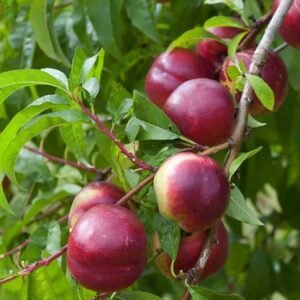
The fruit of Lord Napier is large for an heirloom nectarine: Hogg measures it at two and a half inches both high and wide, about 6 cm. It is oval in shape, marked by a broad, shallow suture, with a depression at the apex ending in a small pointed tip — a morphological detail that helps with identification.
Lord Napier is self-fertile: a single tree is enough to produce fruit, with no pollinating variety. As with all peaches and nectarines, there are no flowering groups and no incompatibility between varieties. The limiting factor is therefore not pollination but the weather: a late frost on open flowers, or a cold, wet week during flowering, reduces fruit set far more reliably than the absence of a neighbour.
Planting a second peach tree nearby, such as the Morton peach tree, another white-fleshed nectarine, therefore does not improve fertilisation of Lord Napier — but it does spread the harvest.
Lord Napier accepts chalky, silty or sandy soils, at acid, neutral or alkaline pH, provided they are moisture-retentive but well drained. Standing water in winter is the main cause of failure. The site should be in full sun, sheltered from wind, facing south or west.
Our Lord Napier whips are supplied bare-root, from December to March. Dig a hole two to three times the diameter of the root system, loosen the base, trim the roots, plant with the root collar at soil level and the graft union above ground, water generously, then mulch.
Lord Napier reaches 2.5 to 4 m in both height and width. Two forms are possible: a free-standing open-centre bush, or fan-trained against a wall — the classic British method, which brings ripening forward and gives protection against cold snaps. The nectarine fruits on the previous year’s wood: pruning consists of renewing that wood each year. Work in spring or late summer, never in a wet winter, to limit the risk of silver leaf.
Peach leaf curl (Taphrina deformans) remains the main problem for Lord Napier, as for all nectarines: several French nurseries rank it among the less susceptible varieties, but no nectarine is immune. Also watch for brown rot on the fruit, silver leaf on pruning wounds, and replant problems if a Prunus already occupied the site. As for pests: aphids, red spider mites and scale insects, especially on fan-trained trees.
Lord Napier is first and foremost a dessert fruit: its melting flesh and free stone make it a nectarine that is easy to bite into and to cut. Picked at the right moment, it keeps for only a few days — that is the price of melting flesh. Slightly under-ripe fruit suits tarts, coulis and sorbets; very ripe fruit suits jam and bottling in syrup.
French makes a distinction that English does not: a « brugnon » has a stone that clings to the flesh, a « nectarine » has a free stone. Robert Hogg explicitly describes the flesh of Lord Napier as separating cleanly from the stone. British catalogues all confirm this with the term freestone, and the RHS registers it as Prunus persica var. nectarina ‘Lord Napier’.
In the strict sense, Lord Napier is therefore a nectarine. French trade uses « brugnon » and « nectarinier » interchangeably, which is why you will find it listed under both names — including in our own French catalogue. In practical terms, for anyone planting it: the flesh comes away cleanly from the stone, which is a real advantage for slicing and for processing.
Hogg placed Lord Napier as the earliest of all nectarines, eight to ten days ahead of ‘Hunt’s Tawny’. It therefore opens the smooth-skinned season, in early to mid-August. To spread the harvest across a family orchard:
Yes, Lord Napier is self-fertile. A single tree is enough to produce fruit, with no pollinating variety. Like all peaches and nectarines, it belongs to no flowering group. Planting a second peach tree nearby does not improve fertilisation, but it does spread the harvest over several weeks.
Lord Napier is harvested in early August in an English climate, and in mid-August according to French nurseries. Robert Hogg described it as the earliest nectarine, eight to ten days ahead of ‘Hunt’s Tawny’. The fruit is picked when the flesh yields slightly under the thumb; it keeps for only a few days.
In the strict pomological sense, Lord Napier is a nectarine: its stone is free and the flesh comes away cleanly, as Robert Hogg describes and as the RHS confirms under Prunus persica var. nectarina. French trade uses « brugnon » and « nectarinier » interchangeably, which explains the double name.
Several French nurseries rank Lord Napier among the varieties less susceptible to leaf curl, but no nectarine is immune and the RHS points out that leaf curl remains the main problem of the species. Plan for two preventive copper-based treatments, at leaf fall and before bud break.
Lord Napier does very well fan-trained against a south- or west-facing wall: this is the traditional British method, which brings ripening forward and shelters the blossom. Pot culture is possible but demanding, as the tree reaches 2.5 to 4 m; keep it for trees grafted on a low-vigour rootstock.
Our advice on video
Our other peach trees
| Weight | 0,33 kg |
|---|---|
| Peach rootstock | GF677, adult size ≈ 4m, Myrobolan adult size ≈ 3.5m, Rubira, adult size ≈ 3m |
They talk about us
 Publié sur Google
 Theo Bernede
Trustindex vérifie que la source originale de l'avis est Google.
Tous les arbres que j’ai reçus et plantés ont bien grandi, et j’ai déjà des mini-pommes cette année ! Très satisfait de la qualité, je recommande vivement. Je repasse d’ailleurs commande cette année sans hésiter!!!Publié sur Google hubert grallPépiniériste très serviable et réactif,commande livrée rapidement en excellent état. une adresse à recommander.Publié sur Google
 Matthieu CARBONNEAccueil de qualité et disponibilité, à des prix très raisonnables. Merci pour tous les conseils.Publié sur Google
 Béatrice BRUVraiment super. J'ai reçu de beaux arbres, rapidement et bien conditionnés à des prix très corrects. Merci beaucoup pour votre engagement, à l'année prochaine pour de futures commandes.Publié sur Google
 Lyda Shun-keoDe très bon conseil, Vincent m'a aidé à choisir des variétés de fruitiers adaptés à la région et la terre de mon jardin. Les scions sont d'excellente qualité et les prix très compétitifs. Je recommande+++Publié sur Google
 Marie PierreMes 4 arbres sont arrivés. Rien à dire sinon parfait de la commande à la livraison. Les petits arbres sont magnifiques. Pépinière à recommander.Publié sur Google
 Stéphane SigSuper adresse,des fruitiers de qualité sont proposés à des prix très abordables. Le patron,en plus de cela, offre un suivi très rapproché si besoin. Adresse à recommander !!!Publié sur Google
 Marie de CAZALSDes variétés anciennes, peu courantes dans les pépinières. Des scions d'excellentes qualités et des conseils précieux. Vous pouvez y aller les yeux fermés. En tout cas, pour ma part, je vous dis à l'année prochaine!Publié sur Google
 Geoffrey LanchasTrès pro, à l'écoute, je recommande ! Merci Vincent.
🎉 Perfect!
Your email has been saved.
See you in late August / early September for pre-orders!
Thanks! 🌱