15,00 €
🌸 Flowering period: Mid-season (May to June)
🫒 Harvest period: Early (October to December)
❄️ Storage: Oil with low stability, to be used quickly; table olives after debittering
Sold in a 1 L pot, around 1 metre tall
In stock
More information
Secure payment by credit card.

The ‘Arbequina’ olive tree (Olea europaea L.) is a traditional olive variety from Catalonia, whose name comes from the village of Arbeca, in the comarca of Les Garrigues (province of Lleida, Spain), valued for its early bearing, its high and regular productivity and its mild, fruity oil. In French, the spellings Arbequine and Arbéquine are also found.
Arbequina has become the benchmark variety for super-high-density hedgerow olive groves. In the garden, the Arbequina olive tree appeals through its moderate vigour, easy to train in open ground as well as in a container. Two points are worth knowing before you buy: its pollination and the real limits of its hardiness.
| Criterion | Value | Detail |
|---|---|---|
| Species | Olea europaea L. (Oleaceae) | Cultivar ‘Arbequina’, and not “var. arbequina“ |
| Synonyms | Arbequine, Arbéquine | French spellings of the Catalan name |
| Origin | Arbeca, Les Garrigues (Lleida, Catalonia) | Palestinian origin: undocumented tradition |
| Breeding | Traditional variety, no breeder | Selected clone: IRTA-i·18 (IRTA, Catalonia) |
| Flowering | Mid-season | May to June in France, depending on the year |
| Pollination | Incompatibility group G1 | Pollinizer from group G2 recommended |
| Harvest | Early | October to December (northern hemisphere) |
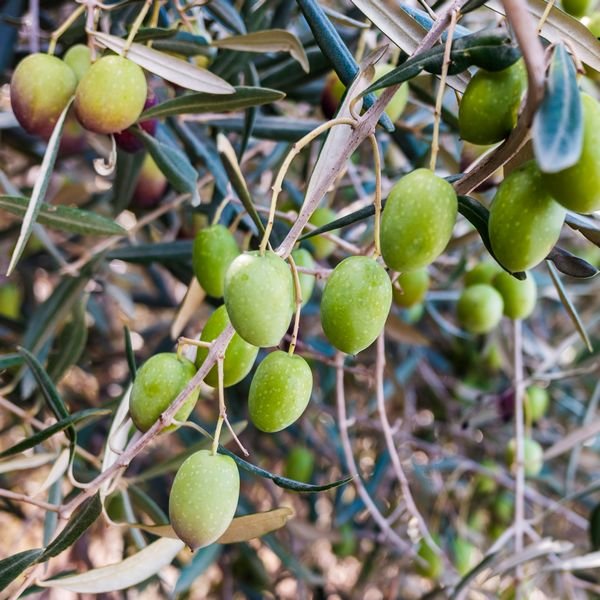
| Fruit | Very small, spherical, symmetrical | Around 1 to 2 g |
| Use | Oil; table olive | Core variety of the Les Garrigues and Siurana PDOs |
| Vigour | Low to moderate | Suited to hedgerow orchards and to container growing |
| Hardiness | Relatively cold tolerant | No reliable threshold specific to the variety |
| Soil | Free-draining; tolerates salinity | Iron chlorosis in very chalky soil |
| Propagation | Roots readily |
The Arbequina olive tree takes its name from Arbeca, the historic cradle of its cultivation. A widespread tradition credits its introduction in the 17th century to the Duke of Medinaceli, lord of the castle of Arbeca, who is said to have brought it back from Palestine. The Arbeca cooperative itself presents this account as a legend: no known source establishes it.
Long confined to the provinces of Lleida and Tarragona, the Arbequina variety spread to Aragon and Andalusia, then to California, Argentina, Chile and Australia. The Catalan research institute IRTA has selected a clone of it, IRTA-i·18, distributed under licence.
Arbequina oil offers excellent tasting qualities: mild, fruity, with little bitterness and little pungency. The trade-off is its low oxidative stability, which is why the olives should not be left to over-ripen.
Most descriptions present the Arbequina olive tree as self-fertile, and Spanish catalogues call it “self-compatible”. Since 2017, however, the work of Pierre Saumitou-Laprade’s team (CNRS, University of Lille) has established diallelic self-incompatibility in the olive: two groups, G1 and G2, whose varieties fertilise each other only across opposite groups.
Arbequina belongs to group G1, and a 2018 Spanish study (Sánchez-Estrada and Cuevas) concludes that it is self-incompatible. An isolated Arbequina olive tree may set a few olives. A regular harvest, however, calls for a pollinizer nearby, since olive pollen is carried by the wind. This is all the more true where olive trees are scarce, as across much of south-west France.
Possible pollinizers (group G2 according to France Olive):
To be avoided as pollinizers for Arbequina:
The Arbequina olive tree requires full sun and perfectly free-draining soil: standing water in winter harms it more than summer drought. Arbequina tolerates salinity but remains prone to iron chlorosis in very chalky soil, which shows as a yellowing of the leaves between the veins. On a limestone slope, have the active lime content measured before planting.
In a dry, warm corner, the Arbequina olive tree goes naturally with the Noir de Caromb fig tree, the Goutte d’or fig tree, the Agat pomegranate tree or the Marcona almond tree.
The olive tree fruits on the previous year’s shoots. Arbequina is pruned at the end of winter, after the hard frosts. The aim is to open up the centre and remove dead wood, without cutting back hard. Its moderate vigour allows open-vase, central-leader or hedgerow training.
Tolerance is not immunity: a variety tolerant to peacock spot can still be affected in mild, damp autumns.
The Arbequina olive is first and foremost an oil olive. Mild and low in pungency, Arbequina oil shines raw: salads, vegetables, fish. Keep it away from light and use it quickly. In Catalonia, the small Arbequina olives are also eaten as table olives, after debittering in brine, like all olives.
The cold tolerance of the Arbequina olive tree is its most repeated selling point, and the most poorly quantified. A Spanish trial (Barranco et al., 2005) ranked it among the three most resistant of eight varieties, with Cornicabra and Picual. An assessment of 24 varieties published in 2016 placed it, on the contrary, among the most damaged.
The hardiness of Arbequina is therefore relative, and no temperature threshold specific to the variety is established. In practice:
Not reliably. Long said to be self-fertile, the Arbequina olive tree belongs to incompatibility group G1 identified by Saumitou-Laprade et al. (2017), and a 2018 Spanish study concludes that it is self-incompatible. An isolated tree may set a few olives, but a regular harvest calls for a group G2 pollinizer planted nearby.
Choose a group G2 variety with fertile pollen, flowering at the same time: Aglandau, Bouteillan, Tanche or Verdale de l’Hérault, according to the list published by France Olive. Avoid Picholine, Cailletier (Frantoio) and Leccino, classified G1 like Arbequina, as well as Lucques and Olivière, from group G2 but reputed to have sterile pollen.
The Arbequina olive tree is reputed to be cold tolerant, but no temperature threshold specific to the variety is established. A Spanish trial ranked it among the three most resistant of eight varieties, while an assessment of 24 varieties published in 2016 placed it among the most damaged. Young plants and container-grown specimens remain the most vulnerable.
Arbequina olives are harvested from October to December in the northern hemisphere, the variety being classed as early. For oil, avoid over-ripeness: Arbequina oil, which has low stability, oxidises more easily than that of other varieties. The fruits, which are very small, are picked by hand or with a comb over a tarpaulin spread out beneath the tree.
Yes. Its low to moderate vigour makes the Arbequina olive tree a variety well suited to growing in a pot or a container. Use a large container with drainage holes and a free-draining growing medium, and water moderately. In a pot, the roots are more exposed to frost than in open ground: shelter the container during spells of prolonged cold.
Our advice on video
| Weight | 2 kg |
|---|
They talk about us
 Publié sur Google
 Theo Bernede
Trustindex vérifie que la source originale de l'avis est Google.
Tous les arbres que j’ai reçus et plantés ont bien grandi, et j’ai déjà des mini-pommes cette année ! Très satisfait de la qualité, je recommande vivement. Je repasse d’ailleurs commande cette année sans hésiter!!!Publié sur Google hubert grallPépiniériste très serviable et réactif,commande livrée rapidement en excellent état. une adresse à recommander.Publié sur Google
 Matthieu CARBONNEAccueil de qualité et disponibilité, à des prix très raisonnables. Merci pour tous les conseils.Publié sur Google
 Béatrice BRUVraiment super. J'ai reçu de beaux arbres, rapidement et bien conditionnés à des prix très corrects. Merci beaucoup pour votre engagement, à l'année prochaine pour de futures commandes.Publié sur Google
 Lyda Shun-keoDe très bon conseil, Vincent m'a aidé à choisir des variétés de fruitiers adaptés à la région et la terre de mon jardin. Les scions sont d'excellente qualité et les prix très compétitifs. Je recommande+++Publié sur Google
 Marie PierreMes 4 arbres sont arrivés. Rien à dire sinon parfait de la commande à la livraison. Les petits arbres sont magnifiques. Pépinière à recommander.Publié sur Google
 Stéphane SigSuper adresse,des fruitiers de qualité sont proposés à des prix très abordables. Le patron,en plus de cela, offre un suivi très rapproché si besoin. Adresse à recommander !!!Publié sur Google
 Marie de CAZALSDes variétés anciennes, peu courantes dans les pépinières. Des scions d'excellentes qualités et des conseils précieux. Vous pouvez y aller les yeux fermés. En tout cas, pour ma part, je vous dis à l'année prochaine!Publié sur Google
 Geoffrey LanchasTrès pro, à l'écoute, je recommande ! Merci Vincent.
🎉 Perfect!
Your email has been saved.
See you in late August / early September for pre-orders!
Thanks! 🌱