

Table des matières
ToggleChapter 1: Introduction to Shaft Formation Pruning of Fruit Trees
The art of cultivating beauty and productivity
Axis pruning, an essential technique for fruit trees, is much more than just a pruning method. It is a true art that, when mastered, transforms our orchards into an oasis of productivity and beauty. In this chapter, we’ll explore the foundations of this technique and why it’s so crucial to the well-being of your trees.
Why the size of Axis Formation?
- A Natural and Effective Method
- At the heart of axis training is the understanding of the tree’s natural growth. This technique aims to guide the tree, not to constrain it, in harmony with its natural growth.
- Multiple Benefits
- Increased productivity : Better sun exposure and optimized airflow.
- Simplified maintenance : Less time spent trimming and maintaining.
- Tree Health : Reduced disease due to an aerated structure.
- Resistance : Fruit trees formed in an axis are more resistant to bad weather (less wind resistance)
Axis Training Size in a Nutshell
Axis training consists of developing a tree around a central axis, with side branches evenly distributed. This structure promotes an even distribution of the tree’s resources, leading to better fruiting and improved overall health.
To learn more about selecting the right tree varieties for this technique, don’t hesitate to consult our guide on How to choose your fruit tree.
In the next chapters, we will detail the key steps to succeed in this training, with a focus on the specific needs of different varieties of fruit trees. Stay tuned to transform your orchard with Axis Training!
Chapter 2: Key Steps in Axis Training Pruning
Mastering the technique for flourishing fruit trees
Forming a fruit tree in the axis is a meticulous process that requires attention and know-how. Follow these steps to ensure healthy and productive growth of your trees.
1. Selection and Preparation
- Tree Choice : Opt for healthy young trees with good growth potential.
- Site Preparation : Make sure the soil is well-drained and fertile.
- Accompaniment: The growth of the tree must be closely monitored
- Irrigation : Irrigation must be carefully treated from the first year
- Fertility : Fertilization must be optimal in order to provide the tree with everything it needs
- Trellising : To help the tree in the first few years, it will need to be staked and/or trellised
- Folding : A branch fold may be required in addition to pruning
2. Shaft Formation Size
- Early Years : Prune the tree to establish a sturdy center axis. The final shape resembles that of a “fir tree”
- Branch Management : Eliminate competing branches to promote proper balance.

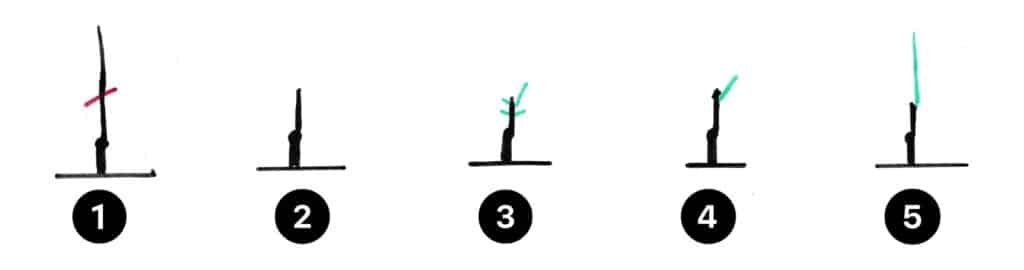
- Period: Winter of planting. Action to be taken: When you plant your tree you can prune it, this step is not mandatory but to rebalance the root part and the leaf part I think it is wise to do it. Some also advise you to prune the roots before planting, personally I think that pulling out already puts enough stress on the root system and that there is no need to add more.
- Period: Winter of planting. Action to be taken: Result after first cut, take the opportunity to put a stake or a trellis (not shown on my diagram)
- Period: Spring. Action to be taken: The fact of having trimmed your tip will generate the growth of the buds that precede the cut. We call these “rejections”
- Period: Spring. Action to be taken: At this point you have to select a single branch to form the axis. Do not prune too early, you have to wait until the branches are about ten centimeters long so as not to cut the “sap pull” effect.
- Period: Spring to autumn Action to be taken: For the rest of the growing season, you will need to attach the shoot to your stake or training to help it grow and be straight. Of course, it will also be necessary to ensure good irrigation and remove the suckers from the rootstock if there are any.
When autumn/winter arrives, two scenarios can arise:
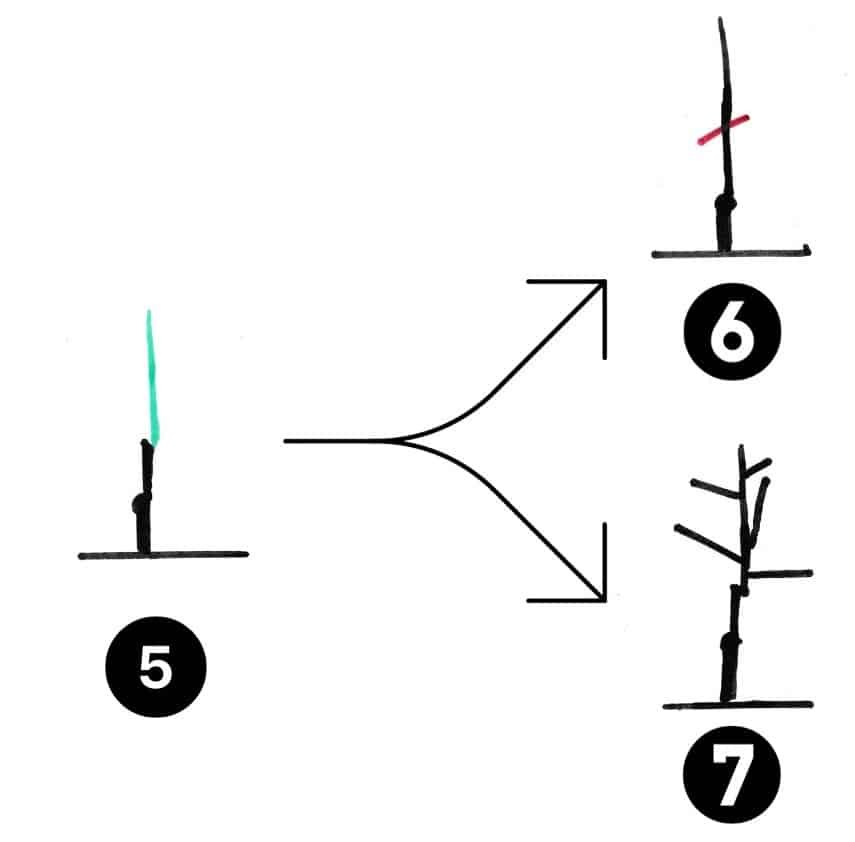
6) Your sprout of the year has not made any branches on the sprout of the year (what is called the anticipations). It doesn’t matter, some varieties are less or more difficult. You will therefore have to re-sharpen your axis 40cm to 60cm above the previous cut and then work with the suckers the following year.
7) Your growth of the year has made branches = the anticipated. This is when during the winter (avoid frosty days) you will have to form your axis by eliminating the branches that have too much vigor and can compete with the Axis.
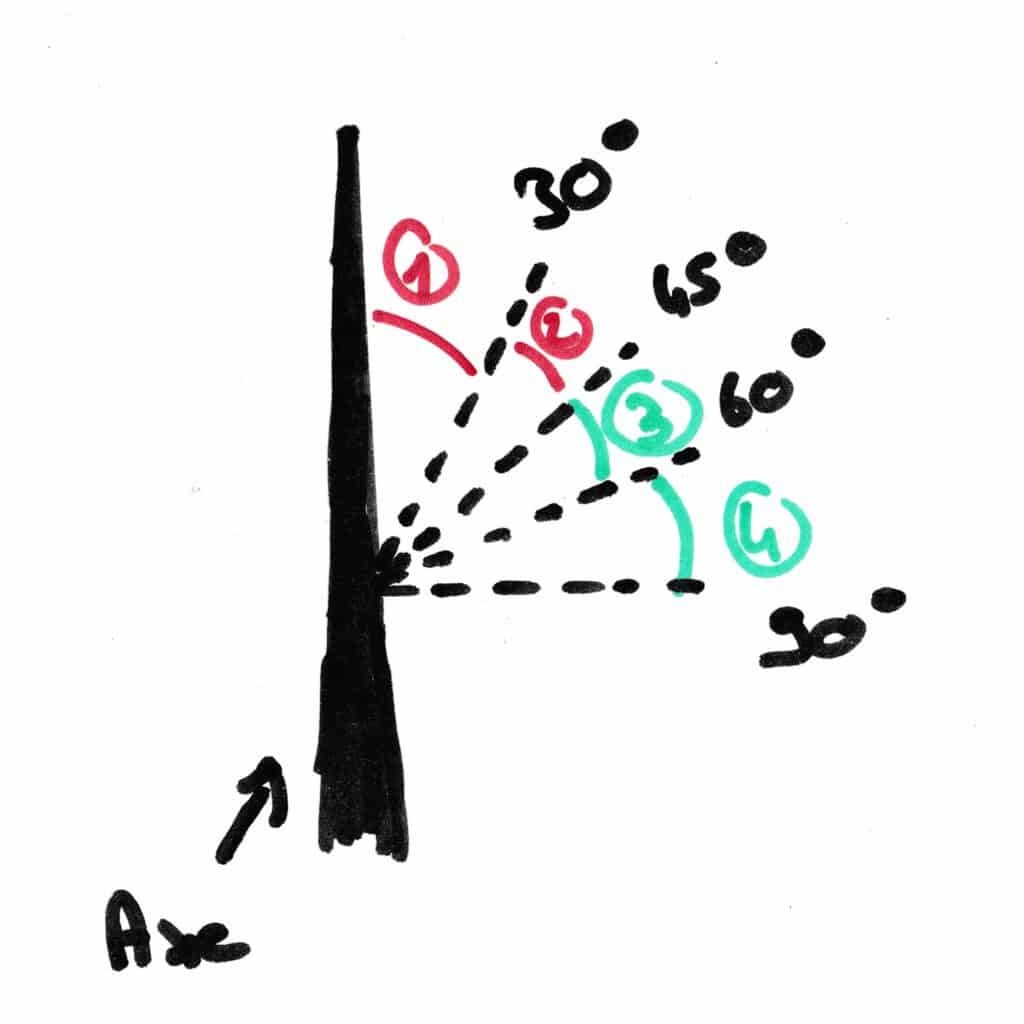
How to Recognize Branches That Have Too Much Vigor – Axis Formation Pruning
Recognizing a vigorous branch – By its angle of insertion:

If the branch is to be pushed on an angle that is too closed, i.e. too vertical, in the same direction as the Axis, cases 1 and 2 in red, they must be removed.
For branches that have grown in a more open angle between 45 and 60° (3 green), you can keep them but you will have to “bend” them next spring. Bending consists of attaching the branch to the stake or to the Axis (the central trunk) in order to bring it horizontally. Warning : This step is only to be carried out at the beginning of spring when the tree is in sap, the branches will be more “flexible”. Doing it in winter can cause breakage.
All branches that have grown horizontally (4 green) can be kept if their diameter is not too large.
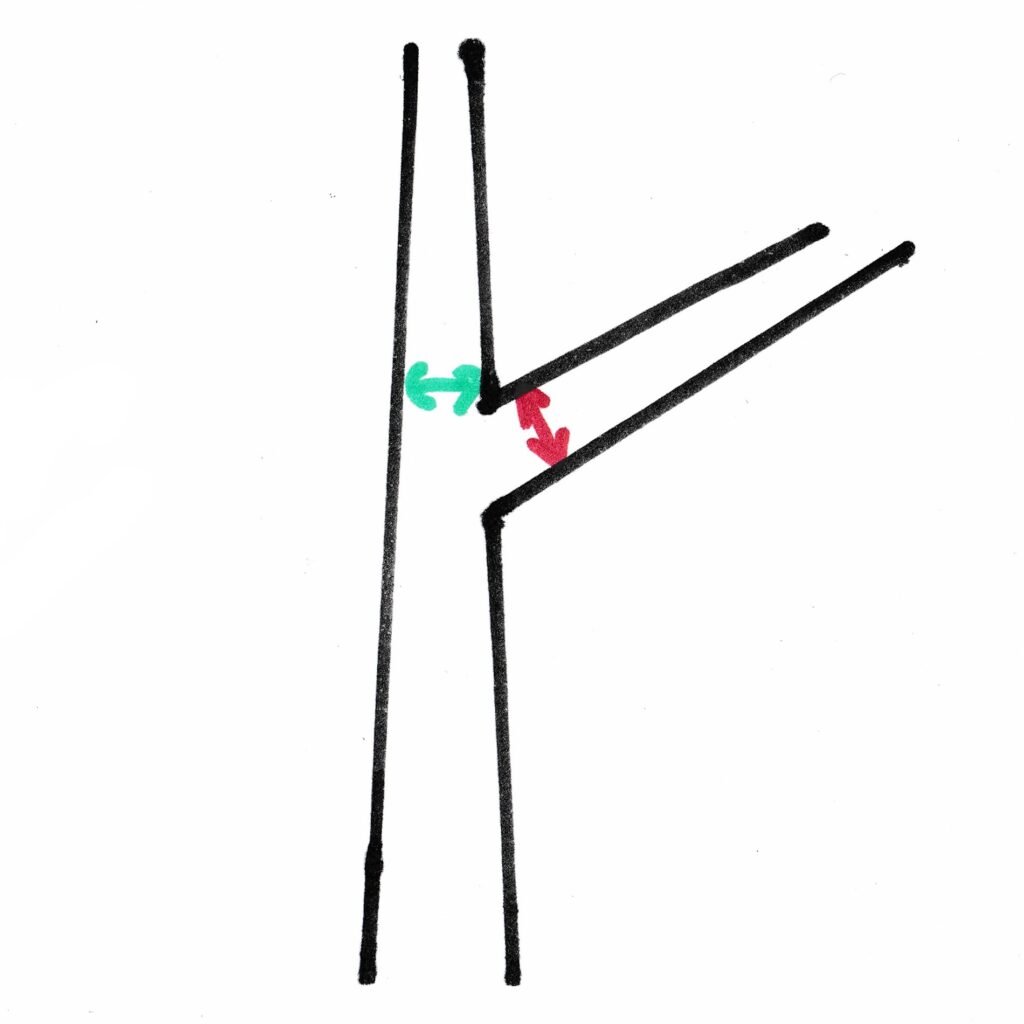
Recognizing a vigorous branch – By its diameter:

If the diameter of the branch (diameter in red) is greater than 1/3 of the diameter of the axis (diameter in green) it must be removed, regardless of its angle.
Now that you know how to recognize a branch that has too much vigor, we can go back to our winter training pruning:
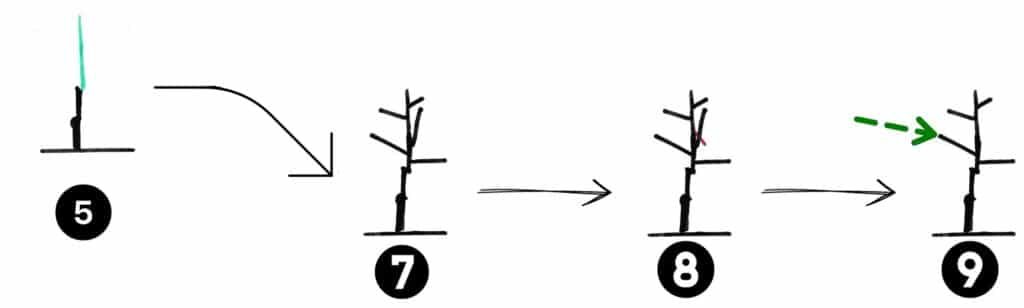
8) Cut the branch that has an angle that is too closed
9) Identify the branch that will be tied/folded the following spring.
In the professional orchard, during this training pruning, the pruners re-sharpen the apex of the tree (the highest part) in order to do the same work again in year 1. This pushes the Central Axis to make wood, to be more rigid and not to bear fruit.
3. Annual Maintenance
- Formation Size: Over the first three or four years, the training pruning must be carried out, then we will move on to a maintenance or fruiting pruning
- Holding Pruning : Make regular cuts to maintain the shape of the tree.
- Monitoring : Be alert for signs of illness or stress.
4. Maximizing Growth
- Feeding and Watering : Provide nutrients and adequate hydration.
- Protection : Protect the tree from pests and extreme weather conditions.
By following these steps for the axis formation of your fruit trees, you will encourage healthy growth and abundant fruiting. For more detailed information on each variety, visit our section on the different types of fruit trees.
Patience and perseverance are key in this process. Over time, you’ll see your efforts rewarded with beautifully shaped and productive trees.
Chapter 3: Specific Tips for Fruit Tree Varieties
Adapting the technique to each tree for a harmonious orchard
Each variety of fruit tree has its own peculiarities that influence the axis formation method. This chapter guides you through these specifics to ensure the success of your orchard.
Understanding the Needs of Each Strain
- Pruning by Variety : Some strains require more frequent pruning, while others thrive with minimal intervention.
- Disease Susceptibility : Know the specific susceptibilities of each type of tree to effectively prevent diseases.
Practical Tips for Common Varieties
- Apple, pear and plum trees : These trees benefit from annual pruning for better fruiting. Axis training pruning is quite appropriate for this type of tree.
- Cherry trees : A gentler approach is often better for this species. But a size of formation in the Axis can be envisaged.
- Peach and Apricot Tree : The training in axis works for peach trees, some orchards in my area are trained in this way. As far as apricot trees are concerned, I advise against any special training. It is a species that goes naturally in goblet and generates a lot of ramifications. Apricot trees don’t like pruning at all. In professional orchards, they are often pruned once every four years to contain them so that they can pass with tractors.
To learn more about choosing the right fruit tree for your region and your needs, do not hesitate to consult our page on the different varieties of fruit trees.
By familiarizing yourself with the specific requirements of each variety, you will be able to apply axis training optimally, ensuring the health and productivity of your orchard.
Chapter 4: The Importance of Pruning in Shaft Training Pruning
A key step for healthy and productive trees
Pruning plays a crucial role in the axis formation of fruit trees. It is not only about shaping the tree, but also about ensuring its health and productivity.
1. Promoting Healthy Growth
- Elimination of Competitive Branches : Remove branches that compete with the main axis to promote balanced growth. (See chapter on how to recognize a vigorous branch)
- Improved Air Circulation : Proper pruning helps prevent disease by improving air circulation through the tree.
2. Fruiting Optimization
- Sun Exposure : Good pruning ensures better sun exposure of the fruit, which is essential for ripening.
- Abundant Harvest : A well-pruned tree often produces more and better fruit.
For detailed information on pruning techniques specific to different fruit trees, I invite you to consult our dedicated article on pruning fruit trees.
By incorporating pruning as a key part of axis training, you ensure not only an aesthetically pleasing orchard but also a robust and generous one.
Chapter 5: Conclusion on Axis Cutting
The key to a prosperous and sustainable orchard
In conclusion, axis training is a pruning technique that, when done well, offers many benefits to your fruit trees. It not only ensures healthy growth and better fruit production, but also contributes to the ease of maintenance and aesthetics of your orchard.
Summary of Benefits
- Balanced Growth : A better distribution of resources for harmonious development.
- Increased Productivity : Better quality fruit in larger quantities.
- Ease of Harvesting and Maintenance : Simplified access to fruit and reduced labor required.
By taking this approach, you will contribute to the vitality and sustainability of your orchard. Axis training pruning is more than a pruning technique, it’s a commitment to the health and productivity of your fruit trees.
For more information and to discover our range of trees adapted to this technique, visit our online shop.
Together, let’s cultivate beauty and abundance in our orchards!