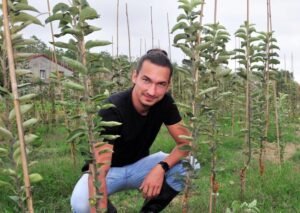

Hi friends, it’s Vincent from the Terra’Terre nursery. Today, I am back in my transplant room to present two types of transplants: the galloping English transplant and the complicated English transplant. At the end of this article, I will give a theoretical recap on wound healing, which is the basis of the transplant. For the moment, it is time to put English grafting into practice.
If you want to see my video on the subject, here it is:
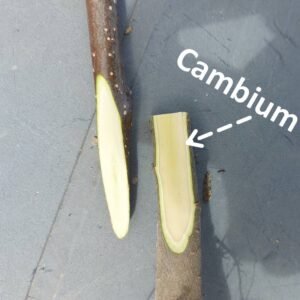
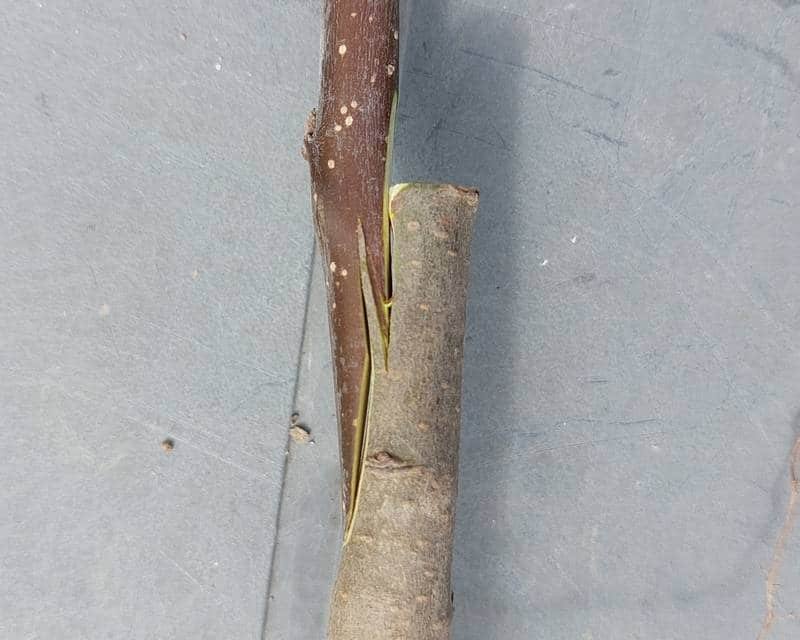
For the cut of the scion, whether it is for the galloping English or the complicated English, it is exactly the same thing. You have to cut as straight as possible. Then, we prepare our scion by aligning the cambia of the scion and the rootstock, because this is where the sap flows.
For the galloping English one, you should choose a smooth part of the rootstock, without knots. The shape of the scion cannot be exactly replicated on the rootstock. The cambium of the rootstock must be matched with that of the scion. Here are the steps:
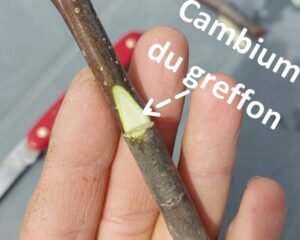
For the complicated English one, the scion and the rootstock must be of the same diameter. The scion and the rootstock are superimposed, making sure that the cambiums are well aligned. Then, we do the ligature to hold the whole thing together.
For ligation, there are several options such as body tape, flexiband or raffia. The important thing is to hold the scion and the rootstock together. A good ligation ensures better healing.
Choosing between the galloping English and the complicated English depends on your needs. If you have few grafts to do, the complicated English will be more aesthetic and clean. For more intensive production, the galloping English is faster and adaptable to different graft diameters.
And there you have it friends, I hope you enjoyed this video. If so, don’t hesitate to let go of a little blue thumbs. If you have any questions or if you do differently, say so in the comments, I will answer as usual. See you soon for a next video, and don’t forget to subscribe!
To make a quick point about the composition of wood: there is the bark, the cambium, and the wood. The cambium generates bark and wood. During a cut, the cambium forms a scar bead that covers the wound. For a good transplant, the wound must be covered to promote the formation of this healing callus. Ideal conditions and good protection ensure a good weld between the scion and the rootstock, guaranteeing the success of the graft.
If you have any questions, feel free to ask them in the comments.
See you soon!
To find all my fruit trees which have been produced mainly in English grafting at a gallop, head to >> my catalog <<
Finally, if you want to see all my tips in video, don’t hesitate to check out my YouTube channel: