
6,00 €
🌸 Flowering period: April – May
🫐 Harvest period: July – August
❄️ Storage: Perfect freezing, immediate processing
Plus d'informations
Paiement sécurisé par carte bancaire.

The Caseille Josta represents a remarkable innovation in the world of berries. This fascinating hybrid, born from the cross between the blackcurrant (Ribes nigrum) and the gooseberry (Ribes uva-crispa), ingeniously combines the best characteristics of its two parents to offer a unique fruit with exceptional qualities.
Developed in Germany in the 1970s, this revolutionary variety takes its name from the first syllables of its parents in German: “Jo” for Johannisbeere (blackcurrant) and “Sta” for Stachelbeere (gooseberry). This horticultural creation allows gardeners to enjoy larger fruits than traditional blackcurrants, without the annoying thorns of the gooseberry.
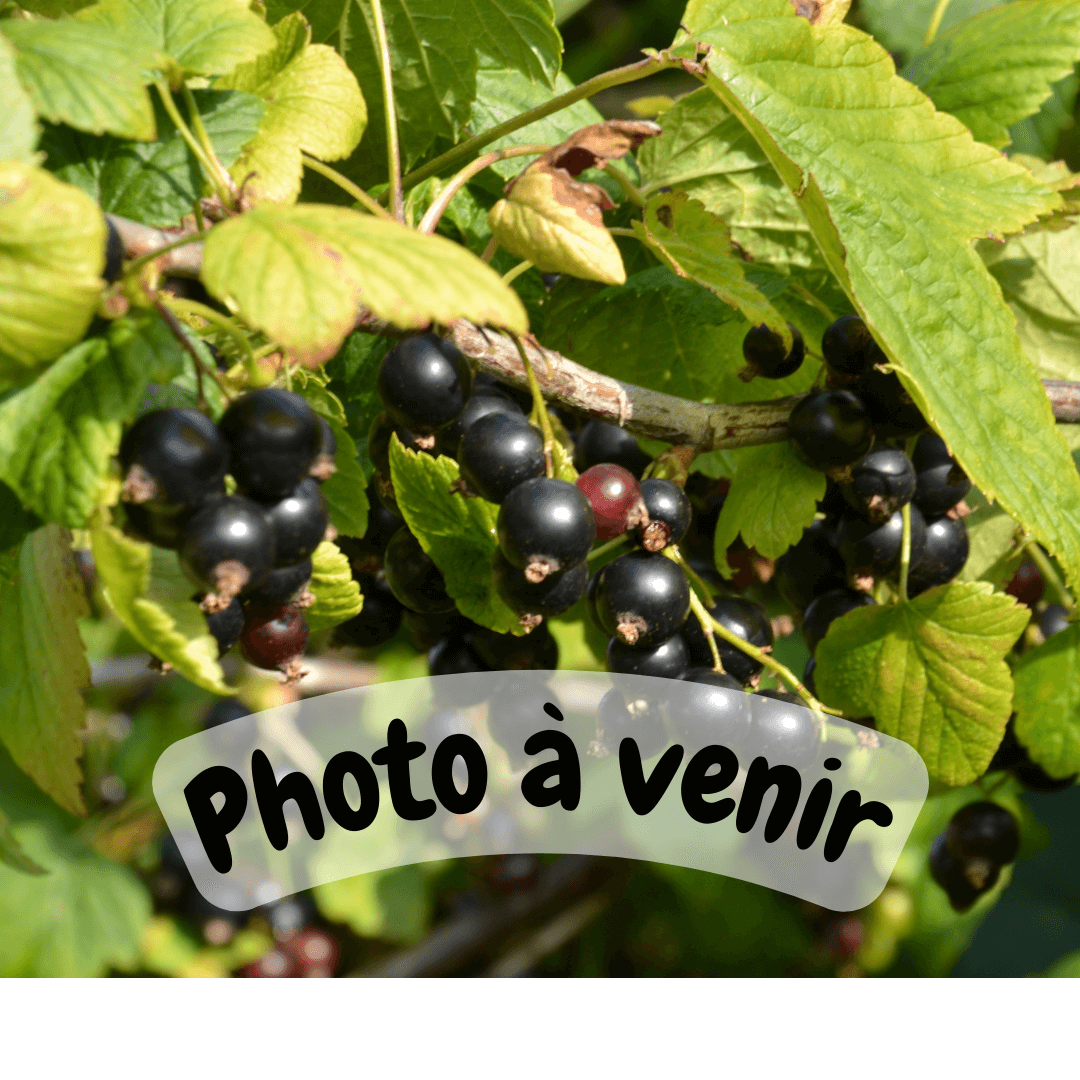
Josta caseilles impress with their generous size, far exceeding that of classic blackcurrants with a diameter of up to 1.5 to 2 centimetres. These round to slightly oval berries weigh an average of 10 grams and have a magnificent intense brown-black, almost purplish colour, which testifies to their full maturity.
The smooth, shiny skin, inherited from blackcurrants, protects firm, juicy flesh with a texture more reminiscent of gooseberry. The unique taste presents a perfect balance between the aromatic intensity of blackcurrant and the tangy freshness of redcurrant, creating a unique and refreshing taste experience.
| Feature | Description | Advantage |
|---|---|---|
| Size | 1.5 to 2 cm in diameter | Easy harvesting |
| Taste | Tangy and fragrant | Culinary versatility |
| Nutritional | Very rich in vitamin C | Health Benefits |
The Caseille Josta shrub develops a vigorous and compact bushy habit, generally reaching 1.5 to 2 meters in height and 1 to 1.5 meters in width. This modest size makes it an ideal choice for gardens of any size, including small urban spaces and even growing in containers on terraces or balconies.
The deciduous foliage consists of dark green trefoil leaves, larger than those of the blackcurrant, measuring 8 to 10 centimetres. Slightly aromatic, they give off a subtle scent when crushed. In autumn, the shrub takes on a beautiful golden hue before the leaves fall, prolonging its decorative interest.
🌿 Major advantage: Unlike the gooseberry, the branches of the Caseille Josta are completely thornless, making pruning and harvesting particularly pleasant and safe, even for children.
Flowering blooms in April-May in the form of small clusters of discreet flowers with greenish to brownish-red petals. Although less spectacular than other fruit shrubs, this melliferous flowering effectively attracts pollinating insects essential for fruiting.
✨ Unique Advantage: Caseille Josta has the huge advantage of being self-fertile, meaning that a single plant is enough to achieve a bountiful harvest. This feature makes it a perfect choice for small gardens or isolated plantings.
Fruiting occurs on 2 to 3-year-old branches, with production generally observed from the second year after planting. A mature plant can produce between 3 and 4 kilograms of fruit per season, a remarkable yield for its size.
Caseille Josta adapts remarkably well to various growing conditions. It thrives in sunny exposure, an optimal condition for fully developing its aromas, but also tolerates partial shade, which is particularly appreciable in regions with very hot and dry summers.
As far as the ground is concerned, this robust hybrid shows exceptional adaptability. It accepts all types of soil up to a pH of 7.5, whether clayey, sandy or even slightly calcareous. The main thing is to have proper drainage to avoid excess winter humidity.
Planting is ideally done in autumn (October-November) or early spring (March-April), avoiding periods of frost. Respect a spacing of 1.5 to 2 meters between plants to allow harmonious development.
The water needs of the Caseille Josta remain modest once the shrub is established. The first year, regular watering promotes rooting, then the shrub becomes remarkably self-sufficient thanks to its deep root system.
An annual supply of compost or well-rotted manure in the spring (1 to 2 litres per square metre) is more than sufficient for nutritional needs. Mulching at the foot maintains moisture and gradually enriches the soil through decomposition.
Pruning Caseille Josta is particularly simple because fruiting takes place on 2 to 3 year old branches. The intervention mainly consists of:
The harvest of Caseille Josta is spread over about two weeks in July-August, with maturity being staggered. The fruits are ready when they have their characteristic brown-black colour and are easily detached with light pressure.
🫐 Harvesting advice: Pick preferably in the morning, in dry weather, to preserve the taste qualities and the hold of the fruit as much as possible. The caseilles are easily detached, making this operation much easier.
Fresh caseilles can be kept for a few days in the refrigerator, but are especially excellent in the freezer where they perfectly maintain their texture and nutritional qualities. This feature allows their use to be considerably extended throughout the year.
The culinary versatility of Caseille Josta makes it an exceptional fruit for lovers of creative cuisine. Its unique taste, combining the intensity of blackcurrant with the freshness of redcurrant, opens up multiple gastronomic possibilities.
Fresh consumption: Delicious plain, they are a refreshing and vitamin-packed snack, particularly appreciated by children for their generous size and balanced flavour.
Sweet transformations: Perfect for making jams, jellies, sorbets, pies, muffins and clafoutis. Their natural richness in pectin makes it easier to take gummy preparations without adding thickeners.
Original preparations: Excellent in chutneys, coulis to accompany meats and cheeses, refreshing syrups or homemade liqueurs for pastry.
Josta caseilles are a real concentrate of health benefits. Exceptionally rich in vitamin C (much more than citrus fruits), they effectively strengthen the immune system and have remarkable antioxidant properties.
Their high anthocyanin content gives them anti-inflammatory and protective properties for blood circulation. The tannins present provide astringent properties beneficial for digestion, while the minerals (iron, calcium, potassium) complete this exceptional nutritional profile.
One of the major strengths of Caseille Josta is its exceptional resistance to common berry diseases. Unlike its parents, it does not suffer from powdery mildew, rust or anthracnose, virtually eliminating the need for phytosanitary treatment.
Its remarkable hardiness allows it to withstand temperatures down to -20°C, making it cultivable in almost all of France. The only requirement: a sufficiently cold winter (at least -5°C) to ensure optimal flowering and fruiting.
Caseille Josta is the ideal introduction to berries for any gardener who wants to combine ease of cultivation, exceptional productivity and original taste. This revolutionary hybrid deserves a place in any gourmet garden, offering a bountiful crop of unique fruits that are impossible to find commercially.
Our other Blackcurrants
Our advice in video
| Weight | 0,33 kg |
|---|---|
| Cassissiers et Groseillier | 1 to 3 branches |

Ils parlent de nous
Trustindex vérifie que la source originale de l'avis est Google. Tous les arbres que j’ai reçus et plantés ont bien grandi, et j’ai déjà des mini-pommes cette année ! Très satisfait de la qualité, je recommande vivement. Je repasse d’ailleurs commande cette année sans hésiter!!!Publié surTrustindex vérifie que la source originale de l'avis est Google. Pépiniériste très serviable et réactif,commande livrée rapidement en excellent état. une adresse à recommander.Publié surTrustindex vérifie que la source originale de l'avis est Google. Accueil de qualité et disponibilité, à des prix très raisonnables. Merci pour tous les conseils.Publié surTrustindex vérifie que la source originale de l'avis est Google. Vraiment super. J'ai reçu de beaux arbres, rapidement et bien conditionnés à des prix très corrects. Merci beaucoup pour votre engagement, à l'année prochaine pour de futures commandes.Publié surTrustindex vérifie que la source originale de l'avis est Google. De très bon conseil, Vincent m'a aidé à choisir des variétés de fruitiers adaptés à la région et la terre de mon jardin. Les scions sont d'excellente qualité et les prix très compétitifs. Je recommande+++Publié surTrustindex vérifie que la source originale de l'avis est Google. Mes 4 arbres sont arrivés. Rien à dire sinon parfait de la commande à la livraison. Les petits arbres sont magnifiques. Pépinière à recommander.Publié surTrustindex vérifie que la source originale de l'avis est Google. Super adresse,des fruitiers de qualité sont proposés à des prix très abordables. Le patron,en plus de cela, offre un suivi très rapproché si besoin. Adresse à recommander !!!Publié surTrustindex vérifie que la source originale de l'avis est Google. Des variétés anciennes, peu courantes dans les pépinières. Des scions d'excellentes qualités et des conseils précieux. Vous pouvez y aller les yeux fermés. En tout cas, pour ma part, je vous dis à l'année prochaine!Publié surTrustindex vérifie que la source originale de l'avis est Google. Très pro, à l'écoute, je recommande ! Merci Vincent.
🎉 Perfect!
Your email has been saved.
See you in late August / early September for pre-orders!
Thanks! 🌱