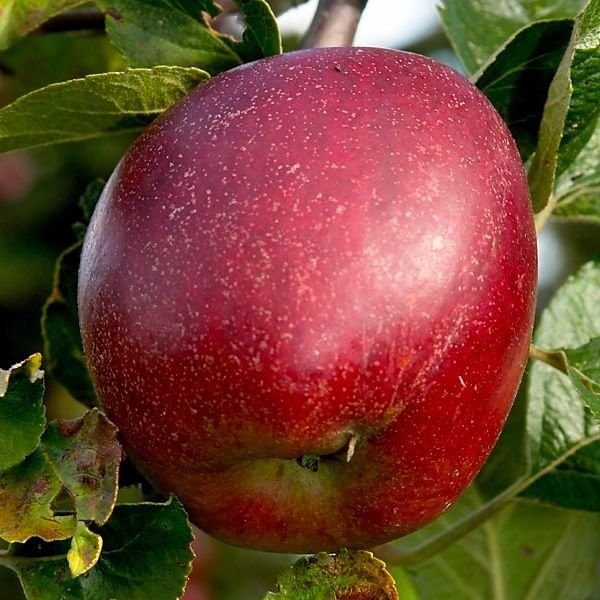
The Colapuis variety, also known as Nicolas Puy, Colapuits or Colapuy, is an ancient heritage variety from the North of France. Renowned for its exceptional hardiness and impact resistance, it is ideal for family orchards. However, it has problems with alternating production.
Characteristics of the fruit
The medium-sized fruit (60-80 mm) has an elongated and homogeneous shape. The epidermis is thick, with a dominant green-yellow colour, covered with a dark red to purple tint on more than 60% of the surface. The flesh is fragrant, crunchy, with a good balance between sugar and acidity. Colapuis is excellent for table-top, cooking, cider and juice.
Use of the fruit
The apple of the Colapuis apple tree is versatile, suitable for various uses: knife, cooking, cider and juice. It is harvested from the end of October to the beginning of November and keeps very well until April. The optimal ripeness for consumption is from December to January.
Tree Description
The Colapuis apple tree has medium vigour with dense, slender branches (type II-III fruiting). The foliage is of low density but of exceptional quality in untreated orchards.
Growing Characteristics
Adaptation to the rootstock: Suitable for all rootstocks.
Flowering: Median to mid-late.
Fertility: Good pollinator.
Disease Susceptibility: Very low, extremely insensitive to scab and powdery mildew.
Originally from the Crimea and brought back in the 19th century by a soldier named Nicolas Dupuis, Colapuis is very common in the high-stem orchards of Avesnois and Picardy thanks to its hardiness.
If you want to have more information on fruit trees, you can find all my advice in video on my YouTube channel
Trustindex vérifie que la source originale de l'avis est Google.
Tous les arbres que j’ai reçus et plantés ont bien grandi, et j’ai déjà des mini-pommes cette année ! Très satisfait de la qualité, je recommande vivement. Je repasse d’ailleurs commande cette année sans hésiter!!!
Publié sur
hubert grall
Trustindex vérifie que la source originale de l'avis est Google.
Pépiniériste très serviable et réactif,commande livrée rapidement en excellent état. une adresse à recommander.
Publié sur
Matthieu CARBONNE
Trustindex vérifie que la source originale de l'avis est Google.
Accueil de qualité et disponibilité, à des prix très raisonnables.
Merci pour tous les conseils.
Publié sur
Béatrice BRU
Trustindex vérifie que la source originale de l'avis est Google.
Vraiment super.
J'ai reçu de beaux arbres, rapidement et bien conditionnés à des prix très corrects.
Merci beaucoup pour votre engagement, à l'année prochaine pour de futures commandes.
Publié sur
Lyda Shun-keo
Trustindex vérifie que la source originale de l'avis est Google.
De très bon conseil, Vincent m'a aidé à choisir des variétés de fruitiers adaptés à la région et la terre de mon jardin.
Les scions sont d'excellente qualité et les prix très compétitifs.
Je recommande+++
Publié sur
Marie Pierre
Trustindex vérifie que la source originale de l'avis est Google.
Mes 4 arbres sont arrivés. Rien à dire sinon parfait de la commande à la livraison. Les petits arbres sont magnifiques. Pépinière à recommander.
Publié sur
Stéphane Sig
Trustindex vérifie que la source originale de l'avis est Google.
Super adresse,des fruitiers de qualité sont proposés à des prix très abordables.
Le patron,en plus de cela, offre un suivi très rapproché si besoin.
Adresse à recommander !!!
Publié sur
Marie de CAZALS
Trustindex vérifie que la source originale de l'avis est Google.
Des variétés anciennes, peu courantes dans les pépinières.
Des scions d'excellentes qualités et des conseils précieux.
Vous pouvez y aller les yeux fermés. En tout cas, pour ma part, je vous dis à l'année prochaine!
Publié sur
Geoffrey Lanchas
Trustindex vérifie que la source originale de l'avis est Google.
Très pro, à l'écoute, je recommande !
Merci Vincent.
🎉 Perfect!
Your email has been saved.
See you in late August / early September for pre-orders!