Description
Fishing Amsden
The Amsden peach tree is a historic American variety discovered by Mr. L.C. Amsden in Cartago, Missouri, around 1900. Sown by chance, this variety quickly established itself as one of the earliest peaches on the market, earning it the nickname “June peach”. Known for its fine, melt-in-the-mouth white flesh, Amsden combines precocity, productivity and disease resistance, making it a preferred choice for more than a century.
Characteristics of the Amsden peach tree
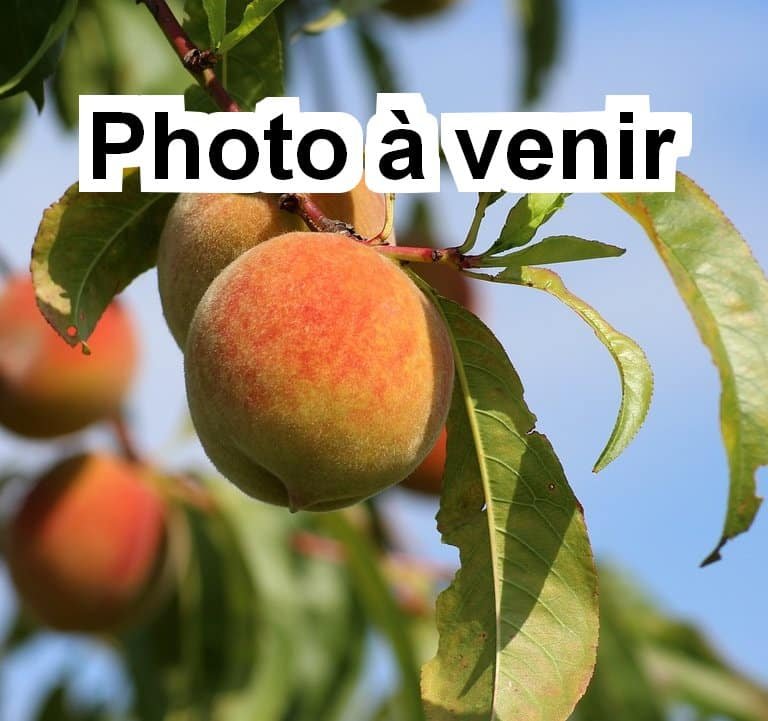
The fruits of the Amsden peach tree are of medium size, measuring about 7 cm in diameter. The velvety skin has a beautiful dark red color on a cream background, creating an attractive visual contrast. The white flesh, slightly pink near the stone, offers a fine and melting texture, juicy as can be, with a perfect balance between sweetness and light acidity.
This variety has remarkable agronomic characteristics:
- 🌸 Early flowering : March, abundant pink flowers
- 🍑 Very early ripening : end of June – beginning of July
- 🛡️ Good resistance to blister and monilia
- ❄️ Hardiness down to -15°C
- 🌳 Vigorous and very productive tree
- 📍 Semi-adherent core (Pavia type)
Cultivation and maintenance
The Amsden peach tree adapts to all types of well-drained, light soils rich in organic matter. It particularly fears stagnant humidity and soils that are too calcareous. Its natural vigour and hardiness allow it to be grown in many regions, although it is necessary to remain vigilant against late frosts due to its early flowering.
Planting and Exhibition
Choose a sunny exposure sheltered from cold winds. In regions with capricious springs, plant against a south-facing wall to benefit from the stored heat. Planting is done from October to April for bare-root plants, all year round for those in containers.
An organic amendment to the plantation, enriched with compost and crushed horn, will promote a good recovery. Watering should be copious at planting, then regular in the first year, especially in periods of summer drought.
Pruning and training
The Amsden peach tree requires annual pruning to maintain its productivity. This operation is carried out just before flowering (February-March):
- Remove the flowerless twigs by pruning them above 2-3 buds
- Shorten the branches that are not very flowering above a wood bud
- Remove dead wood and aerate the center of the tree
- Maintain a balanced structure with 3-5 scaffold branches
Pinching shoots in summer promotes the development of flower buds up to the base of the twigs, thus optimizing future production.
Pollination and associations
The Amsden peach tree is completely self-fertile, guaranteeing fruiting even when planted alone, provided that temperatures are above 8-10°C during flowering. This feature makes it an ideal choice for small gardens or isolated orchards.
To diversify your early harvests, combine Amsden with Burlat cherry , which also ripens in June. To extend the peach season, plant the Reine des Vergers peach tree or the Grosse Mignonne peach tree , which will produce until August.
Complete your orchard with the Bergeron apricot tree for apricots in July, creating a harmonious succession of summer fruits.
Harvesting and Use
The Amsden peach tree is harvested at the end of June, making it one of the first peach trees to offer its fruit. Peaches are ripe when they give way slightly under finger pressure and give off their characteristic fragrance. The picking must be delicate to preserve the quality of the fruit.
Culinary Uses
| 🍑 Fees |
Ideal as a table fruit for its precocity |
| 🥧 Pastries |
Pies, clafoutis, summer charlottes |
| 🍯 Canned goods |
Jams, compotes, fruit in syrup |
| 🍨 Frozen desserts |
Sorbets, ice creams, parfaits |
| 🥤 Drinks |
Fresh juices, vitamin smoothies |
The tart and sweet white flesh of the Amsden lends itself particularly well to light summer desserts. Its melting and juicy texture makes it a perfect fruit for fresh consumption, appreciated by children and adults alike.
Advantages of the variety
The Amsden peach tree has many advantages that explain its longevity in orchards:
- ✅ Exceptional earliness : first catches at the end of June
- ✅ High productivity : fast and consistent fruiting
- ✅ Disease resistance : good tolerance to blister and monilia
- ✅ Self-fertile : perfect for small spaces
- ✅ Hardiness : withstands -15°C in winter
- ✅ Taste quality : fine, melting and fragrant flesh
- ✅ Historical variety : more than 120 years of cultivation
- ✅ Adaptable : suitable for many regions
This century-old American variety remains a reference for lovers of early fishing. Its unique combination of earliness, productivity and resistance makes it a must-have in family orchards, offering the incomparable pleasure of tasting the first peaches of the year.
Our advice in video
Our other Peach Trees