10,00 €
🌸 Flowering period: Mid-July to late August
🍯 Honey flow: July – August (summer nectar gap)
🌰 Fruiting: Bead-like pods, September to October
❄️ Hardiness: USDA zones 4 to 8 — more cold-sensitive in its first three years
In stock
Plus d'informations
Paiement sécurisé par carte bancaire.

The Japanese pagoda tree (Styphnolobium japonicum, synonym Sophora japonica) is a large deciduous tree of the Fabaceae family, native to the dry regions of China and Korea, introduced into France in 1747 by the Jesuit father Pierre Le Chéron d’Incarville, and valued for its cream-white, nectar-rich flowering in July and August — at a time of year when nectar sources are scarce for bees.
We grow the Japanese pagoda tree under certified organic farming (AB / Ecocert) at Le Passage d’Agen, in the Lot-et-Garonne. It belongs to our range of useful trees, intended for beekeepers, forest gardens and agroforestry plantings.
| Criterion | Value | Detail |
|---|---|---|
| Botanical name | Styphnolobium japonicum (Schott, 1830) | Syn. Sophora japonica L., 1767 |
| Family | Fabaceae (Faboideae) | Sophoreae tribe |
| Common names | Pagoda tree, honey tree, weeping pagoda tree (cv. ‘Pendula’) | « Huai » (槐) in Chinese |
| Origin | China and Korea | Introduced to Japan, then to Europe |
| Introduction into France | 1747, Jardin du Roi (Paris) | Father d’Incarville → Bernard de Jussieu |
| Flowering | Mid-July to late August | Panicles 20 to 30 cm long |
| Pollination | Insect-pollinated, a single tree is enough | No pollinizer to plant alongside |
| Fruiting | Bead-like pods, 6 to 8 cm | September-October, seeds toxic |
| Nitrogen fixation | NO | No root nodules |
| Vigour | 20 to 25 m × 10 to 15 m | Fast growth for the first 15 years |
| Hardiness | USDA zones 4 to 8 | More sensitive in its first three years |
| Soil | Free-draining, deep, chalk tolerated | Dislikes waterlogging and strongly acid soils |
| Use | Nectar source, shade, avenue planting, dye | Hard, supple timber |
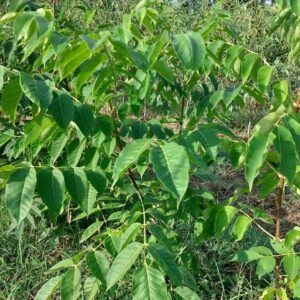
The Japanese pagoda tree forms a tree with a broad, rounded crown, its grey-brown trunk becoming vertically fissured with age. Its young shoots, khaki-green and thornless, stay green for about three years and become covered with elongated white lenticels: this is the surest way to tell it from black locust, whose outline and foliage it shares.
The foliage of the Japanese pagoda tree is compound and odd-pinnate, 20 to 25 cm long, made up of 7 to 17 oval leaflets, dark green above and glaucous beneath. It turns an attractive yellow in October-November. The shade it casts stays light and dappled, which allows an understorey to be cultivated — an asset in forest-garden designs.
The history of the Japanese pagoda tree in France is precisely documented. In 1747, Father d’Incarville, a Jesuit missionary in Peking and a correspondent of the Jardin du Roi, sent Bernard de Jussieu seeds labelled Arbor sinarum incognita. The sowing succeeded; the tree did not flower until the summer of 1779, a first in Europe. That specimen is still alive at the Jardin des Plantes in Paris.
The value of the Japanese pagoda tree to beekeepers lies less in the abundance of its nectar than in its timing. Flowering opens from mid-July, once acacia, chestnut and lime are over and colonies are entering the summer dearth. Bees work the flowers right down to the ground, once these have fallen.
To build a continuous nectar calendar, the Japanese pagoda tree pairs logically with the male goat willow, which opens the season as early as February-March, with chestnut trees in June, then with the bee-bee tree (Tetradium daniellii), which takes over in August-September. Our full selection is gathered in the bee-friendly trees category.
A misconception circulates widely in French-language permaculture content: because it belongs to the Fabaceae, the Japanese pagoda tree is said to be a fertility tree. That is not the case. The genus Styphnolobium was separated from the genus Sophora by the botanist H. W. Schott in 1830 on precisely this criterion: its roots form no nodules and host no rhizobia.
Agronomic work confirms this: in comparative trials, the Japanese pagoda tree behaves as a non-fixing species, its growth being stimulated by a nitrogen input, unlike that of black locust. In practice, if you are looking for a tree to enrich the soil of a forest garden, choose black locust or alder instead. The Japanese pagoda tree is chosen for its nectar, its light shade and its tolerance of drought.
The Japanese pagoda tree requires full sun: it is summer heat that triggers and sustains its flowering. It accepts almost any free-draining soil, including dry, compacted, stony and chalky ground, and dislikes only two situations: soils waterlogged in winter, and distinctly acid soils. It tolerates urban pollution but copes poorly with salt spray.
The Japanese pagoda tree needs no formative pruning; it builds its own habit. Limit yourself to removing dead wood at the end of winter, outside frost periods. The wood becomes brittle with age: avoid very windy sites and keep an eye on included-bark forks on mature specimens. Hard pruning compromises that year’s flowering.
The Japanese pagoda tree is considered little affected by disease. The problems reported concern mainly weakened or wounded specimens: cankers and shoot dieback (Nectria, Cytospora), Verticillium wilt, occasional powdery mildew and rust, and leafhoppers on young shoots. Prevention comes down to three things: careful drainage, no bark wounds, and no mulch in contact with the trunk.
This is the decisive question before buying a Japanese pagoda tree, and the one handled worst. A seed-grown specimen will not flower for a decade; in our climates, observations commonly range from 15 to 30 years, the historic tree at the Jardin des Plantes having waited 32 years. North American arboricultural references give a minimum of about 10 years for the species.
Selected cultivars shorten that wait appreciably: ‘Regent’ is described as flowering from 6 to 8 years. The logic of grafting applies here as for any tree: a scion taken from a specimen that is already mature and flowering carries physiologically mature tissue, which shortens the juvenile phase compared with a seedling. Tell us your aim — beekeeping or ornamental — when ordering: the method of propagation does not have the same consequences.
In China, the flower buds of the Japanese pagoda tree (« huai mi ») are harvested and eaten cooked; they also yield a yellow dye, historically used to colour silk and offering papers. The wood, hard and supple, is valued for structural timber in its native range.
⚠️ Caution: the seeds and pods of the Japanese pagoda tree are toxic and contain lectins. Do not eat them, and bear this in mind if the tree is planted near a play area: the pods fall in quantity in autumn. No part of this tree should be used for food or medicinal purposes without professional supervision.
No, the Japanese pagoda tree is native to the dry regions of China and Korea. It was introduced to Japan, where it was planted near Buddhist temples — hence the name pagoda tree. Linnaeus described it in 1767 from a herbarium specimen supposedly of Japanese origin, permanently fixing a geographically inaccurate name.
A seed-grown Japanese pagoda tree rarely flowers before 10 years, and often takes 15 to 30 years in our climates: the tree at the Jardin des Plantes in Paris, planted in 1747, flowered in 1779. Selected cultivars such as ‘Regent’ are described as flowering from 6 to 8 years.
No. Although it belongs to the Fabaceae, the Japanese pagoda tree forms no root nodules and hosts no nitrogen-fixing bacteria. It was precisely this feature that led to its transfer to the genus Styphnolobium in 1830. It therefore brings no nitrogen fertility to a forest garden.
The seeds and pods of the Japanese pagoda tree are toxic and contain lectins; they must never be eaten. The pods fall in quantity in autumn, a point to consider before planting near a play area. The flowers are traditionally eaten cooked in China, but that use depends on a controlled preparation.
They are two distinct species, often confused. The Japanese pagoda tree (Styphnolobium japonicum) is a legume that flowers from mid-July to late August. The bee-bee tree (Tetradium daniellii) is a member of the Rutaceae, much smaller, and flowers in August-September. Both are nectar sources and complement each other in an apiary.
Yes — once well established, the Japanese pagoda tree copes remarkably well with drought and heat, including on chalky, dry or compacted soil. That tolerance is only acquired after two or three seasons: follow-up watering remains necessary through the first two summers after planting.
Our advice on video
Ils parlent de nous
 Publié sur Google
 Theo Bernede
Trustindex vérifie que la source originale de l'avis est Google.
Tous les arbres que j’ai reçus et plantés ont bien grandi, et j’ai déjà des mini-pommes cette année ! Très satisfait de la qualité, je recommande vivement. Je repasse d’ailleurs commande cette année sans hésiter!!!Publié sur Google hubert grallPépiniériste très serviable et réactif,commande livrée rapidement en excellent état. une adresse à recommander.Publié sur Google
 Matthieu CARBONNEAccueil de qualité et disponibilité, à des prix très raisonnables. Merci pour tous les conseils.Publié sur Google
 Béatrice BRUVraiment super. J'ai reçu de beaux arbres, rapidement et bien conditionnés à des prix très corrects. Merci beaucoup pour votre engagement, à l'année prochaine pour de futures commandes.Publié sur Google
 Lyda Shun-keoDe très bon conseil, Vincent m'a aidé à choisir des variétés de fruitiers adaptés à la région et la terre de mon jardin. Les scions sont d'excellente qualité et les prix très compétitifs. Je recommande+++Publié sur Google
 Marie PierreMes 4 arbres sont arrivés. Rien à dire sinon parfait de la commande à la livraison. Les petits arbres sont magnifiques. Pépinière à recommander.Publié sur Google
 Stéphane SigSuper adresse,des fruitiers de qualité sont proposés à des prix très abordables. Le patron,en plus de cela, offre un suivi très rapproché si besoin. Adresse à recommander !!!Publié sur Google
 Marie de CAZALSDes variétés anciennes, peu courantes dans les pépinières. Des scions d'excellentes qualités et des conseils précieux. Vous pouvez y aller les yeux fermés. En tout cas, pour ma part, je vous dis à l'année prochaine!Publié sur Google
 Geoffrey LanchasTrès pro, à l'écoute, je recommande ! Merci Vincent.
🎉 Perfect!
Your email has been saved.
See you in late August / early September for pre-orders!
Thanks! 🌱