Description
Pear Williams Red
The Red Williams Pear is a spectacular natural mutation of the famous Williams pear, discovered in 1938 in Yakima, Washington. This exceptional variety, also known as Max Red Bartlett or Homored® Infel® 2667, retains all the remarkable taste qualities of its parent variety while offering a unique aesthetic.
The Georges Delbard nurseries were the first to market this innovation in the 1960s, thus marking the history of fruit growing. This summer pear with its bright red colour represents a real aesthetic revolution in the world of pears.
Characteristics of the fruit
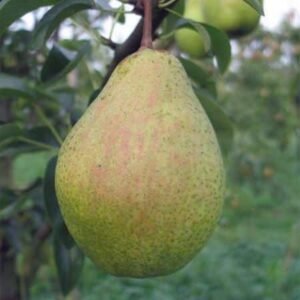
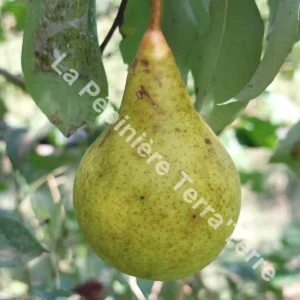
Williams Red pears are distinguished by their deep, bright red colour, dotted with characteristic white dots. Their epidermis changes from vinous red to orange-red when fully ripe, offering a striking visual spectacle in the orchard.
The yellow flesh is firmer than the classic Williams, which gives this variety a better shelf life. It nevertheless retains the melting, fine and juicy texture that the Williams family is known for, with this remarkably sweet and very fragrant taste with intense floral and fruity notes.
| Feature |
Description |
Period |
| 🍐 Shape |
Classic
Piriform |
– |
| 🎨 Color |
Deep red, white |
dots
– |
| 🌸 Flowering |
Early, white |
flowers
Early April |
| 🍐 Harvesting |
Early |
summer pear
Late August – early September |
| 📦 Conservation |
Excellent in the cool |
3 months in the fridge |
Exceptional taste qualities
The Red Williams Pear Tree inherits the impeccable taste qualities of the classic Williams. Its fine flesh develops a remarkably sweet and very fragrant taste, with characteristic musky notes and a slight hint of acidity that perfectly balances the flavor.
🍐 Culinary versatility : This exceptional pear is perfect for all uses – chewable fruit, compotes, pears in syrup, pastries, and even for distillery. Its superior firmness allows it to withstand cooking without falling apart.
Recommended Uses
- Fresh tasting : Excellent table pear, particularly refreshing
- Baking : Ideal for pies, crumbles and sophisticated desserts
- Preserves : Perfect for jams and pears in syrup
- Savoury dishes : Goes wonderfully with white meats
Cultivation and maintenance
The Williams Red Pear is a tree of medium vigour that develops a rather rounded habit, reaching 3 metres high and 1.5 metres wide at maturity. It grows quickly and produces early, being able to produce on one-year-old wood.
This variety has excellent hardiness (resistant to -20°C) and adapts to different types of temperate, oceanic or Mediterranean climates. It prefers a sunny exposure for optimal development.
Cultural requirements
- Exposure : Full sun, well-ventilated location
- Soil : Light, deep, well-drained soils with little limestone
- Watering : Regular in the first year, then moderate
- Altitude : Avoid altitudes above 700 m
Grafting Particularities
⚠️ Important incompatibility : The Red Williams Pear Tree does not have a very good affinity for quince. It is recommended to use it on Pyrodwarf or Kirchensaller rootstocks, or exceptionally on quince with an intermediate variety.
This technical peculiarity requires special attention when choosing the rootstock to optimize the vigour and longevity of the tree.
Pollination and associations
The Williams Red Pear Tree is partially self-fertile and can even produce fruit without pollination (parthenocarpy). However, its fruiting will always be optimized by the presence of other pear trees nearby.
This variety is compatible with most pear trees, with the notable exception of Louise Bonne d’Avranches. For optimal pollination, combine it with the Conference Pear Tree or the Doyenné Pear Tree of the Comice.
💡 Excellent pollinator : Williams Rouge is itself a very good pollinator for most other pear varieties.
Harvesting and storage
The harvest takes place at the end of August – beginning of September, when the pears have developed their beautiful characteristic red hue. A simple test: make a quarter turn with the tail – if the fruit comes off without forcing, it’s the ideal time.
📦 Remarkable preservation : Thanks to its firmer flesh than the classic Williams, this variety can be kept perfectly for up to 3 months in the refrigerator. Ripeness changes quickly after taking it out of the fridge – allow a few days of maturation at room temperature.
Conservation advice
To optimize conservation, harvest the fruit slightly before full maturity and then place it immediately in the refrigerator. This technique significantly extends the tasting period.
Disease resistance
The Red Williams Pear tree inherits the good disease resistance of its parent variety. It is generally not very sensitive to common pathologies, but can be susceptible to scab depending on climatic conditions.
Regular monitoring and appropriate preventive treatments help maintain a healthy and productive orchard.
Advantages and qualities
- 🎨 Unique aesthetics : Dramatic red color, highly decorative
- 🍐 Exceptional taste : Taste qualities identical to Williams
- ⏰ Earliness : Rapid fruiting, one-year production on wood
- 📦 Superior shelf life : 3 months in the refrigerator
- 🌡️ Excellent hardiness : Resistant to -20°C
- 🏛️ Historical innovation : First red pear marketed (1960)
- 🔄 Versatility : Self-fertile and good pollinator
Our advice in video
Our other pear trees