22,00 € – 28,00 €Price range: 22,00 € through 28,00 €
🌸 Flowering period: Late for a peach (end of March to April)
🍑 Harvest period: Late July to early August (≈ 16 days after Red Haven)
❄️ Storage: 3 to 5 days in the fridge — fragile skin
More information
Secure payment by credit card.

The ‘Suncrest’ peach is a modern yellow-fleshed variety from Fresno, California, raised by the American breeder J. H. Weinberger from a cross between ‘Alamar’ and ‘Gold Dust’, and released from 1959 onwards. It is known for the exceptional eating quality of its large freestone peaches, with yellow flesh veined with red, firm and intensely fragrant.
The Suncrest peach holds a place of its own in twentieth-century fruit history: long planted in California, the variety was gradually abandoned by the commercial trade, not for any fault in its flavour, but because the fruit stands up badly to handling. Suncrest is today listed in Slow Food’s Ark of Taste, the international catalogue of products threatened with extinction.
| Criterion | Value | Detail |
| Species | Prunus persica | Common peach, yellow flesh |
| Synonyms | Sun Crest, Sancrest | Spellings found abroad |
| Origin | Fresno, California (United States) | Raiser: J. H. Weinberger |
| Parentage | ‘Alamar’ × ‘Gold Dust’ | Released from 1959 |
| Protection | Unpatented variety | Free of breeders’ rights |
| Flowering | Late for a peach | End of March to April, according to the year |
| Pollination | Self-fertile | No pollinizer needed |
| Harvest | Late July to early August | ≈ 16 days after Red Haven |
| Stone type | Freestone | Comes cleanly away when ripe |
| Storage | 3 to 5 days chilled | Fragile skin, handle with care |
| Chilling requirement | ≈ 500 hours below 7 °C | Moderate, met in a mild winter |
| Vigour | Moderate to strong | 3 to 4 m grown freely |
| Hardiness | About −15 to −20 °C | Species figure, tree dormant |
| Rootstocks offered | GF677, Myrobolan, Rubira | Mature height about 3 to 4 m, depending on the rootstock |
The Suncrest peach makes a tree of moderate to strong vigour, upright at first and opening out with age, commonly reaching 3 to 4 m in height and 3 m across when grown freely. It comes into fruit quickly and crops regularly from one year to the next, with no marked biennial bearing reported by professional European nurseries.
Its pink blossom is described as late by Italian and American professional sources, with flower buds that take frost better than the average peach. This point deserves attention: several French sites describe Suncrest, on the contrary, as an early-flowering variety. We come back below to that contradiction, which is not a trivial one when the time comes to choose.
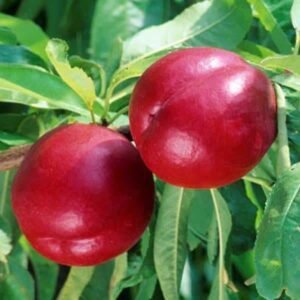
The Suncrest peach is a large fruit, spherical to slightly flattened, with a marked stalk cavity. The faintly downy skin has a yellow ground covered with an intense red wash over much of the fruit — without ever reaching the uniform red that the supermarket trade looks for.
The Suncrest peach is to be judged fully ripe on the tree. Picked too early it stays firm and gives only a fraction of its fragrance; picked at the right moment it is famously juicy — it is the fruit David Mas Masumoto describes as running down your chin.
The Suncrest peach tree is self-fertile: a tree on its own crops without any other variety nearby. That is the general case in Prunus persica, with a few exceptions such as J.H. Hale. The presence of other peach trees flowering at the same time, and the activity of honey bees and wild bees, nonetheless improve how regularly it sets.
To spread the harvest rather than to pollinate, the Suncrest peach pairs well with an early variety such as the Springcrest peach tree, ripening in early July, and with the Reine des Vergers peach tree, a late September variety. Three trees are then enough to cover a whole summer.
The Suncrest peach needs a position in full sun, sheltered from cold winds, and a deep, loose and above all well-drained soil. It dislikes standing moisture, which encourages root asphyxia and canker. On chalky soil the choice of rootstock becomes decisive: a peach seedling yellows quickly beyond a certain level of active lime.
The Suncrest peach is planted bare-root from November to March, outside frost periods and when the soil is not waterlogged. Allow 4 to 5 m between trees in a garden orchard. The graft union must stay above soil level. An organic mulch and consistent watering in the first year determine how well it establishes.
The peach fruits on the previous year’s wood: without pruning, cropping moves out to the tips of the scaffold branches and fruit size falls. On Suncrest, as on any peach, cut back the shoots that have borne each winter, remove dead wood and open up the centre. Thinning the fruit, 4 to 6 weeks after full bloom, is what makes the difference to final size.
The Suncrest peach is not a variety tolerant of peach leaf curl. Sources contradict one another on this precise point, but none places it among the varieties reputed to be little affected, and prudence is called for: treat preventively with Bordeaux mixture at leaf fall and again at bud swell, before the buds break. Also watch for brown rot on the fruit in a wet summer, and always gather up mummified fruit.
The Suncrest peach is above all a dessert peach: its intensely fragrant flesh and free stone make it a fruit for eating straight away. Its firmness also makes it excellent in cooking, where many very juicy peaches collapse.
Suncrest’s yellow flesh browns little when cut, an asset for dishes prepared in advance.
This is the story that sets the Suncrest peach apart from every other Californian variety of its generation. In the 1980s, David Mas Masumoto, a fruit grower at Del Rey in California, could no longer find a buyer for his Suncrest crop: the distributors wanted peaches that were very red, smooth and able to travel. Suncrest is downy, does not redden evenly and bruises at the slightest knock.
On the point of grubbing up the orchard his father had planted after being interned in an American camp during the Second World War, he published an opinion piece in the Los Angeles Times entitled Epitaph for a Peach. The public response pushed him to keep his trees; in 1995 he drew from it a book of the same name, which has become a classic of American agricultural writing. Suncrest then became the first Californian product listed in Slow Food’s Ark of Taste.
That story has a direct practical consequence for you. What excluded Suncrest from the wholesale trade — a fragile skin, incomplete colouring, down — matters not at all in a garden orchard, where the fruit goes from tree to plate in a few hours. 🍑 Suncrest is exactly the kind of variety a gardener can grow and a supermarket cannot sell.
This is the most poorly handled question about the Suncrest peach, and the one that matters most in a region with April frosts such as the Lot-et-Garonne. Three French catalogues give early flowering and advise against the variety where late frosts are severe. Italian and American professional nurseries say the opposite: late flowering, with flower buds resistant to frost.
The weight of evidence leans clearly towards late flowering on the peach scale, a position supported by the technical production catalogues. Two honest qualifications are needed all the same. First, “late” in a peach is still early in absolute terms: flowering comes before the leaves break and remains exposed to late-March frosts. Second, Suncrest’s moderate chilling requirement, of the order of 500 hours below 7 °C, is satisfied very early in our mild South-Western winters: the tree can therefore start into growth sooner here than in central California, where that same figure is judged moderate.
The practical conclusion: Suncrest is not the riskiest variety in the orchard, but neither is it an all-risks insurance against frost. In a frost-prone valley bottom, prefer a frankly late variety. On a slope and in an airy position, it has every place, alongside sure values such as the Red Haven peach tree, the international mid-season reference, or the Dixired peach tree, yellow-fleshed and ripening in early to mid-July.
Yes, the Suncrest peach tree is self-fertile and crops when planted alone. Like almost every variety of Prunus persica, it requires no pollinizer. Planting other peach trees flowering at a similar time does not increase fertilisation decisively, but it keeps pollinators active and above all spreads the picking period over several weeks.
Suncrest peaches are picked from late July to early August in the South-West, about sixteen days after Red Haven. Picking is spread over one to two weeks, in several passes. The fruit is ripe when the yellow ground turns orange and the flesh gives slightly under the thumb, near the stalk.
The Suncrest peach has yellow flesh that is very sweet, slightly sharp, extremely juicy and intensely fragrant. Its texture is firm and low in fibre, melting when fully ripe. It is precisely that eating quality which earned it a place in Slow Food’s Ark of Taste, the international catalogue of foods threatened with extinction.
The Suncrest peach tree is classed among the late-flowering peaches by professional catalogues, with flower buds relatively resistant to frost. That remains relative: any peach flowering, coming as it does before the leaves, is vulnerable to late-March frosts. In a frost-prone position, a temporary fleece secures the crop.
No, the Suncrest peach tree is not among the varieties recognised as tolerant of peach leaf curl. Sources diverge on its exact degree of susceptibility, which invites prudence. Plan two applications of Bordeaux mixture, at leaf fall and then at bud swell, before the buds break in spring.
Yes, provided you choose a low-vigour rootstock and a container at least 50 cm across, with careful drainage. Growing in a pot means consistent watering while the fruit swells and repotting every two to three years. In open ground, the Suncrest peach tree is nonetheless markedly more productive.
You will find our full range on the heirloom and modern peach trees grafted in the Lot-et-Garonne page.
Our advice on video
Our other peach trees
| Weight | 0,33 kg |
|---|---|
| Peach rootstock | GF677, adult size ≈ 4m, Myrobolan adult size ≈ 3.5m, Rubira, adult size ≈ 3m |
They talk about us
 Publié sur Google
 Theo Bernede
Trustindex vérifie que la source originale de l'avis est Google.
Tous les arbres que j’ai reçus et plantés ont bien grandi, et j’ai déjà des mini-pommes cette année ! Très satisfait de la qualité, je recommande vivement. Je repasse d’ailleurs commande cette année sans hésiter!!!Publié sur Google hubert grallPépiniériste très serviable et réactif,commande livrée rapidement en excellent état. une adresse à recommander.Publié sur Google
 Matthieu CARBONNEAccueil de qualité et disponibilité, à des prix très raisonnables. Merci pour tous les conseils.Publié sur Google
 Béatrice BRUVraiment super. J'ai reçu de beaux arbres, rapidement et bien conditionnés à des prix très corrects. Merci beaucoup pour votre engagement, à l'année prochaine pour de futures commandes.Publié sur Google
 Lyda Shun-keoDe très bon conseil, Vincent m'a aidé à choisir des variétés de fruitiers adaptés à la région et la terre de mon jardin. Les scions sont d'excellente qualité et les prix très compétitifs. Je recommande+++Publié sur Google
 Marie PierreMes 4 arbres sont arrivés. Rien à dire sinon parfait de la commande à la livraison. Les petits arbres sont magnifiques. Pépinière à recommander.Publié sur Google
 Stéphane SigSuper adresse,des fruitiers de qualité sont proposés à des prix très abordables. Le patron,en plus de cela, offre un suivi très rapproché si besoin. Adresse à recommander !!!Publié sur Google
 Marie de CAZALSDes variétés anciennes, peu courantes dans les pépinières. Des scions d'excellentes qualités et des conseils précieux. Vous pouvez y aller les yeux fermés. En tout cas, pour ma part, je vous dis à l'année prochaine!Publié sur Google
 Geoffrey LanchasTrès pro, à l'écoute, je recommande ! Merci Vincent.
🎉 Perfect!
Your email has been saved.
See you in late August / early September for pre-orders!
Thanks! 🌱