Description
Apple tree Yellow hare snout
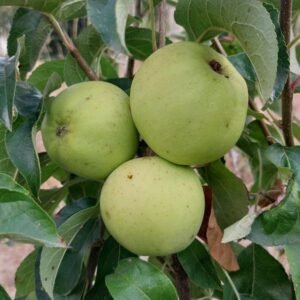
The Yellow Hare’s Muzzle Apple Tree is an old variety emblematic of the South-West of France, originating in the Landes and Gironde. This reinette-type apple is distinguished by its characteristic elongated and truncated conical shape, remarkably reminiscent of a hare’s snout. The fairly large fruits have a smooth skin entirely pale yellow, sometimes very slightly washed with orange-pink when sunstroked, with traces of cork on the peduncle.
Characteristics of the Yellow Hare’s Apple Snout
The tree has medium vigour with a semi-erect and open habit, reaching about 5 metres in height and 3 metres in width at maturity. The downy dark green foliage offers a beautiful ornamental appearance. The late and grouped flowering from the end of April to the beginning of May is a major asset for regions prone to spring frosts, offering excellent protection against late cold.
This hardy variety can withstand temperatures down to -25°C and has excellent resistance to diseases : it is not very sensitive to scab and behaves well against aphids. However, the tree can have a tendency to alternate, sometimes requiring thinning in years of high production.
Cultivation and maintenance
The yellow hare’s muzzle adapts to all types of deep and cool soils, tolerating even slightly calcareous soils, provided that excess water is avoided. A sunny exposure will promote optimal production. Fruit setting is relatively fast for an old variety.
As this variety is not self-fertile, the presence of pollinators is essential. Combine it with the Queen Apple of the Reinettes, the Golden Delicious Apple Tree or the Transparent Apple of Croncels to ensure effective cross-pollination.
Taste qualities and use
The white flesh of the Yellow Hare Mussel is dense, crisp and very juicy, offering a perfect balance between sugar and acidity. Its taste is very sweet with moderate acidity, embellished with a subtle fragrance reminiscent of melon. This unique combination makes it an apple of excellent taste quality, appreciated by connoisseurs.
Culinary Uses
- To eat: excellent table apple thanks to its crunchy and juicy texture
- In juice: Produces fragrant, balanced juices of high quality
- In compote: its dense flesh produces creamy compotes
- In pastry: ideal for pies and cakes thanks to its good resistance to baking
Storage and harvesting
The harvest is usually carried out in the first week of October. The fruits must be picked with care because they are sensitive to shocks. Once harvested, the Yellow Hare Museau apples benefit from a remarkable conservation, which can be kept until March in good conditions (cool and airy premises). This long shelf life makes it a great variety to enjoy fresh apples all winter long.
Table of key features
| Origin |
Landes and Gironde (33-40) |
| Maturity |
Late (October) |
| Caliber |
Fairly large, truncated conical |
| Color |
Solid pale yellow |
| Flesh |
White, dense, crunchy |
| Hardiness |
-25°C |
Advantages of this variety
- Original shape: unique decorative look in the shape of a hare’s snout
- Late flowering: natural protection against spring frosts
- Excellent storage: can be kept until March
- Disease resistance: not very susceptible to scab and aphids
- Taste qualities: perfect balance of sugar and acidity with melon scent
- Versatility: excellent raw and cooked
- Exceptional hardiness: withstands -25°C
The Yellow Hare’s Muzzle Apple Tree represents a precious fruit heritage of the South-West. Its characteristic shape, excellent taste qualities and outstanding shelf life make it a must-have variety for heirloom apple lovers and conservation gardens. Its late flowering and natural resistance to disease also make it a wise choice for a successful organic grow.
my YouTube channel