
10,00 € – 15,00 €Price range: 10,00 € through 15,00 €
🌸 Flowering period: Late (February to March)
🌰 Harvest period: Late August to mid-September
❄️ Storage: 8 to 12 months in shell, in a cool, dry place
Plus d'informations
Paiement sécurisé par carte bancaire.

The purple hazelnut tree (Corylus maxima ‘Purpurea’) is a dark red-leaved cultivar of the Betulaceae family, derived from the giant filbert — a species native to south-eastern Europe, the Balkans and Asia Minor — grown both for its winter ornamental value and for its large, reddish-brown hazelnuts.
We grow the purple hazelnut tree under certified organic farming (AB / Ecocert) in Le Passage d’Agen, in Lot-et-Garonne — France’s leading hazelnut-growing département. Find it alongside our other hazelnut tree varieties.
| Criterion | Value | Detail |
|---|---|---|
| Botanical name | Corylus maxima ‘Purpurea’ | Giant filbert, not C. avellana |
| Family | Betulaceae | Genus Corylus, approx. 17 species |
| Trade names | Purple hazel, red-leaved hazel | Often confused with ‘Fuscorubra’ |
| Species origin | South-eastern Europe, the Balkans, Asia Minor | Distinct range from C. avellana |
| Flowering | Late, February to March | Purple male catkins, 5 to 8 cm |
| Pollination | Self-incompatible — pollinator required | Wind-pollinated, not by bees |
| Harvest | Late August to mid-September | Husk 2× the length of the nut |
| Storage | 8 to 12 months in shell | Drying essential |
| Use | Eating fresh/dried, baking, fruiting hedge | White kernel, reddish-brown shell |
| Vigor | 4 to 6 m × 4 m, free-standing habit | Suckers freely |
| Hardiness | USDA zone 4 to 8 | Hardy throughout France |
| Soil | Moisture-retentive, well-drained, tolerates lime | Dislikes summer drought |
| Bearing age | 3 to 4 years after planting | Full production around 8 years |
This is the blind spot of the French market: two distinct plants are sold under the label “purple hazel”, and you will not get the same result depending on which one you’re supplied with.
The confusion is old and well documented: Loudon used the name C. avellana var. purpurea for what we now call C. maxima ‘Purpurea’, which led W. J. Bean to recommend the epithet ‘Fusco-rubra’ for the purple-leaved avellana hazel, described by Dippel in 1890 from a specimen observed by Göschke in 1887. Ask for the full botanical name when buying — the identifying feature in the orchard being husk length at harvest.
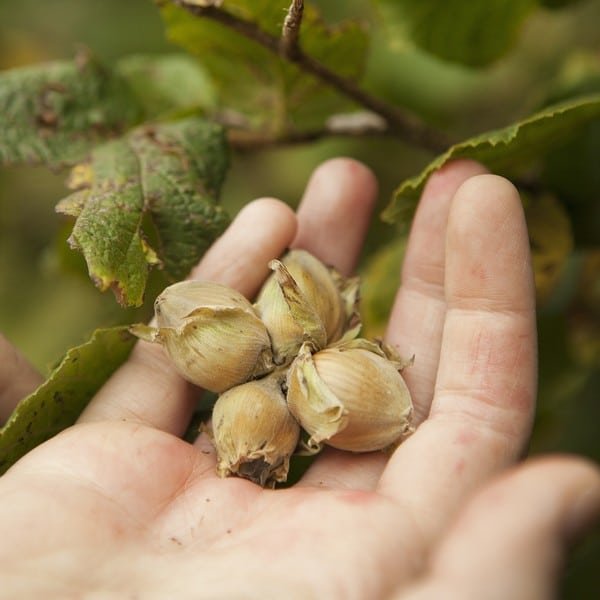
The nut of the purple hazelnut tree is large, with a reddish-brown shell and a white kernel covered in a tawny skin. The flavour is clean and buttery, comparable to good eating varieties; the purple colour is not passed on to the kernel. The fruit ripens in clusters of 2 to 4, enclosed in a fringed, purplish husk, twice as long as the nut — a signature trait of the giant filbert.
The purple hazelnut tree is harvested from late August to mid-September depending on the year. Collect nuts that have fallen to the ground rather than picking them green: a ripe hazelnut detaches from its husk on its own. Dry them for 15 days in the shade, spread in a thin layer before storing; prepared this way, they keep for 8 to 12 months in shell.
The purple hazelnut tree is not self-fertile. You will often read the opposite, sometimes with the advice to “plant two of the same variety” — that is a mistake that costs you your crop. The hazel is indeed monoecious — male catkins and red female flowers on the same plant — but Betulaceae rely on a system of sporophytic self-incompatibility: a cultivar rejects its own pollen, and two plants from the same clone are genetically identical. Two ‘Purpurea’ side by side will produce nothing.
Add to this dichogamy: male catkins and stigmas on the same plant are generally not receptive at the same time. As the purple hazelnut tree is classed as late-flowering, pair it with a cultivar whose catkins release pollen during the same period. We recommend the Merveille de Bollwiller hazelnut tree or the Cosford hazelnut tree, both in the late-flowering group. By contrast, Fertile de Coutard, an early-flowering variety, is a less reliable partner for the purple hazelnut tree.
🌬️ Hazel pollination is wind-borne: it happens through the wind, not bees. Plant partners within 15 m of each other, ideally taking prevailing winter winds into account.
Let’s be direct. Reference pomological sources consider ‘Purpurea’ to be primarily an ornamental cultivar, whose fruiting remains modest compared with orchard varieties. The purple hazelnut tree is the right choice if you want a decorative fruiting hedge, a striking specimen tree in winter, or extra genetic diversity in a food forest.
If nut production is your main goal, look instead at the Corabel hazelnut tree, an INRA introduction with the largest nuts available in France. Combining the two still makes sense: the ornamental one carries the hedge, the productive one carries the harvest.
The purple hazelnut tree needs moisture-retentive, deep, well-drained soil, including lime-rich ground. It is a woodland-edge shrub: it tolerates part shade, but full sun intensifies the purple colouring and fruiting. Its weak point is summer drought — its shallow, spreading roots make it vulnerable from July onward in soils that dry out.
Prune the purple hazelnut tree in late winter, after the catkins have fallen (February-March), never before: doing so would remove the pollen. Thin out the centre every 2 to 3 years to keep light coming in, remove dead wood and crossing branches. From the tenth year onward, carry out a gradual rejuvenation by cutting back half the canopy over two seasons.
Three pests concern the purple hazelnut tree in Lot-et-Garonne:
Hazelnuts from the purple hazelnut tree can be eaten fresh in September, while the kernel is still milky, or dried throughout winter. Roasted for 12 minutes at 160°C and then rubbed to remove the skin, they make a wonderfully fine praline and hazelnut paste. They are also used chopped over salads, ground into shortcrust pastry, or pressed into hazelnut oil.
No, the purple hazelnut tree is not self-fertile. Like all hazels, it relies on sporophytic self-incompatibility: it rejects its own pollen. Planting two plants of the same variety changes nothing, since they are the same clone. A second, different cultivar with overlapping flowering is essential to get any hazelnuts.
Since the purple hazelnut tree flowers late, choose a cultivar from the same group: Merveille de Bollwiller or Cosford both work well. Plant it within 15 metres, as pollination happens through the wind rather than insects. Early varieties such as Fertile de Coutard give a less reliable flowering overlap.
Yes, nuts from the purple hazelnut tree are fully edible and tasty. The shell is reddish-brown, but the kernel stays white with a classic, buttery flavour. The nuts are large. The only caveat is that this cultivar is primarily ornamental and its yield stays more modest than orchard varieties.
Harvest of the purple hazelnut tree runs from late August to mid-September depending on the year and the site. The right cue isn’t the date but detachment: a ripe hazelnut leaves its husk on its own and falls to the ground. Collect it, then dry the nuts for two weeks in the shade before storing.
These are two different plants sold under the same trade name of “purple hazel”. Corylus maxima ‘Purpurea’ keeps its purple foliage all summer and carries a husk twice as long as the nut. Corylus avellana ‘Fuscorubra’ turns bronze-green from June onward, has a short husk, and was selected for production.
Yes, the purple hazelnut tree sends up suckers from the base, like all hazels grown as multi-stemmed shrubs. Remove them at ground level each winter, before they spread out from the clump. This trait becomes an asset in a fruiting hedge, where suckering naturally thickens the base of the shrub.
Our tips in video
Our other hazelnut trees
| Weight | 0,33 kg |
|---|---|
| Hazelnut form | 1st choice (1m), Tuft |
Ils parlent de nous
 Publié sur Google
 Theo Bernede
Trustindex vérifie que la source originale de l'avis est Google.
Tous les arbres que j’ai reçus et plantés ont bien grandi, et j’ai déjà des mini-pommes cette année ! Très satisfait de la qualité, je recommande vivement. Je repasse d’ailleurs commande cette année sans hésiter!!!Publié sur Google hubert grallPépiniériste très serviable et réactif,commande livrée rapidement en excellent état. une adresse à recommander.Publié sur Google
 Matthieu CARBONNEAccueil de qualité et disponibilité, à des prix très raisonnables. Merci pour tous les conseils.Publié sur Google
 Béatrice BRUVraiment super. J'ai reçu de beaux arbres, rapidement et bien conditionnés à des prix très corrects. Merci beaucoup pour votre engagement, à l'année prochaine pour de futures commandes.Publié sur Google
 Lyda Shun-keoDe très bon conseil, Vincent m'a aidé à choisir des variétés de fruitiers adaptés à la région et la terre de mon jardin. Les scions sont d'excellente qualité et les prix très compétitifs. Je recommande+++Publié sur Google
 Marie PierreMes 4 arbres sont arrivés. Rien à dire sinon parfait de la commande à la livraison. Les petits arbres sont magnifiques. Pépinière à recommander.Publié sur Google
 Stéphane SigSuper adresse,des fruitiers de qualité sont proposés à des prix très abordables. Le patron,en plus de cela, offre un suivi très rapproché si besoin. Adresse à recommander !!!Publié sur Google
 Marie de CAZALSDes variétés anciennes, peu courantes dans les pépinières. Des scions d'excellentes qualités et des conseils précieux. Vous pouvez y aller les yeux fermés. En tout cas, pour ma part, je vous dis à l'année prochaine!Publié sur Google
 Geoffrey LanchasTrès pro, à l'écoute, je recommande ! Merci Vincent.
🎉 Perfect!
Your email has been saved.
See you in late August / early September for pre-orders!
Thanks! 🌱