
22,00 € – 28,00 €Price range: 22,00 € through 28,00 €
🌸 Flowering period: Mid to late March
🍑 Harvest period: Mid to late July
❄️ Storage: 4 to 6 days at room temperature
More information
Secure payment by credit card.

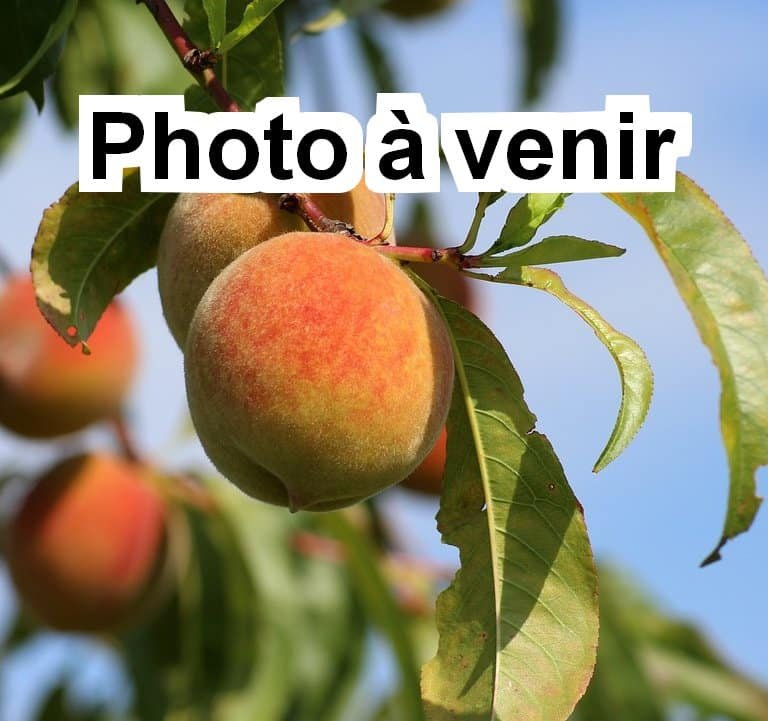
The ‘Charles Roux’ peach tree (Prunus persica) is a French white-fleshed variety listed on the official catalogue in 1961, known for a rare combination of tolerance to leaf curl, brown rot, shot hole and late frost, and for its large 165 to 180 g fruit harvested from mid to late July.
We graft the ‘Charles Roux’ peach tree at our nursery, under certified organic farming (AB / Ecocert), in Le Passage d’Agen (Lot-et-Garonne). It joins our collection of heritage peach trees.
| Criterion | Value | Detail |
|---|---|---|
| Species | Prunus persica (L.) Batsch | Rosaceae |
| Type | White-fleshed, freestone peach | A true peach, neither clingstone nor nectarine |
| Origin | France | Location and breeder not documented |
| Catalogue listing | 1961 | To be confirmed with the CTPS |
| Flowering | Mid to late March | Pink flowers, only lightly frost-sensitive |
| Pollination | Self-fertile | No pollinator required |
| Harvest | Mid to late July | Up to mid-August at altitude |
| Size | 165 to 180 g, about 7 cm | Large to very large |
| Flesh | White, flecked with red | Fine-grained, tender, very juicy |
| Storage | 4 to 6 days | White flesh, fragile |
| Tolerances | Leaf curl, brown rot, shot hole, late frost | Tolerance, not immunity |
| Habit and vigor | Semi-spreading, basitonic, 4 to 5 m | Good vigour, sturdy wood |
| Hardiness | About −15°C | Suited to mid-mountain areas |
| Rootstocks | See dedicated section | GF 305, GF 677, Missouri in use |
The ‘Charles Roux’ peach tree holds a special place among conservation varieties: its reputation does not rest on one outstanding flavour trait, but on a combination of agronomic qualities rarely found together on the same peach tree. It is at once only lightly susceptible to leaf curl, brown rot and shot hole, while also largely escaping late frosts — four constraints which, taken together, account for most peach-tree failures in the family orchard.
These traits are not drawn from a sales catalogue: they appear in the Monograph of the main peach varieties by H. Cavaillet and J. Souty (INRA) and in Les fruits retrouvés by E. Leterme and J.-M. Lespinasse, the two French reference works on the subject. This is what sets ‘Charles Roux’ apart from many so-called “resistant” varieties whose reputation rests on a single copied listing.
One point worth stating for honesty’s sake: the ‘Charles Roux’ peach tree was listed on the official catalogue in 1961. It can therefore be called an old variety in the sense of the family orchard — it has sixty years of track record — without making it a 19th-century variety. Its precise origin, breeder and location are not documented in any accessible pomological source, and we do not repeat origin stories circulating online without a verifiable reference.
The ‘Charles Roux’ peach is a large to very large fruit, 165 to 180 g, about 7 cm in diameter. Its shape is rounded, with a characteristic asymmetry — one cheek more developed than the other —, a well-marked suture and a deep stalk cavity. These are the details, noted in pomological descriptions, that allow the variety to be identified with certainty.
The skin, only lightly fuzzy, is dark red, marbled over a yellow-green ground. The flesh of ‘Charles Roux’ is white, flecked and veined with red, particularly around the stone; it is fine-grained, tender and melting in texture, and very juicy. The flavour is distinctly sweet, lightly tangy, and well scented.
🍑 The stone is free: it separates cleanly from the flesh. ‘Charles Roux’ is therefore a true peach, to be distinguished from a clingstone or a nectarine. This point matters for processing: stoning 15 kg of freestone versus clingstone peaches is not the same afternoon’s work.
The ‘Charles Roux’ peach tree is self-fertile, like almost all Prunus persica. A lone tree produces fruit with no pollinator: there is no variety compatibility to check before planting.
Planting other peach trees alongside it is still useful for spreading out the harvest. As ‘Charles Roux’ holds the mid-to-late-July slot, the Amsden peach tree opens the season much earlier, while the Reine des Vergers peach tree extends it to late August. Both of these varieties share ‘Charles Roux”s good tolerance to leaf curl, making it possible to build a whole orchard grown without heavy spraying.
This is the technical point nobody explains, and yet it is the only one that decides the tree’s productive lifespan. The ‘Charles Roux’ peach tree shows a basitonic tendency and a rather low, semi-spreading habit: its vigour expresses itself mainly at the base of the branches, rather than at their tips.
The practical consequence: left alone, ‘Charles Roux’ thins out at the top. The topmost shoots run out of steam, fruiting drops lower, and the tree ends up producing at knee height while the upper framework empties out. The fix is simple but must be applied consistently:
‘Charles Roux”s wood is sturdy, which limits breakage, but this does not remove the need for thinning in June: one fruit every 15 to 20 cm, or fruit size drops and the tree falls into biennial bearing.
The ‘Charles Roux’ peach tree needs full sun and free-draining soil that is never wet — this is the non-negotiable condition. It tolerates light soils and performs decently in lime-rich ground given a suitable rootstock. Avoid low-lying plots, compacted clay soils and any winter waterlogging.
See the section on basitonicity above, which drives the whole pruning strategy. Calendar reminder: formative and renewal pruning in late winter before bud break, then light summer pruning after harvest to open up the centre. The peach tree fruits on the previous year’s wood: every branch that has fruited must be replaced.
The ‘Charles Roux’ peach tree shows a four-way tolerance profile, documented in pomology:
⚠️ Tolerance does not mean immunity. A prolonged cold, wet spring can still mark the foliage: in organic growing, one application of Bordeaux mixture at leaf fall and a second at bud swell secure the season. One catalogue also notes susceptibility to rust (Tranzschelia), worth watching in late summer. Plum pox virus (sharka) remains incurable and notifiable, regardless of variety.
The ‘Charles Roux’ peach is best enjoyed fresh, at full ripeness. Its size and free stone also make it an excellent peach for processing: jam, compote, syrup preserves, tarts and clafoutis. It also pairs well with white meats and duck breast. For canning, pick it one or two days before eating ripeness so it holds up to cooking; its white flesh browns quickly in air, so squeeze lemon juice over it as soon as it’s cut.
If you’re after a flavour contrast in the same period, Roussanne de Juillet, with its tangy yellow flesh, pairs usefully against the sweetness of ‘Charles Roux’. To stay with a leaf-curl-tolerant white peach, the Grosse Mignonne peach tree is its historic counterpart.
The ‘Charles Roux’ peach tree is only lightly susceptible to leaf curl, as well as to brown rot and shot hole. This profile is documented in the INRA monograph on peach varieties, not just in sales catalogues. This is nonetheless a tolerance and not an immunity: two preventive applications of Bordeaux mixture are still recommended in organic growing.
Yes, the ‘Charles Roux’ peach tree is self-fertile. Its flowers are self-pollinating and a tree planted alone fruits normally, without a pollinator. Planting other peach trees does not significantly change fruit set, but it does spread the harvest over the summer by combining an early and a late variety.
Harvest of ‘Charles Roux’ runs from mid to late July in the South-West lowlands, and up to mid-August at altitude. Pick when the green background of the skin has turned to creamy yellow and the fruit detaches with a simple twist. Expect three picking passes over about ten days.
The ‘Charles Roux’ peach tree reaches 4 to 5 metres in height for about 4 metres of spread, with a rather low, semi-spreading habit. Its vigour is good and its wood sturdy. Allow 4 to 5 metres between two trees. Final height also depends on the rootstock: GF 677 gives a noticeably more vigorous tree than Missouri.
The ‘Charles Roux’ peach tree tends to be basitonic: its vigour expresses itself at the base of the branches, so the top of the framework thins out. Prune the top more severely than the base, cut back the extensions of the main branches every year, and remove water shoots at the base. Prune in late winter, before bud break.
Yes, the ‘Charles Roux’ peach tree is one of the recommended varieties for mountain gardens and cold slopes. It withstands about −15°C and its flowering is only lightly exposed to late frosts, which secures the harvest where other peach trees lose their blossom. Ripening is simply pushed back two to three weeks.
Our tips in video
Our other peach trees
| Weight | 0,33 kg |
|---|---|
| Peach rootstock | GF677, adult size ≈ 4m, Myrobolan adult size ≈ 3.5m, Rubira, adult size ≈ 3m |
They talk about us
 Publié sur Google
 Theo Bernede
Trustindex vérifie que la source originale de l'avis est Google.
Tous les arbres que j’ai reçus et plantés ont bien grandi, et j’ai déjà des mini-pommes cette année ! Très satisfait de la qualité, je recommande vivement. Je repasse d’ailleurs commande cette année sans hésiter!!!Publié sur Google hubert grallPépiniériste très serviable et réactif,commande livrée rapidement en excellent état. une adresse à recommander.Publié sur Google
 Matthieu CARBONNEAccueil de qualité et disponibilité, à des prix très raisonnables. Merci pour tous les conseils.Publié sur Google
 Béatrice BRUVraiment super. J'ai reçu de beaux arbres, rapidement et bien conditionnés à des prix très corrects. Merci beaucoup pour votre engagement, à l'année prochaine pour de futures commandes.Publié sur Google
 Lyda Shun-keoDe très bon conseil, Vincent m'a aidé à choisir des variétés de fruitiers adaptés à la région et la terre de mon jardin. Les scions sont d'excellente qualité et les prix très compétitifs. Je recommande+++Publié sur Google
 Marie PierreMes 4 arbres sont arrivés. Rien à dire sinon parfait de la commande à la livraison. Les petits arbres sont magnifiques. Pépinière à recommander.Publié sur Google
 Stéphane SigSuper adresse,des fruitiers de qualité sont proposés à des prix très abordables. Le patron,en plus de cela, offre un suivi très rapproché si besoin. Adresse à recommander !!!Publié sur Google
 Marie de CAZALSDes variétés anciennes, peu courantes dans les pépinières. Des scions d'excellentes qualités et des conseils précieux. Vous pouvez y aller les yeux fermés. En tout cas, pour ma part, je vous dis à l'année prochaine!Publié sur Google
 Geoffrey LanchasTrès pro, à l'écoute, je recommande ! Merci Vincent.
🎉 Perfect!
Your email has been saved.
See you in late August / early September for pre-orders!
Thanks! 🌱