Description
Dixired peach tree
The Dixired peach tree (Prunus persica ‘Dixired’) is a modern variety of American origin, named and introduced in 1945 by the USDA federal station at Fort Valley, Georgia, from a self-pollinated seedling of the variety ‘Halehaven’, known for its earliness and its productivity. Dixired was for many years the most widely planted early peach in the United States. We graft it organically in our Lot-et-Garonne nursery, where it opens the season for yellow-fleshed peaches.
Dixired at a glance
| Criterion |
Value |
Detail |
| Species |
Prunus persica (L.) Batsch |
Peach, Rosaceae family |
| Origin |
Fort Valley, Georgia, United States |
USDA federal station |
| Year introduced |
1945 |
Named and released by the USDA |
| Parentage |
Self-pollinated seedling of ‘Halehaven’ |
Halehaven = J.H. Hale × South Haven |
| Flowering |
Early, mid-March to early April |
Pink flowers, exposed to frost |
| Pollination |
Self-fertile |
One tree is enough |
| Harvest |
Early to mid-July |
≈ 6 weeks before Elberta |
| Fruit type |
Clingstone — the stone adheres to the flesh |
Yellow flesh, firm, fine-grained |
| Storage |
4 to 6 days in the fridge |
Good keeping for an early variety |
| Use |
Fresh, syrup, baking, jam |
The stone is removed with a spoon |
| Vigour |
Strong, spreading habit |
Comes into fruit quickly |
| Chilling requirement |
High, ≈ 900 hours |
A point to watch in a mild winter |
| Rootstocks offered |
GF677, Myrobolan, Rubira |
Mature height about 3 to 4 m, depending on the rootstock |
About the Dixired peach tree
Dixired belongs to the wave of American selections that overturned the Western peach orchard in the mid-20th century. The USDA station at Fort Valley, in the heart of the Georgia peach-growing region, was looking for early, colourful and firm varieties for shipping. Dixired, chosen from among self-pollinated seedlings of ‘Halehaven’, was named and introduced in 1945 and quickly became the most widely planted early peach in the United States.
Dixired’s genealogy deserves unfolding, because it sheds light on its behaviour. Its parent ‘Halehaven’ was raised in 1932 by Stanley Johnston at the South Haven experimental station in Michigan, by crossing ‘J.H. Hale’ — itself a descendant of Elberta — with ‘South Haven’. Yet it is the same ‘Halehaven’ which, crossed this time with ‘Kalhaven’, gave the famous Red Haven peach tree in 1940. Dixired and Red Haven are therefore half-siblings, which explains the likeness of their flesh and the small gap between their ripening dates.
The Dixired peach tree is vigorous, with a spreading habit, comes into fruit quickly and crops regularly and abundantly. That generosity is also its main agronomic trap: left alone, Dixired systematically overcrops.
Fruit characteristics
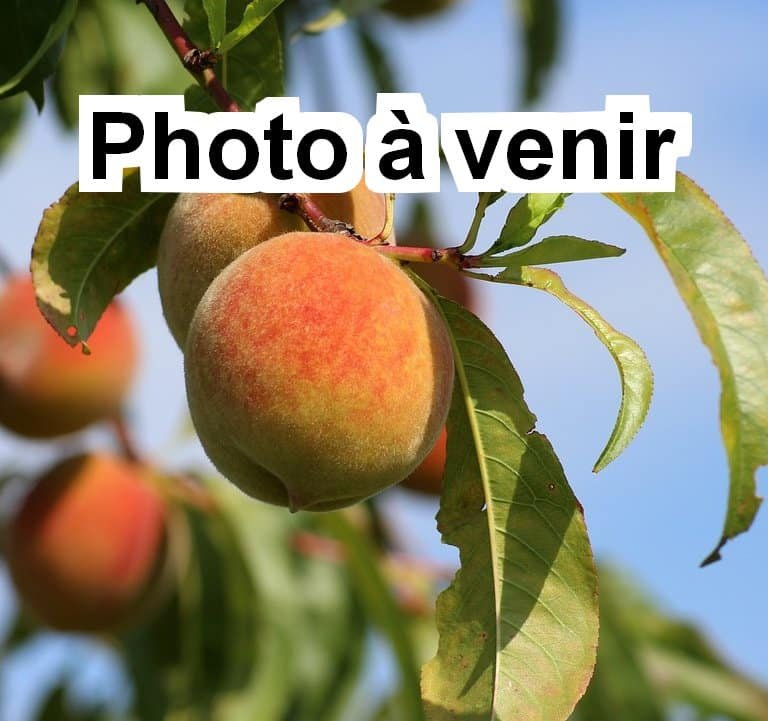
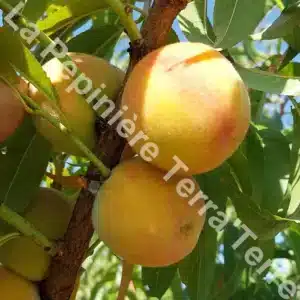
The Dixired peach is rounded, sometimes slightly pointed at the tip, with downy skin of bright red streaked over a yellow ground — a very covering colour that earned it its name. The flesh is yellow, fine-grained, firm and fairly juicy, with a sweet, slightly sharp flavour.
- Type: clingstone — the flesh clings firmly to the stone
- Size: medium; often under 5 cm without severe thinning
- Keeping: firm flesh that stands up well to handling, rare in an early variety
- Ripening: spread over two to three weeks, several pickings needed
This clingstone trait is the point that seller listings generally pass over in silence, although it determines how the fruit is used. A Dixired peach does not split cleanly into two halves like a freestone peach: the flesh stays attached to the stone and is lifted off with a spoon or a knife. That is precisely why Dixired excels in syrup, compote and jam, uses where firm flesh is an asset and where the stone has to be removed in the kitchen anyway.
Pollinating the Dixired peach tree
The Dixired peach tree is self-fertile: a single tree crops without a pollinizer, as does almost every variety of Prunus persica. Wild pollinators and honey bees remain decisive for fruit set, and a temperature above 8-10 °C during flowering is needed for fertilisation.
Dixired’s real constraint is not pollination but its flowering calendar. Flowering from mid-March to early April, Dixired is exposed to spring frosts in cold situations. If your plot is frost-prone, pair it with the Lot-et-Garonne Sanguine peach tree, whose end-of-March flowering is later, to secure a crop whatever the year.
Growing and care
Soil and position
Dixired needs full sun and a light, deep, well-drained soil. The peach above all fears root asphyxia: avoid compacted clays, damp valley bottoms and areas with a high water table. A south-facing position, sheltered from cold winds, limits the risk of frost on the blossom.
Planting
Plant Dixired bare-root from late November to early March, outside frost periods. Allow 4 to 5 m between trees, given its spreading habit. The graft union stays 10 cm above soil level. Water generously at planting, then mulch, without letting the mulch touch the trunk directly.
Pruning and thinning
Train Dixired as an open vase with 3 or 4 scaffold branches, pruning at the end of each winter: the peach fruits on the previous year’s wood, and annual pruning is essential to renew that wood. But with Dixired, the decisive operation is thinning. American references are firm: without severe thinning, the fruit stays small and often does not reach 5 cm in diameter. Thin therefore soon after fruit set, keeping only one fruit every 15 to 20 cm of shoot.
Diseases and resistance
Dixired is not a tolerant variety. It is reported as susceptible to peach leaf curl (Taphrina deformans) by specialist nurseries, which, under organic management and in our damp spring climate, is the main job on the calendar. The other points to watch are those of the species: brown rot on fruit in a stormy summer, powdery mildew on young shoots, and green aphids at bud break.
- Leaf curl: copper treatments at leaf fall and at bud swell
- Brown rot: thin, keep the framework airy, remove mummified fruit
- Prevention: never wet the foliage when watering
Dixired’s chilling requirement: the information missing everywhere
Seller listings generally recommend reserving Dixired for mild-climate regions, on the grounds that its early flowering fears frost. That reasoning is incomplete, and potentially misleading. American data in fact give Dixired a high winter chilling requirement, of the order of 900 hours below 7 °C — on a par with its parent Halehaven.
A consequence rarely written down: in a winter that is too mild, Dixired can show prolonged dormancy, with an uneven, staggered bud break, disorganised flowering and disappointing fruit set. American stations in fact recommended pairing it with a low-chill variety to offset this fault. Dixired is therefore not a mild-climate variety: it is a variety that wants a real winter followed by a hot summer.
🌡️ In the Lot-et-Garonne, this deserves some thought. Our winters still accumulate enough cold in most years, but the trend is downward. Dixired remains plantable here, provided you site it outside frost pockets and are not surprised by an irregular year after an exceptionally mild winter. For a varied orchard, stagger it with the MayFlower peach tree, another clingstone but markedly earlier, the Springcrest peach tree for the end of June, and the Reine des Vergers peach tree to extend the season into September.
Frequently asked questions about the Dixired peach tree
When should Dixired peaches be picked?
Dixired peaches are picked from early to mid-July in the South-West, about ten to fourteen days before Red Haven, the variety that serves as the calendar reference among peaches. Dixired ripens over two to three weeks, which calls for several pickings. The fruit is ripe when it gives slightly under finger pressure.
Is the Dixired peach tree self-fertile?
Yes, the Dixired peach tree is self-fertile: a single tree is enough to crop, without a pollinizer. That is the case for almost every peach variety. Bees nonetheless improve fruit set, and a temperature above 8-10 °C during flowering remains necessary for fertilisation to take place properly.
Is the Dixired peach a freestone?
No, the Dixired peach is a clingstone: its flesh adheres firmly to the stone and does not come away in halves. This trait, never mentioned by sellers, points its use towards syrup, compote and jam, where the stone is removed in the kitchen. Fresh, Dixired is eaten out of hand or cut with a knife.
What is the difference between Dixired and Red Haven?
Dixired and Red Haven are half-siblings, both descended from the variety ‘Halehaven’. Dixired ripens about ten days earlier and gives a more modest fruit with an adherent stone. Red Haven, later, produces a larger freestone peach. The two complement each other well in a family orchard.
Is the Dixired peach tree resistant to leaf curl?
No, Dixired is reported as susceptible to peach leaf curl by specialist nurseries. No yellow-fleshed peach variety is truly resistant to Taphrina deformans. Under organic management, plan copper treatments at leaf fall and then at bud swell, and an airy framework through annual pruning.
What we see in the nursery (Lot-et-Garonne)
Our advice on video
Our other peach trees