Description
Belle des Croix Rouges Peach Tree
The ‘Belle des Croix Rouges’ peach tree (Prunus persica) is an old French variety with white flesh, kept in heritage collections for its tolerance to peach leaf curl, with medium to large fruit ripening from late July to early August.
We graft the ‘Belle des Croix Rouges’ peach tree at our nursery, under certified organic farming (AB / Ecocert), in Le Passage d’Agen (Lot-et-Garonne). It joins our collection of heritage peach trees.
Belle des Croix Rouges identity card
| Criterion |
Value |
Detail |
| Species |
Prunus persica (L.) Batsch |
Rosaceae |
| Type |
White-fleshed peach |
Fuzzy skin |
| Origin |
France (not precisely documented) |
See dedicated section |
| Pollination |
Self-fertile |
No pollinator required |
| Harvest |
Late July to early August |
Mid-September at altitude |
| Size |
Medium to large |
Well coloured red |
| Flavour |
Sweet, juicy, fragrant |
Published reviews vary |
| Storage |
3 to 5 days |
White flesh fragile in transport |
| Leaf curl (Taphrina deformans) |
High tolerance |
Tolerance, not immunity |
| Use |
Fresh, jam, preserving jars |
Good suitability for processing |
| Adaptation |
Lowland and altitude |
Suited to organic growing |
| Rootstocks |
See dedicated section |
Seedling favoured by some nurseries |
Introducing Belle des Croix Rouges
The ‘Belle des Croix Rouges’ peach tree belongs to that handful of old varieties that heritage collections and organic nurseries have kept, not for an outstanding flavour, but for a precise agronomic reason: it stands up to leaf curl. It appears on this basis in the reference list of tolerant peach varieties, alongside Amsden, Grosse Mignonne, Charles Roux and Reine des Vergers.
This is a positioning worth stating plainly. The ‘Belle des Croix Rouges’ peach tree is a variety for the family orchard and the conservation orchard, made to produce reliably with minimal intervention, in a system where spraying is largely avoided. It never had a commercial career and does not aim to compete with market peaches.
What we know — and don’t know — about the origin of Belle des Croix Rouges
Let’s be transparent: the origin of the ‘Belle des Croix Rouges’ peach tree is not documented in any accessible pomological source. No breeder, no breeding date, no place of origin. The name evokes a place name — a hamlet called “les Croix Rouges” — but no document allows us to link it to a specific location, and we will not offer an unverifiable guess.
What can be said is that ‘Belle des Croix Rouges’ is an old French variety, included in heritage lists of disease-tolerant varieties and distributed by nurseries specialising in old varieties in France and French-speaking Switzerland. If you hold a pomological source documenting its origin, write to us: we will update this page and credit you.
Fruit characteristics
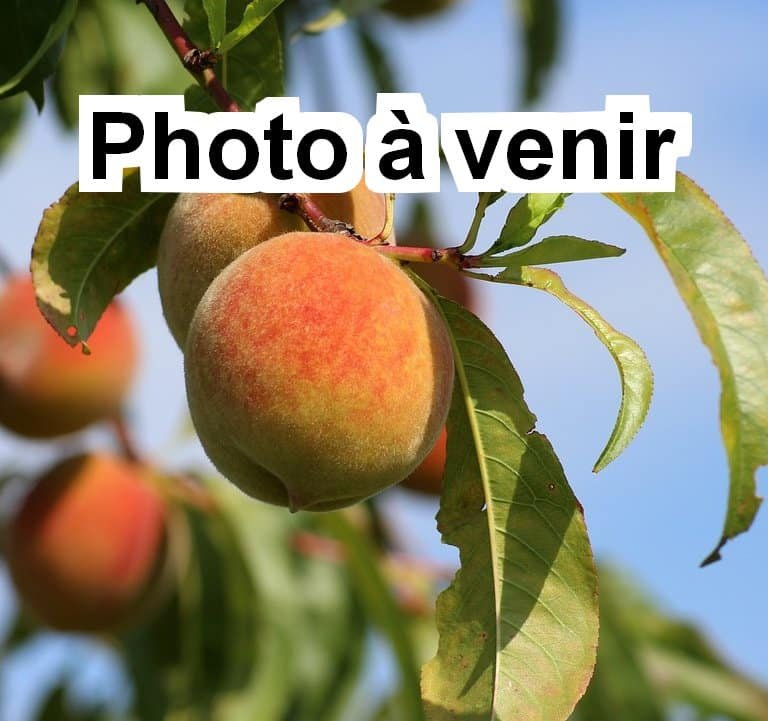
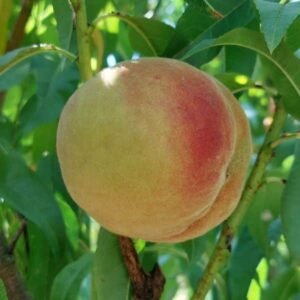
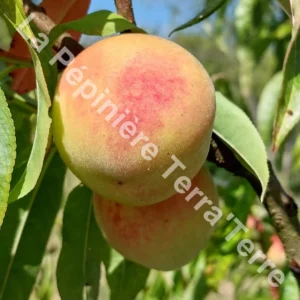
The ‘Belle des Croix Rouges’ peach is a medium to large fruit, with fuzzy skin strongly coloured dark red on the sun-exposed side. The flesh is white, juicy, moderately firm in texture, with a high sugar content and mild acidity.
Published opinions differ noticeably, and we would rather tell you so. Nursery catalogues describe it as sweet, juicy and well scented; conversely, feedback from home gardeners collected in pomological databases judges it bland, even bitter, and recommends Amsden or Mayflower instead among the tolerant varieties. This gap is not trivial, and it has a largely technical explanation: picking date.
Picking Belle des Croix Rouges at the right time: the deciding factor
A white-fleshed peach picked three days too early is bland and slightly bitter; the same fruit, picked at the right time, is sweet and fragrant. The ‘Belle des Croix Rouges’ peach tree seems particularly demanding on this point, which would explain the polarised opinions.
- Don’t rely on colour. The red colouring of ‘Belle des Croix Rouges’ develops early and says nothing about ripeness.
- Rely on the background colour around the stalk: the green should have turned to cream.
- The scent should be noticeable from 30 cm away without handling the fruit.
- The fruit detaches with a slight twist, without pulling.
- Pick in several passes, over 8 to 12 days: ripeness is never even across the tree.
🍑 A ripe ‘Belle des Croix Rouges’ peach only keeps for 3 to 5 days. That is the price of white flesh, and the reason this variety never left the family orchard.
Pollinating Belle des Croix Rouges
The ‘Belle des Croix Rouges’ peach tree is self-fertile, like almost all Prunus persica: its flowers are self-pollinating and a lone tree produces fruit without any pollinator. This is one of the rare fruit trees where you have no variety compatibility to check.
Planting other peach trees alongside it is still useful for another reason: spreading out the harvest. Since ‘Belle des Croix Rouges’ occupies the late-July slot, the Amsden peach tree and the Mayflower peach tree open the season considerably earlier, while the Reine des Vergers peach tree closes it in late August. These three varieties share its good tolerance to leaf curl.
Growing and caring for the Belle des Croix Rouges peach tree
Soil and exposure
The ‘Belle des Croix Rouges’ peach tree needs full sun and light, free-draining soil with no excess active lime. It dislikes waterlogged roots even more than drought: avoid low-lying plots and compacted clay soils. An open, airy position, away from dense hedges, limits lingering humidity on the foliage in spring.
Planting
- Timing: December to March, bare-root, frost-free.
- Spacing: 4 to 5 m between two peach trees.
- Graft point: 8 to 10 cm above final soil level, never buried.
- Well-rotted compost at planting, staking for the first two years.
- Thinning in June: one fruit every 15 to 20 cm, for fruit size and to prevent biennial bearing.
Pruning
The peach tree fruits on the previous year’s wood: a branch that has fruited will never fruit again. Pruning the ‘Belle des Croix Rouges’ peach tree therefore means renewing part of the framework each year, removing spent wood in favour of vigorous mixed shoots. Prune in late winter, before bud break, then carry out light summer pruning after harvest to open up the centre.
Diseases and resistance
Peach leaf curl (Taphrina deformans) is the whole reason for this variety’s existence — but let’s be precise: ‘Belle des Croix Rouges’ is tolerant, not immune. It performs noticeably better than susceptible varieties, while still being able to be affected during prolonged cold, wet springs. In organic growing, two applications of Bordeaux mixture, one at leaf fall in November and the other at bud swell in February, are enough to secure the season.
Also keep an eye on brown rot (Monilinia laxa) on flowers and fruit — systematically remove mummified fruit —, on powdery mildew in dry summers, and on plum pox virus (sharka), which is incurable and notifiable.
Rootstocks offered for Belle des Croix Rouges
Culinary uses
The ‘Belle des Croix Rouges’ peach is best eaten fresh, at full ripeness. Its sugar content and medium firmness also make it a good peach for processing: jams, light syrup preserves, coulis, tarts. For canning, pick it one or two days before eating ripeness so it holds up to cooking. Its white flesh browns quickly in air: squeeze lemon juice over it as soon as it’s cut.
Frequently asked questions about the Belle des Croix Rouges peach tree
Is the Belle des Croix Rouges peach tree resistant to leaf curl?
The ‘Belle des Croix Rouges’ peach tree is tolerant to leaf curl, not immune. It is among the reference varieties for growing without heavy spraying and performs noticeably better than susceptible varieties, but it can be affected during prolonged cold, wet springs. Two preventive applications of Bordeaux mixture are still recommended in organic growing.
Is the Belle des Croix Rouges peach tree self-fertile?
Yes, the ‘Belle des Croix Rouges’ peach tree is self-fertile. Its flowers are self-pollinating and a tree planted alone will produce normally, without a pollinator. Planting other peach trees does not significantly improve fruit set, but it does spread the harvest over the summer by combining early and late varieties.
When should Belle des Croix Rouges peaches be harvested?
Harvest of ‘Belle des Croix Rouges’ runs from late July to early August in the South-West lowlands, and up to mid-September at altitude. Don’t rely on the red colour, which develops early and is misleading: judge by the background colour turning from green to cream, by the scent, and by the fruit detaching with a simple twist.
What does the Belle des Croix Rouges peach taste like?
The ‘Belle des Croix Rouges’ peach is described as sweet, juicy and fragrant by catalogues, but feedback from gardeners judges it bland or slightly bitter. This gap is largely explained by picking date: white flesh picked too early develops a bitterness that full ripeness removes.
What is the origin of the Belle des Croix Rouges peach tree?
The precise origin of the ‘Belle des Croix Rouges’ peach tree is not documented in any accessible pomological source: no breeder, no date, no location. It is an old French variety, kept and distributed by nurseries specialising in old varieties for its disease tolerance. Any verifiable source is welcome.
Is the Belle des Croix Rouges peach tree suited to organic growing?
Yes, the ‘Belle des Croix Rouges’ peach tree is one of the best-suited varieties for an organic orchard, precisely because of its tolerance to leaf curl, the main constraint for peach growing without synthetic treatments. It is also noted as suited to higher-altitude sites, where fungal pressure differs from the lowlands.
Our experience at the nursery (Lot-et-Garonne)
Our tips in video
Our other peach trees