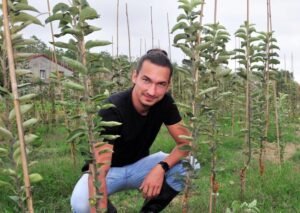

Hello friends, it’s Vincent from Terra’Terre Nursery. Today I’m in my grafting room to show you two types of graft: the quick whip graft, known in French as “au galop”, and the whip-and-tongue graft. At the end of this article, I’ll give a short theoretical recap on wound healing, which is the basis of all grafting. For now, let’s put whip grafting into practice.
If you’d like to watch my video on the subject, here it is:
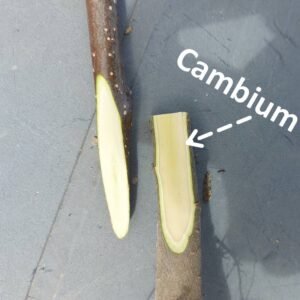
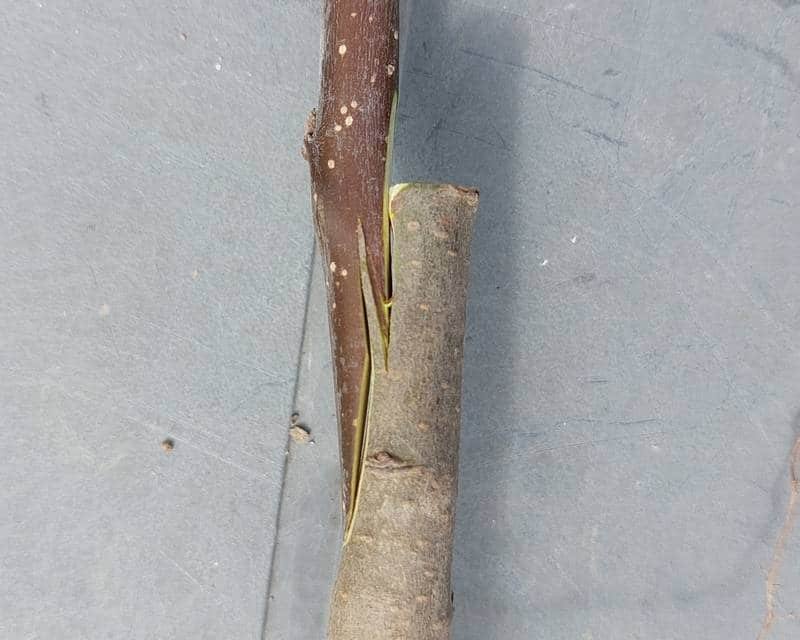
The scion is cut in exactly the same way for the quick whip graft and for the whip-and-tongue graft. The cut must be as straight as possible. We then prepare the scion so that the cambium of the scion lines up with the cambium of the rootstock, because that is where the sap flows.
For the quick whip graft, choose a smooth, knot-free part of the rootstock. The shape of the scion cannot be reproduced exactly on the rootstock, so the aim is to match the cambium of the rootstock with that of the scion. Here are the steps:
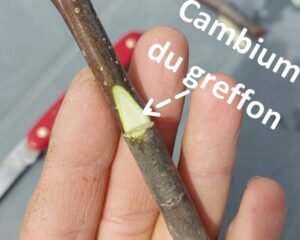
For the whip-and-tongue graft, the scion and the rootstock must have the same diameter. The two are fitted together, making sure that the cambium layers are perfectly aligned. The graft is then tied to hold everything in place.
Several materials can be used to tie a graft: grafting tape, Flexiband or raffia. What matters is that the scion and the rootstock are held firmly together. Good tying means better healing.
The choice between the two depends on your needs. If you only have a few grafts to make, the whip-and-tongue graft gives a neater, cleaner result. For larger-scale production, the quick whip graft is faster and adapts to scions of different diameters.
There you go, friends, I hope you enjoyed this video. If you did, feel free to give it a thumbs up. If you have any questions or do things differently, tell me in the comments and I’ll reply as usual. See you soon for the next video, and don’t forget to subscribe!
A quick word on how wood is made up: there is the bark, the cambium and the wood. The cambium produces both the bark and the wood. When a cut is made, the cambium forms a ridge of callus tissue that gradually covers the wound. For a successful graft, the wound must be covered to encourage this healing callus to form. Ideal conditions and good protection ensure a strong union between the scion and the rootstock, and therefore a successful graft.
If you have any questions, feel free to ask them in the comments.
See you soon!
To see all my fruit trees, most of which are produced by quick whip grafting, head to >> my catalogue <<
And if you’d like to watch all my advice on video, take a look at my YouTube channel: