Description
Mayflower Peach Tree
The Mayflower peach tree is an old variety of American origin, ranked among the very first peaches of the year, producing a clingstone with white flesh and a skin almost entirely carmine red, ripe from late May to early June. The Mayflower peach tree owes its appeal to this extreme earliness and to its good tolerance to peach leaf curl. We graft it at our nursery, in Le Passage d’Agen, Lot-et-Garonne, under AB / Ecocert certification.
Mayflower peach tree identity card
| Criterion |
Value |
Detail |
| Species |
Prunus persica |
White-fleshed clingstone |
| Synonyms |
May Flower, May flower |
Spellings found in catalogues |
| Origin |
North America |
North Carolina according to French sources |
| Stone |
Clinging |
Classed as a clingstone |
| Flesh |
White, fine, juicy |
Sweet and tangy |
| Skin |
Carmine red over a yellow ground |
Colouring covers almost the whole fruit |
| Size |
Fairly large |
Medium according to some sources |
| Flowering |
Early, March |
Pink flowers |
| Pollination |
Self-fertile |
No pollinator needed |
| Harvest |
Late May to early June |
22 days before Charles Ingouf |
| Storage |
A few days |
Fruit for immediate eating |
| Use |
Fresh, pies, preserving jars |
Clinging stone dictates how it’s cut |
| Vigor |
Vigorous, upright habit |
About 5 m in all directions |
| Hardiness |
About −15°C |
Flowering exposed to late frosts |
| Diseases |
Good resistance to leaf curl |
Good behaviour reported against brown rot |
| Rootstocks offered |
|
Peach seedling commonly used for this variety |
Introducing the Mayflower Peach Tree
Mayflower belongs to the generation of 19th-century American peaches selected to open the season, at a time when earliness was worth its weight in gold: the first fruit on the market fetched a premium price. French sources place its origin in North Carolina, around 1860; this dating deserves some caution, since older descriptions place Mayflower relative to the ‘Sneed’ variety, released at the end of the century.
Beware of a common mix-up: several online listings state “origin: China” for the Mayflower peach tree. They are describing the botanical origin of the peach as a species, not that of the cultivar, which is indeed American. Mayflower remains today a collector’s and family-orchard variety, absent from commercial orchards, where modern, later-flowering introductions have taken over its slot.
Fruit characteristics
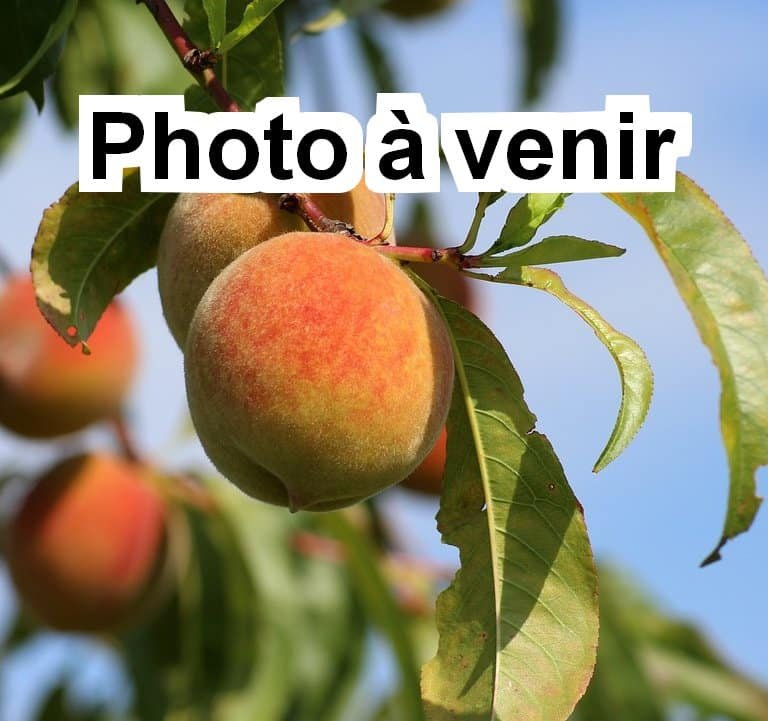
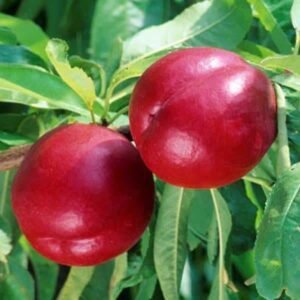
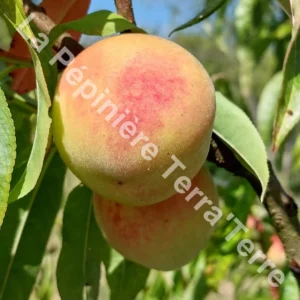
The Mayflower peach is fairly large for such an early variety, which is its main technical strength — early-season peaches are usually small. Its colouring is spectacular: a carmine red covering almost the entire surface of the fruit, over a yellow ground.
- Flesh: white, fine, juicy.
- Flavour: sweet and tangy, without heaviness.
- Stone: clinging — Mayflower is a clingstone.
A word of honesty about Mayflower’s flavour, since sources disagree: old catalogues judged it excellent, French pomological references call it decent. Both are saying the same thing in different words. A late-May peach does not rival a full-season Grosse Mignonne in aromatic depth; it is worth what it is — the first of the orchard.
Pollinating the Mayflower Peach Tree
The Mayflower peach tree is self-fertile: a single tree produces fruit, with no pollinator variety needed. As with all peach trees, there is neither a flowering group nor incompatibility between varieties. The real risk to the Mayflower harvest is not pollination but timing: with flowering in March, a single frost on open flowers is enough to wipe out a year’s crop. That is the price of a late-May harvest.
Growing and caring for the Mayflower Peach Tree
Soil and exposure
Mayflower prefers light, healthy soil with no excess moisture, in a sunny position. Given its early flowering, choose a site sheltered from cold winds and, above all, away from low ground where cold air settles on March mornings. Training it against a south-facing wall is an excellent option.
Planting
Our bare-root trees are shipped from December to March. As Mayflower is vigorous and upright, allow about 5 m around the tree. Plant with the graft union above ground, water generously, mulch well.
Pruning
The peach tree fruits on the previous year’s wood: pruning Mayflower means renewing this wood every year, otherwise fruiting drifts away from the centre of the tree. Mayflower’s upright habit calls for opening up the framework to let light in. Prune in spring or late summer, never in wet weather, to limit the risk of bacterial canker.
Diseases and resistance
This is Mayflower’s second strength: it shows good resistance to peach leaf curl (Taphrina deformans), confirmed by several independent nurseries, and good reported behaviour against brown rot. This does not exempt it from standard care — two preventive copper treatments, at leaf fall and before bud break, and removal of mummified fruit — but Mayflower is one of the varieties that forgives a year of relaxed vigilance.
Culinary uses
Mayflower is best eaten fresh, picked at the right moment, when nothing else in the orchard is yet ripe. Its sweet-tangy balance and clinging stone naturally suit preparations cut into wedges: thin tarts, clafoutis, syrup preserves. Its white flesh and strongly coloured skin give compotes and coulis an attractive pink hue.
Clingstone or freestone? What Mayflower’s clinging stone changes
In French naming convention, a “pêche” has a stone that separates freely, a “pavie” a clinging one. Mayflower is a clingstone: its flesh stays attached to the stone. Old descriptions, like nurseries that take the trouble to note it, agree on this point, which most online listings leave out.
The practical consequence is very concrete. Don’t try to twist a Mayflower peach open into two halves: you will tear the flesh. Cut the fruit into wedges along the suture line and detach each wedge. This is also what makes Mayflower well suited to preserving: clingstones hold up better to cooking and in jars than melting-fleshed varieties.
Mayflower in a harvest calendar
Mayflower opens the season, and old benchmarks place it precisely: it ripens 22 days before Charles Ingouf, and four to five days before the American variety ‘Sneed’, itself known as very early. To build a family orchard producing from late May to late September:
Frequently asked questions about the Mayflower peach tree
When are Mayflower peaches harvested?
Mayflower is harvested from late May to early June, making it one of the very first peaches of the year. Old benchmarks place it 22 days before Charles Ingouf. In the Lot-et-Garonne climate, expect early June rather. The harvest window is short: just a few days, worth watching closely.
Is the Mayflower peach tree self-fertile?
Yes, the Mayflower peach tree is self-fertile. A single tree is enough to produce fruit, with no pollinator variety needed nearby. Like all peach trees, it belongs to no flowering group. The limiting factor for the harvest remains spring frost: with flowering in March, Mayflower’s blossoms are exposed.
Is Mayflower resistant to peach leaf curl?
Yes, Mayflower is among the old varieties recognised for their good resistance to leaf curl, and its behaviour against brown rot is also reported as good. No peach tree is fully immune, though: keep up two preventive copper treatments, at leaf fall and before bud break.
Does the stone of the Mayflower peach separate from the flesh?
No. Mayflower is a clingstone: its stone clings and the flesh stays attached to it. Cut the fruit into wedges along the suture line rather than trying to separate two halves. This clinging trait is not a flaw: clingstones hold up better to cooking and are particularly well suited to preserving jars.
Is the Mayflower peach tree suited to areas north of the Loire?
Its resistance to leaf curl is in its favour, but its early flowering in March makes it risky in frost-prone areas. North of the Loire, reserve Mayflower for a sheltered spot, ideally trained against a south-facing wall, and away from cold low ground. In an open orchard, a later-flowering variety will be safer.
Our experience at the nursery (Lot-et-Garonne)
Our tips in video
Our other peach trees