
Table des matières
ToggleChapter 1: Introduction to Central Leader Training of Fruit Trees
The art of combining beauty and productivity
Central leader training is an essential technique for fruit trees and much more than a simple pruning method. It is a real art which, once mastered, turns our orchards into havens of productivity and beauty. In this chapter, we look at the basics of the technique and why it matters so much for the well-being of your trees.
Why Central Leader Training?
- A Natural and Effective Method
- At the heart of central leader training is an understanding of the tree’s natural growth. The technique aims to guide the tree, not to force it, in harmony with the way it naturally grows.
- Many Advantages
- Higher productivity: better exposure to the sun and better air circulation.
- Easier maintenance: less time spent pruning and caring for the tree.
- Tree health: less disease thanks to an open structure.
- Resistance : fruit trees trained to a central leader withstand bad weather better (they catch less wind)
Central Leader Training in Brief
Central leader training means developing a tree around a central axis, with side branches evenly spaced around it. This structure distributes the tree’s resources evenly, leading to better fruiting and better overall health.
To find out more about choosing tree varieties suited to this technique, see our guide on how to choose your fruit tree.
In the next chapters, we detail the key steps to successful training, focusing on the specific needs of different fruit tree varieties. Stay tuned to transform your orchard with central leader training!
Chapter 2: Key Steps of Central Leader Training
Mastering the technique for thriving fruit trees
Training a fruit tree to a central leader is a meticulous process that requires care and know-how. Follow these steps to ensure healthy, productive growth.
1. Selection and Preparation
- Choosing the tree: choose healthy young trees with good growth potential.
- Preparing the site: make sure the soil is well drained and fertile.
- Monitoring: the tree’s growth must be followed closely
- Watering: watering must be careful, right from the first year
- Fertility : feeding must be optimal so that the tree has everything it needs
- Training support: to help the tree in its first years, it should be staked and/or tied to a trellis
- Bending: bending branches may be needed in addition to pruning
2. Central Leader Formative Pruning
- First years: prune the tree to establish a strong central leader. The final shape looks like a “Christmas tree”
- Managing branches: remove competing branches to keep a good balance.

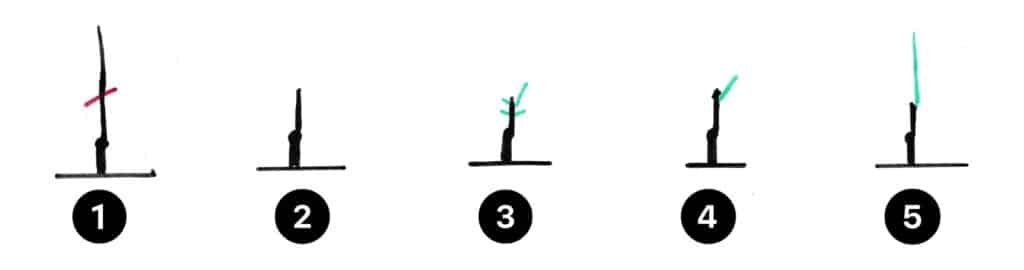
- Period: winter of planting. What to do: when you plant your tree, you can head it back. This step is not compulsory, but I think it is wise, to rebalance the roots and the top of the tree. Some people also advise pruning the roots before planting; personally, I think lifting the tree already puts enough stress on the root system and there is no need to add more.
- Period: winter of planting. What to do: the result after the first cut. Take the opportunity to put in a stake or a trellis (not shown on my diagram).
- Period: spring. What to do: heading back your whip will make the buds just below the cut break into growth. These are new shoots.
- Period: spring. What to do: at this stage, select a single shoot to form the leader. Do not prune too early: wait until the shoots are about ten centimetres long so as not to cut off their “sap-drawing” effect.
- Period: spring to autumn. What to do: for the rest of the growing season, tie the shoot to your stake or trellis to help it grow straight. Of course, also make sure the tree is well watered and remove any suckers from the rootstock.
When autumn/winter comes, there are two possible situations:
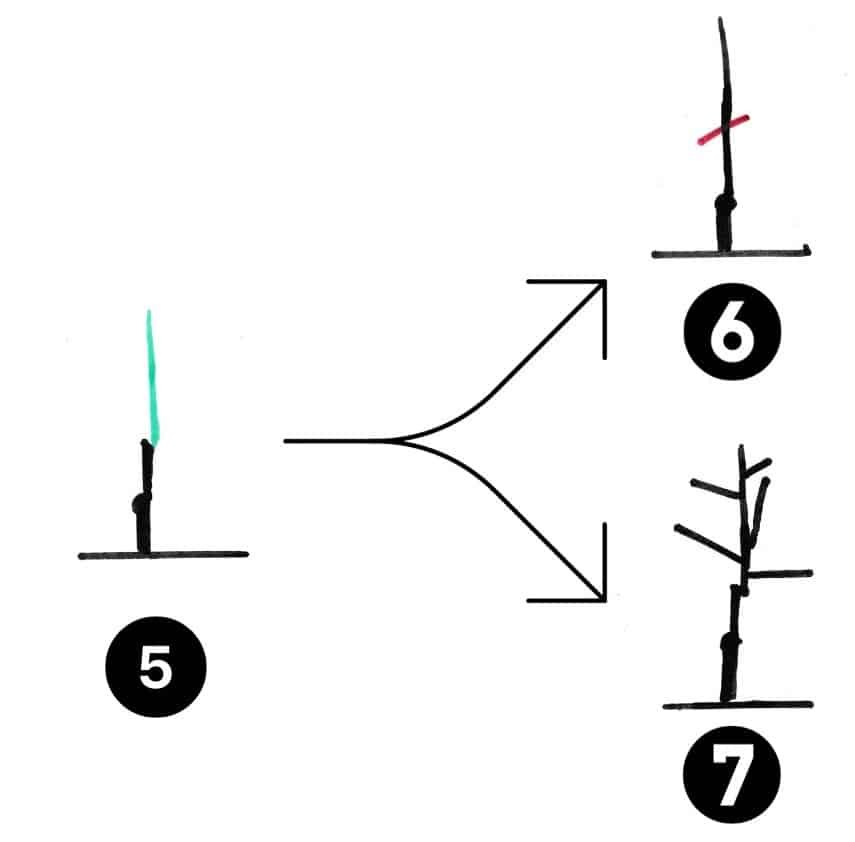
6) This year’s growth has not produced any side shoots (known as feathers or sylleptic shoots). That is not a problem: some varieties produce fewer feathers, or produce them less readily. Simply head back the leader again 40 to 60 cm above the previous cut and work with the new shoots the following year.
7) This year’s growth has produced side shoots, the feathers. This is when, during the winter (avoiding frosty days), you will need to shape your central leader by removing branches that are too vigorous and could compete with the leader.
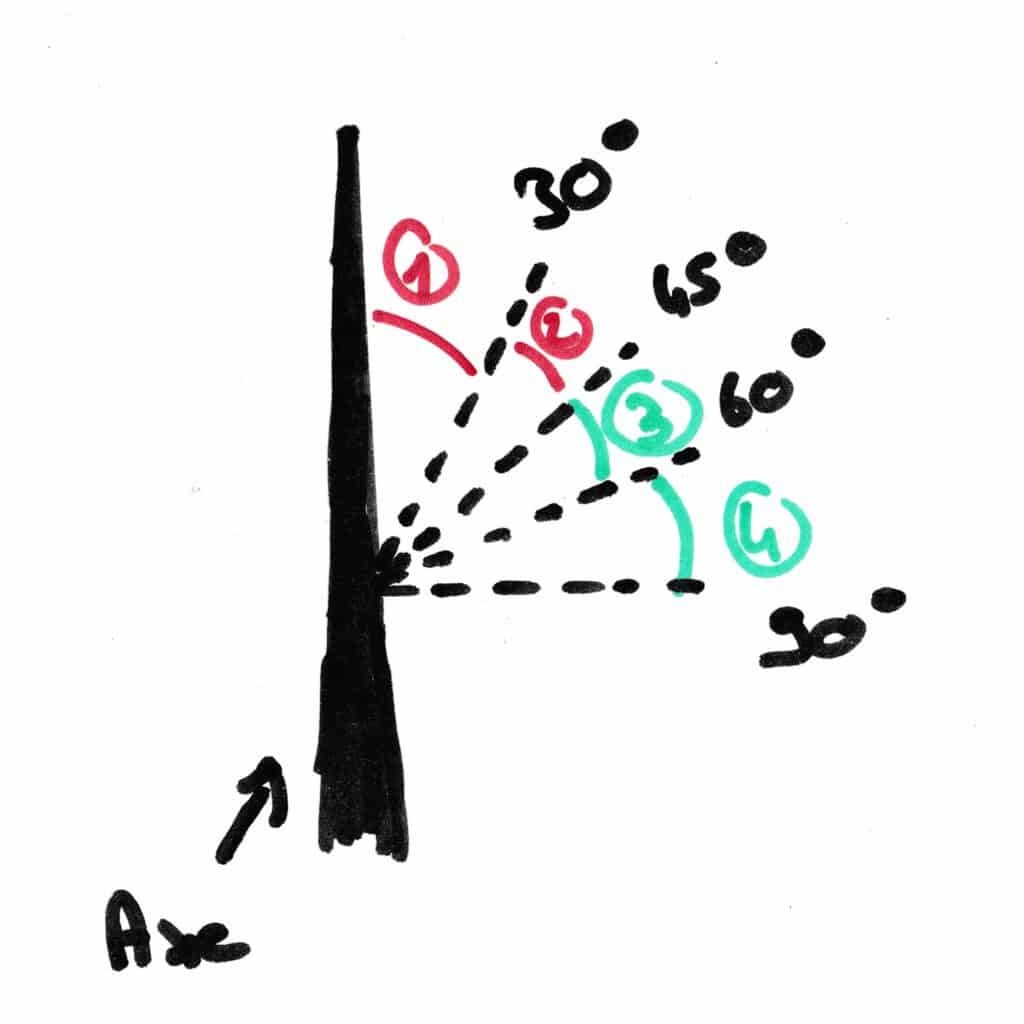
How to recognise overly vigorous branches – Central leader training
Recognising a vigorous branch by its angle:

If the branch has grown at too narrow an angle, that is too vertically, in the same direction as the leader (cases 1 and 2 in red), it must be removed.
Branches that have grown at a wider angle, between 45 and 60° (3, green), can be kept, but you will need to “bend” them next spring. Bending means tying the branch to the stake or to the leader (the central trunk) to bring it down to the horizontal. Caution : only do this in early spring, when the sap is rising and the branches are more flexible. Doing it in winter can break them.
All branches that have grown horizontally (4, green) can be kept as long as their diameter is not too large.
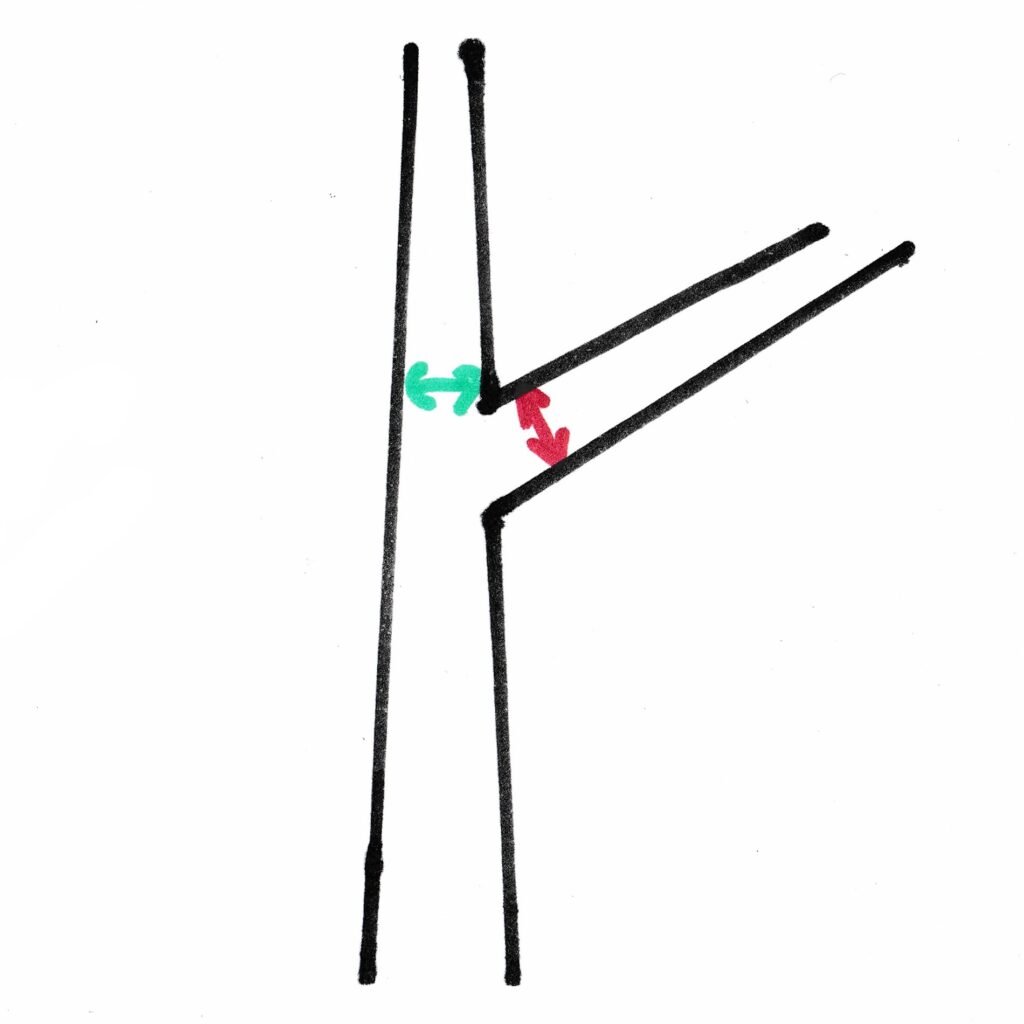
Recognising a vigorous branch by its diameter:

If the diameter of the branch (red) is more than a third of the diameter of the leader (green), it must be removed, whatever its angle.
Now that you know how to recognise an overly vigorous branch, let’s return to our winter formative pruning:
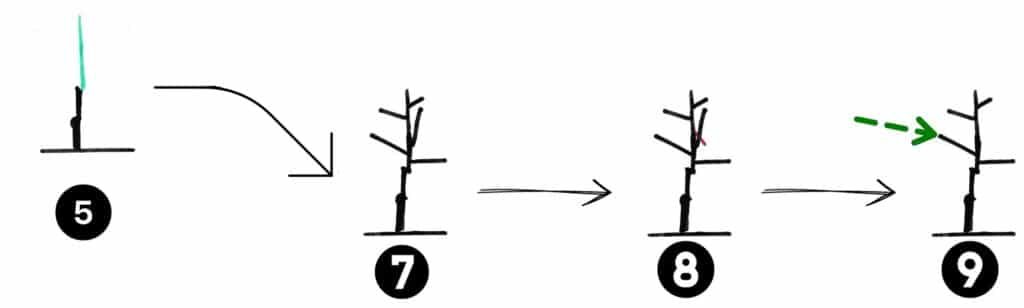
8) Cut the branch with too narrow an angle
9) Identify the branch to be tied down/bent the following spring.
In commercial orchards, during this formative pruning, growers head back the top of the tree (the apex) again so as to repeat the work done in year 1. This makes the central leader produce wood, become stiffer and not start fruiting too early.
3. Annual Care
- Formative pruning: formative pruning should be carried out during the first three to four years; after that, you move on to maintenance or fruiting pruning
- Maintenance pruning: make regular cuts to maintain the shape of the tree.
- Monitoring: watch out for signs of disease or stress.
4. Optimising Growth
- Feeding and watering: provide adequate nutrients and water.
- Protection: protect the tree from pests and extreme weather.
By following these steps for training your fruit trees to a central leader, you will encourage healthy growth and abundant fruiting. For more detailed information on each variety, visit our section on the different types of fruit tree.
Patience and perseverance are key to this process. Over time, your efforts will be rewarded with beautifully shaped, productive trees.
Chapter 3: Specific Advice for Fruit Tree Varieties
Adapting the technique to each tree for a harmonious orchard
Each fruit tree variety has its own characteristics that influence how it is trained to a central leader. This chapter guides you through them to ensure your orchard’s success.
Understanding the Needs of Each Variety
- Pruning by variety: some varieties need more frequent pruning, while others thrive with minimal intervention.
- Susceptibility to disease: know the specific susceptibilities of each type of tree to prevent disease effectively.
Practical Advice for Common Fruit Trees
- Apple, pear and plum trees: these trees benefit from annual pruning for better fruiting. Central leader training is entirely suitable for them.
- Cherry trees: a gentler approach is often preferable for this species, but central leader training can be considered.
- Peach and apricot trees: central leader training works for peach trees; some orchards near me are trained this way. For apricot trees, I advise against any particular training system. The apricot naturally grows into an open vase shape and branches a great deal. Apricot trees do not like pruning at all: in commercial orchards they are often pruned only once every four years, to keep them small enough for tractors to pass.
To find out more about choosing the right fruit tree for your region and needs, see our page on the different fruit tree varieties.
By familiarising yourself with the specific requirements of each variety, you can apply central leader training in the best way and ensure the health and productivity of your orchard.
Chapter 4: The Importance of Pruning in Central Leader Training
A key step for healthy, productive trees
Pruning plays a crucial role in training fruit trees to a central leader. It is not only about shaping the tree, but also about ensuring its health and productivity.
1. Promoting Healthy Growth
- Removing competing branches: remove branches that compete with the main leader to encourage balanced growth (see the section on recognising a vigorous branch).
- Better air circulation: proper pruning helps prevent disease by improving air circulation through the tree.
2. Optimising Fruiting
- Sun exposure: good pruning gives the fruit better exposure to the sun, which is essential for ripening.
- Abundant harvests: a well-pruned tree often produces more and better fruit.
For detailed information on pruning techniques for different fruit trees, I invite you to read our dedicated article on pruning fruit trees.
By making pruning a key part of central leader training, you ensure an orchard that is not only attractive but also robust and generous.
Chapter 5: Conclusion on Central Leader Training
The key to a thriving, long-lasting orchard
In conclusion, central leader training is a pruning technique which, done well, offers many advantages for your fruit trees. It ensures healthy growth and better fruit production, and also makes your orchard easier to maintain and more attractive.
Summary of Advantages
- Balanced growth: better distribution of resources for harmonious development.
- Higher productivity: better-quality fruit in greater quantity.
- Easier harvesting and maintenance: easier access to the fruit and less work.
By adopting this approach, you will contribute to the vitality and longevity of your orchard. Central leader formative pruning is more than a pruning technique: it is a commitment to the health and productivity of your fruit trees.
For more information and to discover our range of trees suited to this technique, visit our online shop.
Together, let’s grow beauty and abundance in our orchards!