
22,00 € – 28,00 €Price range: 22,00 € through 28,00 €
🌸 Flowering period: Early (mid to late March)
🍑 Harvest period: Mid-July to early August
❄️ Storage: 3 to 5 days at room temperature
More information
Secure payment by credit card.

The ‘Redwing’ peach tree (Prunus persica) is an American white-fleshed variety, protected by American plant patent PP 621 granted in the 1940s, known for fine, very sweet flesh with practically no acidity, harvested from mid-July to early August.
We graft the ‘Redwing’ peach tree at our nursery, under certified organic farming (AB / Ecocert), in Le Passage d’Agen (Lot-et-Garonne). It joins our collection of peach trees.
| Criterion | Value | Detail |
|---|---|---|
| Species | Prunus persica (L.) Batsch | Rosaceae |
| Type | White-fleshed peach | Fuzzy skin, pinkish red |
| Cultivar origin | United States | Not China: see dedicated section |
| Protection | US Plant Patent PP 621 | Granted in the 1940s |
| Flowering | Early, mid to late March | Pink flowers |
| Pollination | Self-fertile | No pollinator required |
| Harvest | Mid-July to early August | Spread over about 3 weeks |
| Size | Medium, 6.5 to 7 cm | Sources vary on this point |
| Flavour | Very sweet, no acidity | Distinctly low-acid character |
| Storage | 3 to 5 days | White flesh, fragile |
| Diseases | Fairly low susceptibility to leaf curl and brown rot | Tolerance, not immunity |
| Habit and vigor | Very spreading, vigorous, 3 to 4 m | Fast growth |
| Hardiness | About −15°C | Southern half of France |
| Notable offspring | Sugar May, Summer Sweet, Snow King | Parent of modern white peaches |
The ‘Redwing’ peach tree occupies a curious place: French catalogues class it among the “old” varieties, when it is in fact a 20th-century American commercial cultivar, selected and patented in the United States under number PP 621. The word isn’t misused in an orchard sense — ‘Redwing’ has more than eighty years of track record — but it is not a 19th-century farmhouse variety, and we would rather say so.
What ‘Redwing’ brought to the world of the peach is a very specific trait: white flesh that is very sweet and practically free of acidity. At a time when European white peaches tended to be tangy, this “sweet” profile made ‘Redwing’ a benchmark variety. It remains one of its strongest selling points today: children and palates sensitive to acidity take to it immediately.
The ‘Redwing’ peach tree grows into a vigorous tree with a very spreading habit, reaching 3 to 4 m, with fast growth and early bearing. Its yield is abundant and consistent, with no marked biennial pattern — a point all sources agree on.
An error circulates on several French nursery websites, which list “Origin: China” on their ‘Redwing’ page. It comes from a mix-up of levels: the peach as a species (Prunus persica) is indeed native to China, but the ‘Redwing’ cultivar is American. The proof is a matter of public record and verifiable: it is the subject of a plant patent filed in the United States, PP 621, which presupposes breeding and asexual propagation documented on American soil.
‘Redwing’ was later introduced to the European market as part of a programme bringing in American white peaches. It now appears in the catalogues of many French nurseries, particularly in the South-West and South-East.
This is the least-known aspect of the ‘Redwing’ peach tree, and yet the most remarkable. Look up the patents of the great commercial white peaches of the 1990s: ‘Redwing’ appears systematically in their family trees, as a parent or grandparent.
In other words: the low-acid sweetness that characterises the modern white peaches found on market stalls today largely descends from ‘Redwing’. Planting a ‘Redwing’ peach tree in your garden means growing the original rather than one of its descendants bred for firmness and transport — at the cost of a softer flesh and a shorter shelf life, which matters not at all when the tree is ten metres from the kitchen.
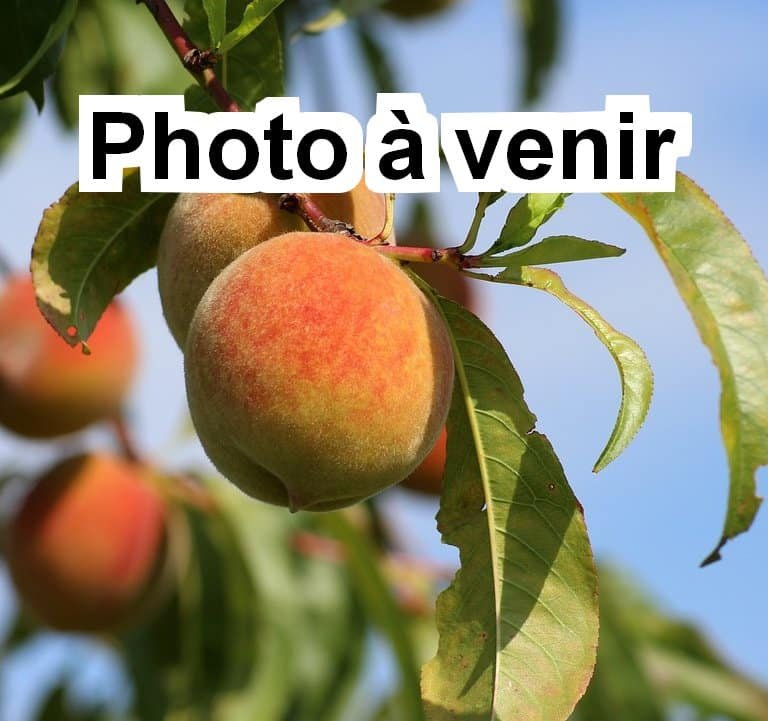
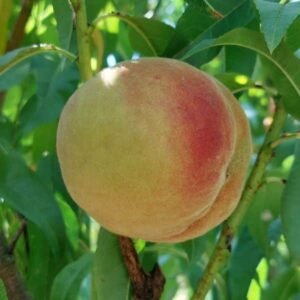
The ‘Redwing’ peach has bright pinkish-red skin, broadly coloured over a cream to pale yellow ground, only lightly fuzzy. The flesh is white, fine, tender and very juicy, with a distinctly sweet, fragrant flavour, without the usual tangy edge of European white peaches.
On size, sources disagree noticeably: from “small 6.5 cm peaches” to “large fruit” depending on the catalogue. This discrepancy is probably explained by how the tree is managed: ‘Redwing’ is very productive, and an unthinned crop load mechanically gives smaller fruit. We therefore describe it as medium-sized, with this caveat: without serious thinning in June, expect small fruit.
🍑 The stone of ‘Redwing’ is described as free by most sources, semi-free by another. The variety is therefore properly a peach rather than a clingstone, but flesh/stone separation can be imperfect depending on the year.
The ‘Redwing’ peach tree is self-fertile, like almost all Prunus persica. Its flowers are self-pollinating and a lone tree fruits normally: there is no variety compatibility to check before planting.
The benefit of planting other peach trees lies elsewhere — spreading out the harvest. As ‘Redwing’ holds the mid-July to early-August slot, the Amsden peach tree opens the season considerably earlier and the Reine des Vergers peach tree extends it to late August.
This is the real constraint of the ‘Redwing’ peach tree, and it deserves to be stated plainly. Its flowering starts as early as mid-March, two to three weeks before late-flowering varieties. In Lot-et-Garonne and more broadly across the southern half of France, this is an asset: early flowering goes hand in hand with an early harvest and good fruit set.
North of the Loire, however, or at altitude, this same earliness exposes ‘Redwing’ to late April frosts: open flowers freeze, and the crop is lost. Add to this a moderate hardiness of around −15°C, and the verdict is clear: ‘Redwing’ is a variety for the southern half of France. In borderline situations, plant it against a south-facing wall or high on a slope, never in a low valley bottom where cold air settles.
If your plot is frost-prone in spring, choose a late-flowering variety rather than forcing ‘Redwing’ — the Grosse Mignonne peach tree is a better candidate in these situations.
The ‘Redwing’ peach tree needs full sun and a spot sheltered from cold winds. The soil must be light, sandy-loam, perfectly drained: this is the absolute condition. Avoid heavy soils, low-lying plots and any winter waterlogging.
The peach tree fruits on the previous year’s wood: every branch that has fruited must be renewed. On ‘Redwing’, whose habit is very spreading, pruning has two aims: keeping an open, well-lit goblet shape, and straightening the main branches, which tend to sag under the crop load. Renewal pruning in late winter before bud break, light summer pruning after harvest.
The ‘Redwing’ peach tree is described as fairly lightly susceptible to leaf curl (Taphrina deformans) and to brown rot (Monilinia laxa). This is a relative tolerance, not an immunity: in organic growing, keep up two applications of Bordeaux mixture, one at leaf fall in November and the other at bud swell in February. Systematically remove mummified fruit. Plum pox virus (sharka) remains incurable and notifiable.
The ‘Redwing’ peach is best eaten fresh: its acid-free sweetness makes it an ideal eating peach, particularly popular with children. It suits fruit salads, coulis and tarts. In jam and preserving jars, its lack of acidity calls for correction — add lemon juice, or the preparation will lack brightness and may not set well.
To build a contrasting basket, the Red Haven peach tree, another great 20th-century American variety but with firmer yellow flesh, is the exact counterpart to ‘Redwing’ over a similar period.
Yes, the ‘Redwing’ peach tree is self-fertile. Its flowers are self-pollinating and a tree planted alone fruits normally, without a pollinator. Its yield is reported as abundant and consistent. Planting other peach trees does not change fruit set but does spread the harvest by combining an early and a late variety.
Harvest of ‘Redwing’ runs from mid-July to early August in the southern half of France, over about three weeks. Pick when the fruit becomes slightly soft and very fragrant, and detaches with a simple twist. The red colour appears well before ripeness, so it is not a reliable cue.
The ‘Redwing’ peach tree is described as fairly lightly susceptible to leaf curl and brown rot, without being immune. In organic growing, keep up two preventive Bordeaux mixture treatments, at leaf fall and then at bud swell. Its early flowering exposes it more to frost damage than to fungal disease.
The ‘Redwing’ peach tree is a cultivar of American origin, protected by US plant patent PP 621 granted in the 1940s. Several French websites wrongly state “origin: China”: it is the species Prunus persica that comes from China, not this cultivar. ‘Redwing’ was later introduced to the European market.
No, the ‘Redwing’ peach tree is reserved for the southern half of France. Its very early flowering, from mid-March, exposes it to late April frosts, and its hardiness tops out around −15°C. North of the Loire or at altitude, choose a late-flowering variety instead, or plant ‘Redwing’ against a south-facing wall.
‘Redwing’ peaches are medium-sized, around 6.5 to 7 cm. Catalogues disagree, from “small peaches” to “large fruit”, which is explained by management: as ‘Redwing’ is very productive, an unthinned crop load gives small fruit. Thinning in June, one fruit every 15 to 20 cm, noticeably improves size.
Our tips in video
Our other peach trees
| Weight | 0,33 kg |
|---|---|
| Peach rootstock | GF677, adult size ≈ 4m, Myrobolan adult size ≈ 3.5m, Rubira, adult size ≈ 3m |
They talk about us
 Publié sur Google
 Theo Bernede
Trustindex vérifie que la source originale de l'avis est Google.
Tous les arbres que j’ai reçus et plantés ont bien grandi, et j’ai déjà des mini-pommes cette année ! Très satisfait de la qualité, je recommande vivement. Je repasse d’ailleurs commande cette année sans hésiter!!!Publié sur Google hubert grallPépiniériste très serviable et réactif,commande livrée rapidement en excellent état. une adresse à recommander.Publié sur Google
 Matthieu CARBONNEAccueil de qualité et disponibilité, à des prix très raisonnables. Merci pour tous les conseils.Publié sur Google
 Béatrice BRUVraiment super. J'ai reçu de beaux arbres, rapidement et bien conditionnés à des prix très corrects. Merci beaucoup pour votre engagement, à l'année prochaine pour de futures commandes.Publié sur Google
 Lyda Shun-keoDe très bon conseil, Vincent m'a aidé à choisir des variétés de fruitiers adaptés à la région et la terre de mon jardin. Les scions sont d'excellente qualité et les prix très compétitifs. Je recommande+++Publié sur Google
 Marie PierreMes 4 arbres sont arrivés. Rien à dire sinon parfait de la commande à la livraison. Les petits arbres sont magnifiques. Pépinière à recommander.Publié sur Google
 Stéphane SigSuper adresse,des fruitiers de qualité sont proposés à des prix très abordables. Le patron,en plus de cela, offre un suivi très rapproché si besoin. Adresse à recommander !!!Publié sur Google
 Marie de CAZALSDes variétés anciennes, peu courantes dans les pépinières. Des scions d'excellentes qualités et des conseils précieux. Vous pouvez y aller les yeux fermés. En tout cas, pour ma part, je vous dis à l'année prochaine!Publié sur Google
 Geoffrey LanchasTrès pro, à l'écoute, je recommande ! Merci Vincent.
🎉 Perfect!
Your email has been saved. We'll let you know as soon as the next pre-orders open.
Thank you! 🌱